Who needs to plan ahead?
The baby’s readiness, whether milk is a new food and the cottage’s refrigeration arrangements each change what is practical to pack.
Carers starting solids on a cottage break
NHS guidance places the start of complementary feeding at around 6 months, when a baby can sit with a steady head, coordinate their eyes, hands and mouth, and swallow food. Plan dairy as a food alongside usual milk feeds, not as their replacement.
Parents introducing cow’s milk as a food
If milk is new to the baby, allow time to introduce it on its own in a very small amount and watch for a reaction, as the NHS advises for foods that can trigger allergies.
Self-caterers transporting chilled food
Check the travel cooling plan and the cottage fridge before packing chilled pots. NHS advice calls for a cool bag with frozen water bottles or ice blocks when taking baby food out.
What should you check before buying?
Start with readiness and the exact food label, then decide whether you can store and serve the product safely during the trip.
| Priority |
What to check |
Your needs |
| Readiness for solids |
Use the NHS signs: around 6 months old, sitting with a steady head, coordinating eyes, hands and mouth, and swallowing food. Do not rely on a “stage 1” description alone. |
I want to know my baby is ready for solids before choosing a dairy product for the holiday. |
| Fat level and ingredients |
Check for a plain, full-fat option and read the ingredients for added sugar or sweeteners. The NHS recommends full-fat yoghurt and fromage frais up to age 2 and says babies do not need sugar or sweeteners. |
A simple dairy option matters more to me than a flavoured children’s pot or a familiar brand. |
| Milk and other ingredients |
Read the exact pack’s ingredient and allergen statements. If cow’s milk is new, NHS advice is to introduce foods that can trigger allergies one at a time and in very small amounts. |
I need to tell which food my baby is trying, rather than introduce several unfamiliar ingredients together. |
| Product age statement |
Check the specific variant, not just its range name. Sainsbury’s lists one Petits Filous multipack as suitable from weaning onwards and another as made for children from 3 years old. |
When choosing individual pots for travel, I want the label to match my baby’s age and to understand what is in them. |
| Travel and storage |
Follow the pack’s storage instructions and confirm the cottage has a working fridge. The NHS advises a cool bag with frozen water bottles or ice blocks; food not kept cold should be eaten as soon as possible, within 4 hours maximum, and leftovers discarded. |
I can take chilled dairy only if the journey and cottage storage arrangements let me handle it safely. |
Which brand and retailer labels are relevant?
These references help distinguish product ranges and label claims; a brand name alone does not establish suitability for a baby beginning solids.
Petits Filous
Sainsbury’s lists children’s yoghurt pots with differing age statements within this range.
- One listed multipack says it is suitable from weaning onwards.
- That multipack lists sugar and fructose; another listed variant is positioned from age 3. Check the exact pack.
Yoplait
Yoplait is named as the manufacturer on the Petits Filous listings.
- The listings provide product-specific ingredients and age statements to compare.
- Those statements differ by variant and do not apply to every product made by Yoplait.
Tesco
Tesco’s yoghurt range includes natural yoghurt and children’s yoghurt or fromage frais categories.
- Its categories give shoppers a way to compare plain products with children’s pots.
- Tesco warns that products can be reformulated. Read the physical label for ingredients, allergens and storage instructions.
Sainsbury’s
Sainsbury’s lists natural yoghurt choices as well as branded children’s pots.
- Its listings distinguish some natural yoghurt choices from low-fat and fat-free options.
- Children’s pots differ in age statement and ingredients; check the selected pack before buying.
Müller
Tesco lists Müller Light and Müller Corner products among its wider yoghurt ranges.
- Those listings do not establish a plain, full-fat early-weaning option. Check any exact product’s label before considering it for this use.
Rachel’s
A Rachel’s product listed by Tesco is a low-fat fig-and-honey yoghurt.
- That specific product contains honey, which the NHS says must not be given before age 1, and does not match its full-fat dairy recommendation for young children.
Joybuy fruit yoghurt pouches
These 6+ months fruit yoghurt pouches offer a different format from plain fromage frais. If you are considering one for the cottage, compare its current pack label with the plain, full-fat, unsweetened dairy choice discussed above and follow its storage instructions.
 No image available
Ella’s Kitchen Organic Mango Greek Style Yoghurt Pouch 6+ Months 90g
The 90g mango yoghurt pouch is labelled 6+ months, but it is a flavoured option rather than plain fromage frais. Check the current pack for its fat designation, ingredients, milk-allergen information and storage instructions before planning how to serve it at the cottage.
View on Joybuy
 No image available
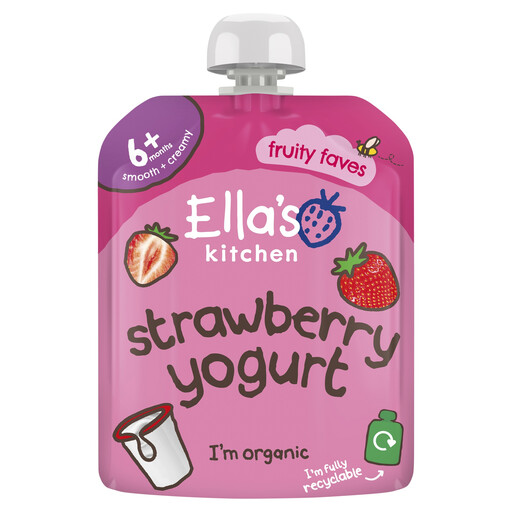
Ella’s Kitchen Greek Yoghurt With Strawberry 6+ Months 90g
This 90g strawberry yoghurt pouch is labelled 6+ months and is not a plain fromage frais option. Before choosing it for early weaning, check the current pack for pasteurisation, fat designation, ingredients, milk-allergen information and storage instructions.
View on Joybuy
Questions about early-weaning dairy
Can a baby have fromage frais when starting solids?
Fromage frais can be considered when a baby is around 6 months old and shows the signs of readiness for solids. The NHS recommends full-fat yoghurt and fromage frais up to age 2; choose a plain, unsweetened option and check the pack, while continuing usual breast milk or first infant formula feeds.
What if my baby has not had cow’s milk before?
Introduce a milk-containing food on its own in a very small amount so that you can spot a reaction, in line with NHS allergy advice. If your baby has a diagnosed food allergy or eczema, or there is a family history of allergy, eczema, asthma or hay fever, ask a GP or health visitor for advice before introducing it.
Can I take chilled fromage frais to a holiday cottage?
Yes, if you can keep it cold during travel and refrigerate it on arrival. The NHS advises using a cool bag with frozen water bottles or ice blocks; if food has not been kept cold, eat it as soon as possible and within 4 hours maximum, and discard leftovers.
Does “suitable from weaning onwards” mean a pot has no added sugar?
No. A Petits Filous multipack listed by Sainsbury’s carries that age statement but includes sugar and fructose in its ingredients. Read both the age statement and the ingredients on the exact variant.
Can I save part of a pot after my baby has eaten from it?
Do not save a half-eaten portion for later: NHS guidance says to throw away leftovers. If serving from a larger tub, put a small amount into a separate bowl first and follow the pack’s storage instructions for the remaining untouched food.


