What should you check?
Start with the required welfare claim, then check whether the exact product and preparation method work for the menu and kitchen.
| Priority |
What to check |
Your needs |
| Free-range status |
Check for “free-range” on the exact frozen pack or supplier specification. Confirm that the wording applies to the product ordered, not a fresh equivalent; record any other welfare assurance separately. |
Our purchasing rules require outdoor access, so a “slower reared” description alone will not meet them. Waitrose & Partners describes slower-reared frozen thighs separately from its explanation of free-range chickens’ outdoor access; RSPCA Assured also distinguishes outdoor access from other welfare features. |
| Menu fit |
Check the cut, portion format, ingredients and allergens against the planned recipe and residents’ assessed requirements. Confirm that the pack size suits the kitchen’s batch preparation. |
I need a chicken format that works for the meals served and for residents’ individual requirements. In England, the Care Quality Commission’s Regulation 14 guidance says providers must meet assessed nutritional needs and take account of preferences and religious or cultural backgrounds. |
| Preparation |
Read the product’s storage and cooking instructions. GOV.UK advises fully defrosting food before cooking unless the manufacturer says to cook it from frozen, and defrosting frozen food in the fridge. |
Our kitchen needs a safe way to store, defrost and cook the chosen product within its documented food-safety process. A welfare claim cannot replace workable preparation instructions. |
Retailer references for chicken formats and claims
These range descriptions help distinguish product formats and welfare wording; a claim for one product should not be transferred to another.
Waitrose
Waitrose & Partners lists frozen breast fillets, mini fillets and slower-reared thighs in its frozen chicken range.
- Its frozen range identifies raw cuts that a kitchen can assess for different recipes.
- Its separate fresh-chicken guidance explains free-range outdoor access; check any frozen product’s own documentation before applying that claim.
Tesco
Tesco lists frozen diced breast, breast fillets and mini fillets.
- The listed cuts give kitchens different formats to assess for their menus.
- A free-range claim elsewhere in a retailer’s chicken range does not establish one for a frozen item; check the exact pack.
M&S
M&S includes free-range chicken in its wider chicken range and identifies a British free-range whole chicken.
- Its named product provides an example of an explicit free-range description.
- That description should not be applied to a frozen product without checking the frozen item’s own specification.
Joybuy product options
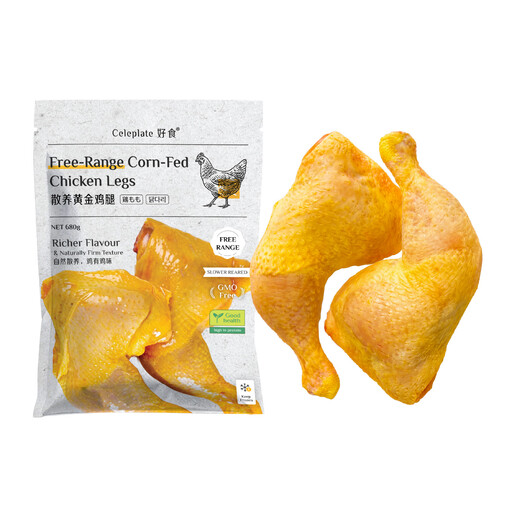
This chicken-leg option is listed for a frozen free-range purchasing requirement. Before using it for a care-home menu, confirm both claims on the delivered pack or supplier specification and check the preparation directions.
 No image available
Celeplate Free-Range Corn-Fed Chicken Legs 680g
The leg cut may suit recipes planned around chicken legs, provided the portion and ingredients fit residents’ requirements. Treat the free-range wording as a product claim: check it and the frozen status on the delivered pack, then follow the manufacturer’s preparation instructions and the kitchen’s documented cooking process.
View on Joybuy
Frequently asked questions
Does “slower reared” mean free-range?
No: treat them as different descriptions unless the exact frozen product states both. Waitrose & Partners describes slower-reared frozen chicken separately from its explanation of free-range birds’ outdoor access, and RSPCA Assured distinguishes chickens with outdoor access from those kept in barns.
What should a care home check before ordering free-range frozen chicken?
Check that the exact frozen product’s pack or supplier specification states “free-range”. Then confirm the cut, ingredients, allergens, pack size, storage directions and cooking instructions against the planned menu and kitchen process; keep the product documentation if the claim is a purchasing requirement.
Can raw chicken be cooked directly from frozen?
Follow the manufacturer’s directions for the exact product. GOV.UK advises fully defrosting food before cooking unless those instructions say to cook it from frozen, and recommends defrosting frozen food in the fridge.
What cooking control applies to chicken pieces?
The Food Standards Agency’s MyHACCP guidance gives 70°C for 2 minutes as an example critical limit for controlling Salmonella when cooking chicken pieces. A care-home kitchen should use documented controls appropriate to its product, equipment and cooking process.
What does England’s care-home guidance require when planning chicken meals?
The Care Quality Commission’s Regulation 14 guidance for England says providers must assess and meet people’s nutritional needs and take account of preferences and religious or cultural backgrounds. Check the care home’s own purchasing specification separately for any free-range condition.


