Families with a cautious eater
If only familiar shapes or mild flavours are accepted, start with a known chicken format. Countable pieces can help with a small meal, but check the coating, ingredients and allergens before changing varieties.


For a fussy eater who eats only a little chicken, individually removable pieces let you cook a small amount, while a two-piece pack offers a predictable count if you know how much they will accept. Neither a small bag nor a piece count proves that the pack is one serving; larger raw packs require more planning when their instructions call for defrosting, and flavour, coating and allergens still matter.
If only familiar shapes or mild flavours are accepted, start with a known chicken format. Countable pieces can help with a small meal, but check the coating, ingredients and allergens before changing varieties.
Individually frozen pieces let you remove the amount needed while leaving the rest frozen. A counted two-piece pack can also be manageable, provided its weight and the eater’s usual amount make sense together.
Raw frozen chicken may suit an eater who accepts unbreaded chicken and seasoning prepared at home. Check whether the pack requires refrigerator defrosting and whether its pieces are practical for the meals you plan.
Choose a format the eater accepts, then check how much you can cook at once and what preparation the pack requires.
Consider when: The eater accepts bite-size breaded chicken and you want to remove just a few pieces for a meal.
Trade-off: Sainsbury’s describes SFC Original Chicken Poppets as individually quick frozen, but they are formed chicken rather than whole-cut fillets.
Consider when: A familiar, repeatable shape matters more than being able to remove several small pieces.
Trade-off: Two pieces do not necessarily equal two suitable servings; check the total weight and the eater’s usual amount.
Consider when: Plain chicken is accepted and you can plan preparation ahead.
Trade-off: Sainsbury’s says its 2kg mixed chicken portions must be defrosted before cooking and cooked on the day they are defrosted.
| Priority | What to check | Your needs |
|---|---|---|
| Portioning | Check whether pieces can be removed separately, the total pack weight and any stated servings. A two-piece pack is not automatically two suitable meals. | I want to cook a small amount without committing to the whole pack. If the pieces are large, I need to consider how much will actually be eaten. |
| Food acceptance | Compare whole-cut and formed chicken, the coating and the seasoning. Read the current ingredients and allergen statement for the exact variety. | A familiar shape or mild flavour may matter more to my eater than the size of the bag. |
| Preparation | Check whether the instructions say to cook from frozen or defrost first, and which cooking method they cover. Follow the pack’s cooking instructions. | For a meal I have not planned ahead, I need a product whose instructions allow cooking from frozen. |
| Pack size | Compare the amount you can cook with the amount you can store. For raw chicken that requires defrosting, check when the defrosted food must be cooked. | A larger pack works for me only if I have freezer space and a practical plan for using it. |
A counted pack makes meal planning easier, but each piece may be larger than the eater’s accepted amount. Waitrose labels its two frozen garlic chicken Kyivs as two servings; that label cannot establish an individual eater’s portion.
Check the pack weight and stated servings against the amount usually eaten before choosing a two-piece format.
Sainsbury’s says its 2kg mixed frozen chicken portions are not suitable for cooking from frozen and must be cooked on the day they are defrosted.
If you need to cook straight from the freezer, choose a product whose own instructions expressly allow it. Otherwise, allow for refrigerator defrosting as directed on the pack.
Chicken form, coating and seasoning differ: Sainsbury’s describes SFC Poppets as formed chicken, while Waitrose describes its hot-and-spicy mini fillets as chicken-breast strips in a spicy crumb.
Compare those characteristics with foods the eater already accepts, and check the current label for ingredients and allergens.
These examples show how pack formats differ; check the exact product rather than assuming a brand’s entire range has the same portions or preparation instructions.
Sainsbury’s lists Birds Eye chicken breast steaks and chicken grills in two-piece packs.
Its frozen chicken listings include individually frozen breaded pieces and a 2kg mixed raw chicken-portion pack.
Waitrose lists frozen breast fillets and mini fillets, alongside prepared products with stated servings.
Tesco lists frozen raw cuts including drumsticks, thighs and boneless thighs, as well as prepared chicken products.
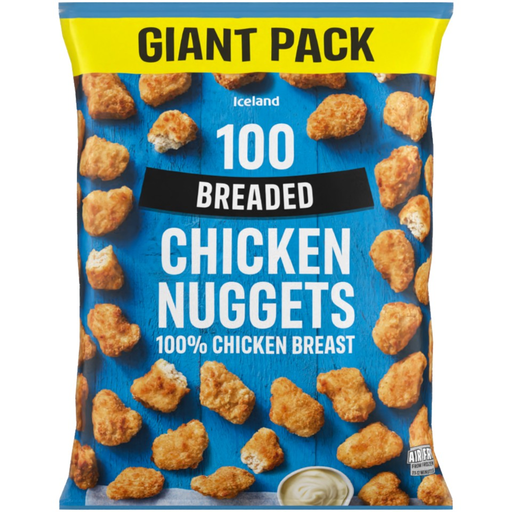
This nugget pack is an option for an eater who already accepts breaded nuggets and for meals where you want to remove a selected number of pieces. It is a bulk pack, not a single-serving pack.
 No image available
For an eater who accepts nuggets, the pack instructions say to remove the required amount and provide oven and air-fryer directions for cooking from frozen. This is a 100-piece, 1.4kg pack rather than a stated one-person serving. The product information lists wheat and possible milk, and warns that some bones may remain; check the current packaging and serve with care.
No. Check the stated servings, total weight and piece count instead of judging by the bag’s size. Waitrose labels its 380g hot-and-spicy mini fillets as two servings, while Sainsbury’s describes the 170g SFC Poppets by pack size and individually frozen format.
Only when the particular product’s instructions say to cook it from frozen. GOV.UK’s food hygiene guidance says frozen food must otherwise be fully defrosted before cooking and advises defrosting it in the fridge. Sainsbury’s says its 2kg mixed raw chicken-portion pack is not suitable for cooking from frozen.
Follow the pack instructions and check that the chicken is thoroughly cooked before serving. GOV.UK’s food hygiene guidance gives a core temperature of 70°C for two minutes as standard advice and says poultry should be steaming hot throughout.
Check the current ingredients and allergen statement for the exact product before serving it. A familiar-looking coating does not mean two chicken products have the same ingredients, and changing varieties can change what needs checking.