Care-home cooks serving small batches
Choose a product whose instructions work with measured quantities and the kitchen's equipment. A serving shown in nutrition information is not an individual resident's portion.


For lower-volume meals, consider a smaller retail bag; for regular multi-resident batches, compare foodservice chips with the quantities your kitchen cooks. Neither pack type sets an individual resident's portion. Measure portions against assessed needs, follow the chosen product's cooking instructions and check any prescribed texture at serving temperature.
Choose a product whose instructions work with measured quantities and the kitchen's equipment. A serving shown in nutrition information is not an individual resident's portion.
Compare pack sizes against the amounts the home can store and use, then check the current ingredients, allergens and cooking instructions for the product being ordered.
Follow each resident's clinical recommendation rather than choosing chips by cut or appearance. The International Dysphagia Diet Standardisation Initiative (IDDSI) calls for texture testing under intended serving conditions.
Start with the resident's needs, then choose a pack and cooking process that the kitchen can use consistently.
| Priority | What to check | Your needs |
|---|---|---|
| Resident portions | Set the amount through the resident's assessment and menu plan. Treat a pack's nutrition serving as label information, not a portion instruction. | I need to serve an amount that fits each resident's assessed needs, rather than giving everyone the same pack-reference serving. The Care Quality Commission's Regulation 14 guidance applies to providers in England. |
| Prescribed texture | Check the individual clinical recommendation and applicable IDDSI criteria. Test food at its intended serving temperature; crispness or chip size cannot establish suitability. | If a resident has a prescribed texture, I need a potato preparation that meets it. Standard chips should not be assumed suitable. |
| Small batches | Check the stated cooking quantity, tray or basket loading and any instruction to adjust time. McCain Foodservice gives a 500 g cooking basis for Original Choice Thick Cut Chips; Aunt Bessie's advises reducing time for smaller quantities of its Homestyle Chips. | Some meals call for only a modest amount. I need a repeatable way to measure and cook that batch without treating the supplier's cooking basis as a resident portion. |
| Pack turnover and storage | Compare the bag size with expected use and the space available for frozen storage. Follow the chosen pack's storage instructions and the kitchen's temperature-monitoring process. | A smaller bag may suit less frequent chip service; regular multi-resident service may call for a different format. Either way, the kitchen needs to store and use it as directed. |
| Ingredients and dietary fit | Read the delivered pack's current ingredient and allergen information. Similar-looking chips can differ: the Marks & Spencer Triple Cooked Chips page lists beef dripping. | I need the chosen product to fit residents' dietary requirements and the approved menu, especially when a recipe or supplier changes. |
Product pages give nutrition-reference servings, but these do not determine what an individual resident needs. In England, Care Quality Commission Regulation 14 guidance requires providers to assess nutritional needs and provide food to meet them.
Set and record portions through the home's menu and care processes; use pack quantities to plan cooking, not to prescribe intake.
IDDSI says individual recommendations follow clinical assessment and food should be tested under intended serving conditions. A chip's appearance does not show that it meets the required texture.
Follow the resident's recommendation and the applicable IDDSI tests. Use another suitable potato preparation if standard chips do not meet those requirements.
Recipes can differ in ways that affect dietary fit. For example, the Marks & Spencer Triple Cooked Chips product page lists beef dripping, while the Joybuy listing for McCain Chunky Home Chips identifies wheat as an allergen.
Check the current delivered pack's ingredients and allergen statement before approving it for the menu.
Suppliers give product-specific instructions: McCain describes a 500 g cooking basis for some chips, while Aunt Bessie's advises a shorter time for smaller quantities of Homestyle Chips. Those directions cannot simply be transferred to another cut or appliance.
Record the chosen product, batch weight and tray or basket load in the kitchen procedure, and check the result when any of them changes.
These product examples illustrate pack and preparation differences; brand inclusion does not establish suitability for an individual resident.
McCain has retail frozen-chip bags and a separate foodservice range, including Original Choice Thick Cut Chips.
Its Homestyle Chips come in an 800 g frozen bag that may fit lower-volume service.
Tesco's own-label frozen range includes a 1.5 kg Crinkle Cut Chips bag.
Its 1.5 kg Crinkle Cut Chips product page provides a 125 g cooked nutrition-reference serving.
M&S lists smaller chip products, but its 400 g Chunky Chips and 450 g Triple Cooked Chips are described as suitable for freezing rather than as products sold frozen.
This bagged frozen-chip option is for kitchen-prepared batches, not individually wrapped servings. Decide the amount to cook through the home's menu process and check the result against each resident's requirements.
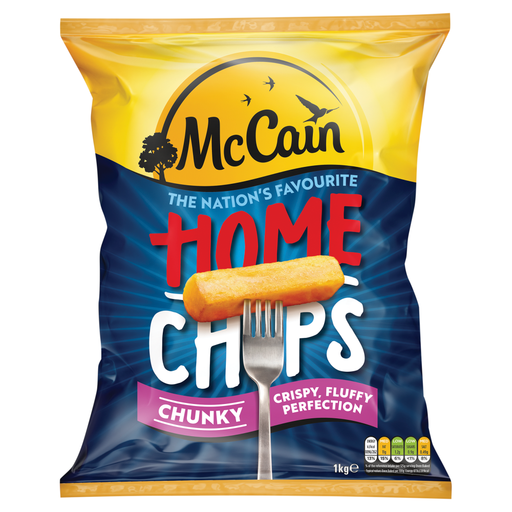 No image available
The 1 kg frozen bag can be drawn down for kitchen-prepared batches rather than used as individual portions.
The Joybuy listing specifies storage at -18°C or below and oven preparation in a single layer, with turning. It identifies wheat as an allergen; check the current pack against residents' requirements.
For smaller batches, check the current pack instructions and the kitchen's cooking procedure. A prescribed IDDSI texture still requires an individual recommendation and assessment at intended serving conditions.
No. The 110 g, 115 g and 125 g servings shown on the cited chip product pages are nutrition references, not individual care-plan portions. Set the amount through the resident's assessed needs and the home's menu process.
Not automatically. IDDSI says individual recommendations follow clinical assessment and food must be tested under intended serving conditions. If Level 7 Easy to Chew is prescribed, its separation, pressure and moisture criteria need to be met; do not assume crisp chips pass.
Follow that product's instructions for quantity, loading and timing, then check that the food is piping hot before serving. McCain's cited instructions use a 500 g cooking basis for some products, while Aunt Bessie's advises reducing time for smaller Homestyle Chips batches; neither instruction sets the time for a different product or appliance.
No. A claim describes particular dietary characteristics of a specific product, not its fit with every resident's needs. Check the current ingredients and allergens: the M&S Chunky Chips page states vegan, vegetarian and gluten free, whereas its Triple Cooked Chips page lists beef dripping.
Follow the chosen pack's storage instructions and the home's food-safety process. Food Standards Agency MyHACCP guidance calls for adequate frozen-food storage facilities and temperature monitoring; check the delivered label for product-specific directions.