Care-home catering buyers
If chips appear regularly on the menu, consider how many portions the home plans to serve, how much freezer space a bag occupies and whether it can be used within the home’s stock-rotation procedures.


A larger bag of frozen chips makes sense for a care home when meal volumes, freezer space and stock rotation allow it to be used as planned. Choose the exact product against residents’ assessed nutritional, allergen and texture needs: ordinary chips should not be assumed suitable for someone whose care plan specifies a modified texture.
If chips appear regularly on the menu, consider how many portions the home plans to serve, how much freezer space a bag occupies and whether it can be used within the home’s stock-rotation procedures.
For services covered by CQC Regulation 14, the Care Quality Commission says nutritional needs must be assessed and food provided to meet them, taking account of preferences and religious and cultural backgrounds. A single chip choice may not meet every resident’s needs.
Check the exact product’s ingredients and allergens, and follow each resident’s current texture recommendation where applicable. The International Dysphagia Diet Standardisation Initiative (IDDSI) provides the texture terminology used in the UK.
Start with the planned menu and residents’ requirements, then choose a pack size that the kitchen can store, prepare and use.
| Priority | What to check | When it matters to me |
|---|---|---|
| Pack size | Compare the pack weight with planned portions, menu frequency and stock rotation. Tesco Groceries lists frozen-chip examples from 1.5kg to 2.25kg; size alone does not establish which pack fits a home. | I need enough chips for scheduled meals without taking on a bag that is awkward to store or use as planned. |
| Frozen storage and cooking | Confirm freezer capacity and temperature-monitoring procedures. Follow the storage and cooking directions on the exact pack; MyHACCP guidance calls for adequate facilities for frozen-food storage and temperature monitoring. | Our kitchen needs to hold the intended stock and prepare it under its established food-safety procedures. |
| Ingredients and meals | Read the current ingredients, allergen declaration and nutrition panel for the chosen product. Match the menu to residents’ assessed needs and relevant preferences, as set out in Care Quality Commission guidance. | I cannot assume that one frozen-chip recipe suits everyone eating the meal. |
| Meal texture | Check the resident’s current care plan and any specified IDDSI texture. The Care Quality Commission says dysphagia care plans should include consistency recommendations and risk assessments; cooking ordinary chips differently does not establish that they meet a specified texture. | For a resident with a texture-modified meal plan, I need to serve food that follows that plan rather than choose chips by pack size. |
A bag that exceeds planned meal use can put pressure on freezer space and stock rotation.
Check expected portions, available frozen storage and the home’s planned use before increasing pack size.
Ordinary chips should not be presumed to meet a resident’s dysphagia care plan. IDDSI texture descriptions refer to food characteristics, not simply how long an item has been cooked.
Follow the current consistency recommendation and the home’s dysphagia procedures, seeking the specialist input specified in the care plan.
Recipes and coatings differ. McCain lists wheat in the batter for its Home Chips Straight Cut line, so the word “chips” is not enough for an allergen decision.
Review the current packaging or supplier specification for each exact product, including after a recipe or supplier change.
More frozen stock requires space within the home’s storage and temperature-monitoring arrangements.
Confirm capacity, storage instructions and rotation procedures before ordering more bags.
A familiar name or range can help narrow the search, but suitability depends on the exact frozen-chip product selected.
McCain has Home Chips and Oven Chips lines in the frozen-chip listings discussed here.
Tesco Groceries lists several own-label frozen-chip styles in 1.5kg bags.
The M&S frozen-chip range includes French Fries and Straight Cut Chips in 1.5kg packs, alongside other styles.
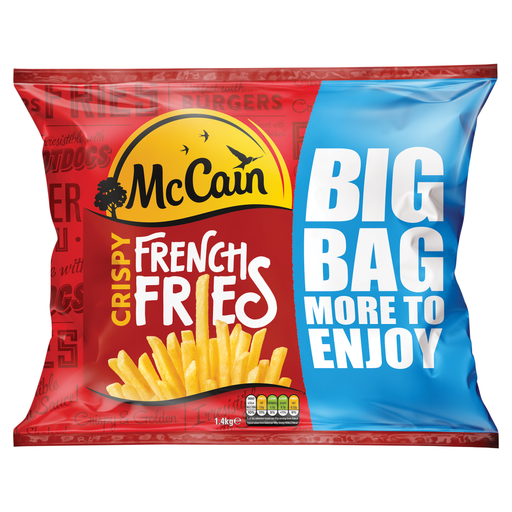
This frozen-fries option comes in a 1.4kg bag. Compare that size with the home’s planned portions and freezer arrangements before choosing it for regular service.
 No image available
The 1.4kg bag is smaller than the 1.5kg–2.25kg examples discussed above; check whether it fits planned portions and stock rotation. Review the current pack’s ingredients, allergens and cooking directions before service, and follow residents’ care plans for any texture requirements.
Not without checking individual needs. For services covered by CQC Regulation 14, the Care Quality Commission says providers must assess nutritional needs and provide food that meets them, while taking account of preferences and religious and cultural backgrounds. Check the chosen product and relevant care plans before adding it to a shared menu.
Do not assume they meet that resident’s assessed texture recommendation. Follow the current care plan and the home’s dysphagia procedures; IDDSI terminology describes specified food textures, and an ordinary chip is not shown to meet one merely because it has been cooked differently.
Check planned meal use, freezer capacity, frozen-food storage controls and temperature monitoring. MyHACCP guidance calls for facilities adequate for freezing, storing frozen food and monitoring temperatures; follow the exact pack’s storage and cooking instructions as well.
No. Ingredients can differ between product lines: McCain lists wheat-containing batter for Home Chips Straight Cut. Check the current label of the exact product being served rather than applying one line’s ingredient list to another.