What should you check?
Decide who the dish will serve and how it fits the menu, then check its preparation instructions and label before choosing.
| Priority |
What to check |
Your needs |
| Servings and role |
Read the stated serving count and net weight. Decide whether the dish is a complete meal, a shared main or a side; weight alone does not establish how many people it serves. |
I’m feeding a particular number of people, so I need portions that fit the table rather than assuming a larger-looking pack will be enough. |
| Festive menu fit |
Compare the recipe, ingredients and preparation method. A premium or Christmas range can help you find options, but the range name is not a quality or nutrition rating. |
For a shared meal, I might want one substantial dish to serve with sides; for a separate supper, an individual ready meal may make more sense. |
| Nutrition label |
Check salt, saturated fat and fibre on the exact product. Compare per-serving and per-100g figures carefully, particularly when pack sizes or serving counts differ. |
I want to compare what each person will eat, not judge the meal by its premium branding or compare unlike portion sizes. |
| Cooking schedule |
Note each pack’s appliance method, temperature, cooking time and any standing time. Check whether dishes need the same oven at incompatible settings. |
With one oven and several dishes to prepare, I need a schedule that works on Christmas Day. |
| Ingredients and allergens |
Read the current ingredients and allergen declaration for every main, side and sauce. Follow each product’s own frozen-cooking or defrosting directions. |
Different guests may need different dishes, so I need to check each pack rather than rely on a recipe name or range label. |
Which retailer ranges are relevant?
These retailer ranges offer different places to start a Christmas freezer shop; compare individual dishes rather than treating a range label as a verdict.
M&S
M&S lists frozen dishes such as Scottish salmon en croute and seafood-based meals that could form part of a small festive menu.
- Look at the dish format when deciding whether it will be the main event or one part of the meal.
- Confirm the stated servings and local availability for the particular product you choose.
Waitrose
Waitrose lists frozen dishes for two, including pea-and-asparagus risotto and chicken-and-king-prawn paella in 800g packs.
- The stated two-person format offers a starting point for a smaller Christmas table.
- Check the individual recipe, allergens and cooking method rather than choosing on pack size alone.
Tesco
Tesco’s frozen ready-meal category provides filters for family meals, meals for two and dietary categories.
- Use the format filters to narrow the choice by the number of diners.
- Check the specific product and its availability before making it central to the menu.
Sainsbury’s
Sainsbury’s lists frozen Taste the Difference meals for one, including a 400g Coq Au Vin.
- A clearly labelled individual meal can suit a separate Christmas supper.
- Check its nutrition and ingredients; the premium range name does not answer either question.
Asda
Asda separates frozen premium ready meals from other ready-meal categories in its online aisle.
- The category can help locate recipes to compare for the occasion.
- Read each meal’s serving information and cooking instructions, which can differ between products.
Iceland
Iceland’s frozen Christmas range includes ready meals, meal-in-a-bag options, sides and party food.
- The range covers several parts of a freezer-based festive menu.
- Check the directions for every component; a bundle and an individual ready meal may need different preparation.
A frozen pie on Joybuy
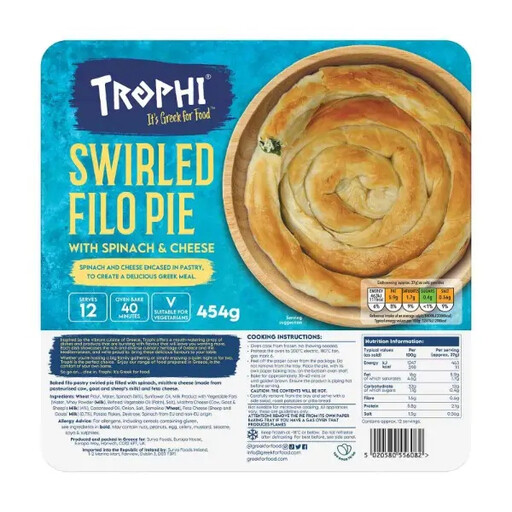
This spinach-and-cheese pie is an option to consider for a Christmas meal if a savoury oven dish fits your menu. Check its portions before relying on it as a shared main; its listing does not establish a premium-range designation.
 No image available
Trophi Swirled Pie (Spanakopita), Spinach & Cheese, 454g
The spinach-and-cheese pie offers a savoury dish to consider alongside other Christmas food. The pack is 454g; check its serving guidance, cooking directions, nutrition and allergens before deciding how it fits your meal.
Joybuy
Questions about frozen Christmas meals
How can I tell whether a frozen dish will feed everyone?
Use the pack’s stated number of servings, then decide whether the dish will be the main course or part of a larger meal. Net weight helps you compare packs, but a “premium” label and weight alone do not establish the portion count.
Can I microwave a premium frozen meal?
Microwave it only if the exact product’s instructions permit that method. Follow its stated wattage, cooking and standing directions, and check that the food is piping hot before serving.
Can I defrost a frozen Christmas meal before cooking?
Defrost it before cooking only when that product’s directions allow it. An Iceland Christmas dinner product specifies a refrigerator-defrost method, while other meals instruct customers to cook from frozen; follow the instructions for the item in front of you.
How should I check allergens when serving several dishes?
Read the current allergen declaration and ingredients for every main, side, sauce and dessert. Similar-looking frozen meals can use different ingredients, so check each product separately.
Does a premium frozen meal have a particular nutrition profile?
No nutrition profile follows from a premium label: compare the exact meal’s salt, saturated fat and fibre figures, taking its serving size into account. Action on Salt’s 2025 audit covered 1,511 ready meals across 11 major UK retailers and reported 56% high in salt, 42% high in saturated fat and 71% low in fibre; those audit results do not describe every individual meal.


