What should you check before choosing?
Choose the format first, then compare the exact packs on fat per 100g, guest suitability and the time and space needed to prepare them.
Plain white fish
Choose when: Keeping added coating out of the main course matters more than serving a crisp fish dish.
Plan for: Seasoning, sides or sauce, and plating the fillets yourself.
Lightly dusted fish
Choose when: You want a seasoned coating and its ingredients suit every guest being served.
Bear in mind: “Lightly dusted” describes the coating, not the product’s fat content.
Battered fish
Choose when: A familiar battered presentation matters more to the menu than minimising fat.
Bear in mind: Batter can add allergens, and the cited Birds Eye product has a higher declared fat figure than the cited plain and dusted cod products.
| Priority |
What to check |
Your needs |
| Fat and format |
Compare fat per 100g on the current packs, noting the stated basis. Tesco lists 0.6g for its plain Cod Fillets; M&S lists 5.9g for Lightly Dusted Cod; Waitrose & Partners lists 14g for Birds Eye battered cod. Account for any sauce or cooking ingredients you add. |
I want to keep fat down, so I would rather choose the fish and add my own seasoning than assume a coating has a particular nutrition value. |
| Cooking |
Read each pack’s from-frozen or thawing directions, oven settings and cooking time. Follow its instructions for checking that the fish is cooked before serving; do not reuse another product’s timings. |
My oven schedule needs to leave enough time to cook and plate every portion for guests. |
| Allergens and bones |
Check the current ingredients, allergen statement and bone warning. The Waitrose & Partners listing for Birds Eye battered cod identifies fish, wheat, milk and mustard; coated products need their own checks. |
If a guest avoids an ingredient, I need to know what is in the exact fish product before settling the menu. |
| Portions and storage |
Compare pack weight and fillet or steak count with the guest list. Check that the packs fit your freezer and follow their storage instructions. |
I need enough portions without relying on a last-minute extra pack or more freezer space than I have. |
Joybuy white-fish option
This tilapia option may suit a dinner-party menu built around white fish; use its current pack details to decide whether it meets your fat, portion and preparation requirements.
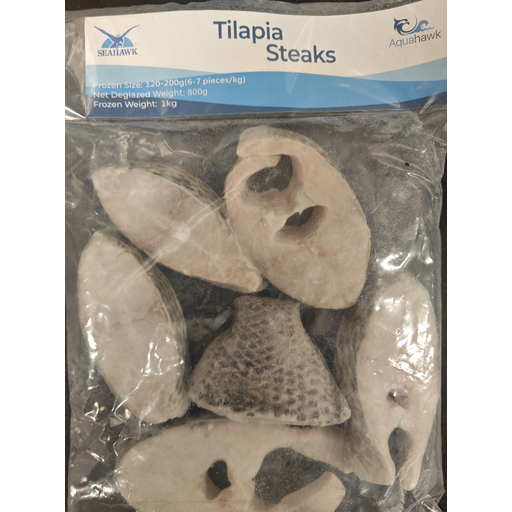 Image unavailable
Aqua Hawk Tilapia Steaks, 6/7 steaks, 800g net
For a dinner party built around white fish, this 800g net pack lists six or seven steaks. Check the current pack’s fat per 100g, ingredients, allergens, bone information and cooking directions before planning portions. The listing describes the fish as raw; cook it thoroughly according to its instructions.
View on Joybuy
Common questions
Should I choose plain frozen cod when keeping fat down matters?
Plain cod is a useful starting point for this menu: Tesco Cod Fillets list 0.6g fat per 100g and M&S Wild Icelandic Cod Fillets list 1.2g per 100g. Check the current pack, then choose enough fillets for your guest count and account for any sauce or cooking ingredients you add.
Does “lightly dusted” mean “reduced fat”?
No: “lightly dusted” describes a coating, not a fat comparison. M&S lists 5.9g fat per 100g for its Lightly Dusted Cod and 1.2g per 100g for its plain Wild Icelandic Cod Fillets. Check the current pack for its nutrition values and any specific comparative claim.
Can I cook frozen fish directly for guests?
Yes, if the exact pack instructs you to cook it from frozen. Tesco Cod Fillets specify 25 minutes at 180°C in a conventional oven or 160°C in a fan oven, followed by one minute standing. Follow the instructions and cooking checks for your own product rather than transferring Tesco’s timings to another fish.
Which allergens should I check in coated frozen fish?
Check for fish and every ingredient in the coating. The Waitrose & Partners listing for Birds Eye battered cod identifies wheat, milk and mustard, while M&S Lightly Dusted Cod contains gluten-containing cereals. Use the current pack’s allergen statement when planning for individual guests.
Should I thaw frozen fish before cooking or refreeze it afterwards?
Follow the directions for the product you buy: Tesco Cod Fillets give oven-from-frozen instructions, while the M&S plain and lightly dusted cod pages say to keep the products frozen and not refreeze them after thawing. Do not assume those directions apply to a different pack.


