What should you compare?
Choose the measure that matters for this occasion first, then check the pack and the assembled serving. A low-fat claim, a relative fat reduction and a calorie-led category are not interchangeable.
Labelled low fat
Choose when: meeting the UK low-fat condition is central to the dessert choice; M&S lists 1.1 g fat per 100 g for its Low Fat Birthday Cake Ice Cream.
Bear in mind: the same M&S product lists 18.1 g sugars per 100 g, so its low-fat claim does not answer every nutrition question.
Reduced-fat sharing tub
Choose when: you want a large vanilla tub to scoop for several guests and a relative reduction in fat meets your needs; Tesco lists Wall’s Soft Scoop Vanilla Light in an 1800 ml tub.
Bear in mind: Tesco lists 4.3 g fat per 100 g for this product, above the UK low-fat condition for solid foods.
Other formats or calorie-led choices
Choose when: you want to compare frozen yoghurt or sorbet, or calories matter more to you than a low-fat claim.
Bear in mind: a category name does not establish the fat content of each product; check the individual nutrition panel.
| Priority |
What to check |
Your needs |
| Fat and labelling |
Read total fat per 100 g for a solid dessert or per 100 ml for a liquid. Department of Health and Social Care guidance gives UK low-fat limits of 3 g per 100 g for solids and 1.5 g per 100 ml for liquids; “reduced fat” describes a different claim. |
I want to use the label to check whether a dessert meets my fat requirement. In a Food Standards Agency and Ipsos Northern Ireland survey of 611 people interviewed from 16 September to 23 November 2024, 49% actively used traffic-light labels when shopping for food; this was not a frozen-dessert-specific measure. |
| Calories and sugars |
Compare energy, fat and sugars using the same per-100 g or per-100 ml basis. Then check the portion you plan to serve and account for sauces, cream, biscuits or cake served with it. |
A lower-calorie description does not answer my question about fat or sugars. I also need to decide whether I am comparing the frozen dessert alone or the whole afternoon-tea serving. |
| Guests and serving |
Check the pack size, ingredients, allergen and “may contain” statements, and storage directions for the exact flavour. Choose a format that can be served to the intended number of guests. |
If I am serving other people, I need a portion format that works for the table and ingredient information that addresses their requirements before the dessert is offered. |
Brand and retailer references
These ranges offer different places to start browsing; judge low-fat suitability from each individual product’s label, not its retailer or category.
M&S
M&S lists frozen yoghurt options as well as Low Fat Birthday Cake Ice Cream.
- Its Low Fat Birthday Cake Ice Cream lists 1.1 g fat per 100 g, below the UK low-fat condition for solid foods.
- The same product lists 18.1 g sugars per 100 g; check the current pack for ingredients and allergens.
Tesco
Tesco has calorie-led frozen-dessert browsing categories alongside individual ice cream listings.
- Its under-150-calories-per-100-ml category offers a way to browse by an energy measure.
- Tesco lists 4.3 g fat per 100 g for Wall’s Soft Scoop Vanilla Light, so its reduced-fat positioning should not be read as a low-fat claim.
Waitrose
Waitrose lists frozen yoghurt, frozen kefir and sorbet options in its frozen-dessert categories.
- The category choices offer several formats to compare for an afternoon-tea serving.
- A browsing-category description does not establish the fat content of every item; read each product’s nutrition panel.
Sainsbury’s
Sainsbury’s lists sorbet, frozen yoghurt and milk-free frozen-dessert options alongside ice cream.
- The separate formats can help narrow a search by serving style or stated ingredient requirement.
- Check the exact product’s fat figure and allergen information; neither a format nor a milk-free category establishes that it is low fat.
Häagen-Dazs
Häagen-Dazs describes its UK vanilla ice cream as made with cream, milk, sugar and eggs.
- Its ingredient description helps distinguish this conventional ice cream from the alternative frozen-dessert formats.
- For a decision based on fat content or allergens, read the current pack information for the exact tub.
A Joybuy dessert option
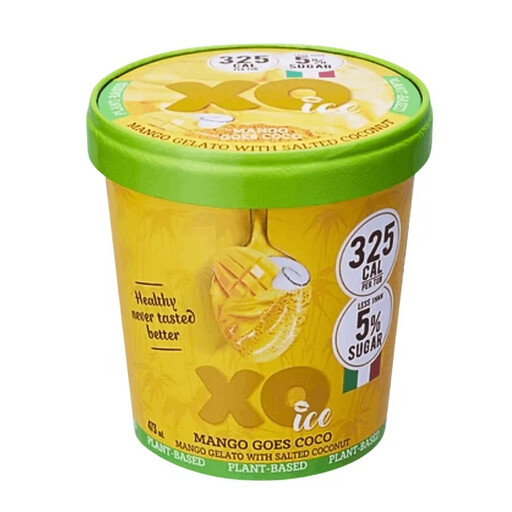
This plant-based gelato is an option to consider when comparing frozen desserts for afternoon tea by format or calories. Check its current nutrition panel if meeting the UK low-fat condition is your priority.
 No image available
XO ICE Low Calories Mango and Coconut Plant-Based Gelato 473 ml
The 473 ml gelato tub offers a mango-and-coconut, plant-based format for an afternoon-tea dessert. Compare the current pack’s fat, energy and sugars per 100 g before choosing it for a particular nutrition requirement, and check its ingredients and allergen warnings for guests.
Joybuy
Frequently asked questions
What does “low fat” mean on a frozen dessert in the UK?
Department of Health and Social Care guidance gives a limit of no more than 3 g fat per 100 g for a solid food making a low-fat claim, or 1.5 g per 100 ml for a liquid. Check which measure applies to the product rather than treating “light” or “reduced fat” as equivalent wording.
Is reduced-fat ice cream necessarily low fat?
No. Tesco describes Wall’s Soft Scoop Vanilla Light as having 30% less fat than similar ice creams, but lists 4.3 g fat per 100 g. That exceeds the UK low-fat condition of 3 g per 100 g for solid foods.
Does a calorie-led frozen dessert also have less fat?
Not necessarily: calories and fat are separate nutrition measures. Joybuy lists 151 kcal and 5.5 g fat per 100 g for Halo Top Golden Blondie, so compare the figures relevant to your choice rather than using one as a substitute for the other.
What should I check before serving guests with allergies?
Read the current ingredients, allergen statements and any “may contain” warning for the exact product and flavour. For example, Joybuy’s Halo Top Golden Blondie listing names egg, milk and wheat and says it may contain peanuts and soya; check the pack before serving because another dessert or flavour may differ.
How should I store a frozen dessert for afternoon tea?
Follow the directions on its current pack and plan when to take it out for serving. M&S specifies keeping its Low Fat Birthday Cake Ice Cream frozen at −18°C and says not to refreeze it.


