Care-home catering teams stocking a core freezer menu
For cooks and food-service managers choosing two different fish lines while retaining control over recipes, portions and side dishes.


For a standard care-home menu, start with an uncoated white-fish line for recipes the kitchen controls and a salmon line for an oily-fish option. This gives the kitchen two distinct menu roles in light of NHS advice to include an oily fish among weekly fish portions, but neither product can replace checks against each resident’s allergen and documented texture requirements.
For cooks and food-service managers choosing two different fish lines while retaining control over recipes, portions and side dishes.
For kitchens that must keep standard purchasing separate from each resident’s documented swallowing requirements. The Health and Safety Executive stresses that preparation and service systems must ensure the appropriate food reaches people with swallowing difficulties at every mealtime.
For purchasers who need current product-specific ingredients and allergen information before substituting a coated fish product for a plain fillet.
Choose the two menu roles first, then check whether the particular packs and preparation instructions work for the kitchen and its residents.
| Priority | What to check | Your needs |
|---|---|---|
| Two menu roles | Check the fish species and whether each product is plain or coated. The NHS advises at least two fish portions a week, including one oily-fish portion. | I need a white-fish base for different recipes and a separate oily-fish option, rather than two similar coated products. |
| Individual texture plans | Check each resident’s documented requirements and the kitchen’s preparation and service controls. The Health and Safety Executive warns that people with swallowing difficulties must receive food appropriate to their requirements at every mealtime. | A standard fillet must not be served as a substitute for a resident’s prescribed texture-modified meal. |
| Ingredients and allergens | Check the current pack and supplier specification for fish and any ingredients added by coatings, sauces or seasoning. Account for allergen controls during preparation and service. | Where menus have different allergen requirements, I need to assess each product separately rather than rely on its fish name. |
| Bones and portion format | Read the pack’s bone warning, even when a product is described as boneless. Compare the stated pack weight and portion format with the portions the kitchen intends to prepare. | I need portions the team can check and prepare for the intended residents; a boneless label alone is not enough. |
| Freezer and cooking instructions | Check labelled storage temperatures and whether the product requires thawing or can be cooked from frozen. M&S specifies frozen storage at −18°C for its cited British hake fillets. | The chosen packs need instructions that fit our freezer, preparation schedule and food-safety controls. |
| Bulk supply | Confirm case quantity, net fish weight, portion yield, delivery arrangements and a current supplier specification before adopting a retail-size pack as a regular line. | For repeated care-home service, I need a dependable quantity and a workable portion format, not just a suitable-looking retail pack. |
Joybuy describes Young’s Chip Shop Omega 3 Fish Fillets as battered Alaska pollock. That product name does not make it a salmon portion for the oily-fish menu role.
Check the species when selecting the oily-fish line. Assess battered fish separately for its ingredients and intended menu use.
A coating changes the product being served. Birds Eye’s cited breaded cod, for example, carries a warning that it may contain milk.
Keep current specifications for each product and check them against residents’ allergen requirements before changing a menu item.
The Health and Safety Executive says care providers need robust systems to ensure people with swallowing difficulties receive appropriate texture-modified food at every mealtime. An ordinary fillet format does not establish suitability for an individual resident.
Prepare, check and serve the meal according to that resident’s documented plan and the home’s service controls.
A pack that illustrates the right fish type does not, by itself, establish the case quantity or portion yield needed for routine care-home service.
Confirm net weight, portion count, ingredients, allergens, storage, cooking instructions and delivery arrangements with the intended supplier.
These product lines illustrate formats to compare; a brand name alone does not establish the specification of a particular pack.
Its cited frozen salmon fillets illustrate an oily-fish freezer line.
Its cited British hake fillets illustrate a plain white-fish line.
Young’s lists natural fish fillets as well as coated frozen-fish formats.
Its cited breaded cod provides an example of a coated, cook-from-frozen format.
These two products represent different lines for a standard menu: frozen pangasius for the white-fish role and sockeye salmon for the oily-fish role. Check the current packs and supplier arrangements before choosing either for care-home service.
 No image available
A frozen white-fish option for a kitchen selecting its own recipe. The product name specifies individually quick-frozen fillets, a 170/200g size designation, 1kg total weight and 800g net weight. Check the current pack for bone, storage and cooking instructions, and confirm portion yield and case quantities for bulk service.
 No image available
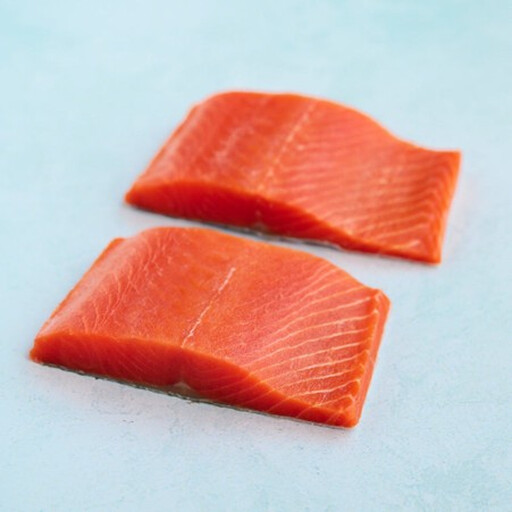
A salmon option for the oily-fish menu role. The product name identifies wild sockeye salmon fillet steaks in a 220g pack. Check the current pack for allergens, bones, storage and preparation instructions, and confirm the portion format and case quantity before bulk use.
For a standard menu, a white-fish line and an oily-fish line serve different purposes. NHS advice calls for at least two fish portions a week, including one oily-fish portion; individual care plans still govern what each resident can receive.
Only if it is prepared and served in accordance with that resident’s documented swallowing requirements. The Health and Safety Executive says care providers’ systems must ensure people with swallowing difficulties receive appropriate texture-modified food at every mealtime.
Check the current label and supplier specification for the exact product, including fish and ingredients added by any coating, sauce or seasoning. Keep that information available for the home’s allergen controls rather than assuming products with the same fish name have the same ingredients.
Follow each product’s labelled frozen-storage temperature and preparation instructions, including whether it requires thawing or can be cooked from frozen. For example, M&S specifies −18°C storage for its cited British hake fillets and says the raw fish must be cooked.
No. Read the current pack’s residual-bone warning and retain appropriate preparation and serving checks. M&S warns that its cited hake fillets may contain bones, while Birds Eye gives a similar warning for its cited breaded cod.