Parents preparing a quick toddler tea
A countable frozen format lets you cook a small quantity. Follow the pack instructions, then seat the child upright and supervise eating, as NHS guidance advises for young children.


For a toddler dinner, countable fish fingers can make it easier to cook a small amount; plain frozen fillets offer more control over the final size and texture but need more preparation. Neither a pack count nor its stated serving defines a toddler portion. Check the current ingredients and allergens, follow the cooking instructions, inspect the fish for bones and adapt the serving to the child.
A countable frozen format lets you cook a small quantity. Follow the pack instructions, then seat the child upright and supervise eating, as NHS guidance advises for young children.
Check the exact product rather than the fish-finger category. The M&S Made Without cod fingers are labelled wheat free and gluten free, but still contain fish.
Fish fingers made with cod, haddock or pollock use white fish. NHS guidance distinguishes these from oily fish, so an omega-3 label does not make the two types interchangeable.
Start with how much you want to cook, then check the exact pack for allergens, preparation instructions and nutrition information.
| Priority | What to check | Your needs |
|---|---|---|
| Flexible quantity | Check the piece count and whether the pack gives nutrition per two, three or four pieces. Treat that reference as label information, not a toddler serving. | I want to cook a small amount for one meal without treating the whole pack, or its stated serving, as the right amount for my child. |
| Allergens | Read the current ingredients and allergen statement. Check fish and any wheat or other listed allergens; gluten free does not mean fish free. | If we avoid wheat or gluten, I need a product that meets that requirement while still checking whether its fish content is suitable. |
| Bones and texture | Look for bone warnings and cooking directions. NHS guidance advises checking food size, shape and texture, seating young children upright and supervising eating. | Before serving, I need to inspect the cooked fish and make its size and texture manageable for my child. |
| Nutrition label | Compare salt and other listed values on the same basis, such as per 100g. A per-portion figure may refer to several fingers. | I want to compare the products themselves, rather than assume a free-from or omega-3 label tells me their salt content. |
| Fish format | Check the named fish species and whether you are buying coated fingers or plain fillets. NHS guidance distinguishes white fish such as cod, haddock and pollock from oily fish. | Countable fingers suit a meal where I want to cook only a few pieces; a fillet gives me more control over how I prepare the final serving. |
The cited products give nutrition for differing numbers of fingers. Those references do not account for an individual toddler’s meal.
Use the count to decide how many pieces to cook, then serve an amount appropriate to the child and the rest of the meal.
M&S Made Without cod fish fingers are labelled gluten free and wheat free, but contain fish. Other breadcrumbed examples list both fish and wheat.
Check the current ingredients and allergen statement against the specific food that must be avoided.
Some fish-finger listings warn that bones may remain. NHS guidance identifies bones, as well as unsuitable food size and texture, as choking concerns for young children.
Follow the cooking instructions, inspect the serving, adapt its size and texture, and supervise the child while they eat upright.
The cited omega-3 fish fingers use white fish. Their labels do not make them the same type of fish as oily fish, and coated products have differing ingredients and salt values.
Check the species, ingredients and nutrition panel for the exact product, comparing salt on a consistent basis.
These examples illustrate pack formats and label details to compare; each observation applies to the named product, not every product from its brand.
Ocado lists an eight-piece breaded haddock fish-finger product.
Young's has both fish fingers and natural frozen fillets to consider.
Tesco lists a 300g, ten-pack cod fish-finger product.
Sainsbury's lists a 300g, ten-piece breaded cod-fillet pack.
Asda lists a 300g, ten-piece omega-3-labelled fish-finger pack.
Ocado lists both M&S haddock fingers and a separate Made Without cod-finger product.
These options cover a countable fish-finger pack and a four-fillet cod pack. Choose the format by how much you plan to cook and how you will prepare the child’s serving.
 Image unavailable
The ten-piece pack lets you choose how many fingers to cook rather than using it as one toddler serving. Contains fish and wheat; check the current label, and adapt the cooked pieces’ size and texture before serving.
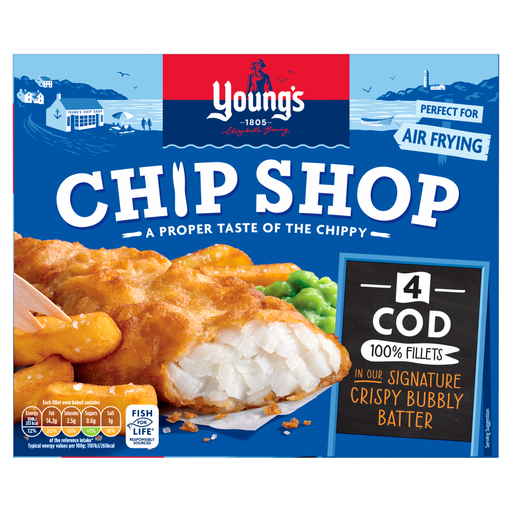 Image unavailable
A four-fillet pack lets you choose how many to cook, but a whole fillet is not automatically a toddler serving. Contains fish, wheat and mustard; follow the pack’s cooking instructions, then inspect and adapt the serving for the child.
No: the cited packs contain nine or ten fingers, and their nutrition references cover two, three or four fingers rather than prescribing a toddler portion. Choose how many to cook for the child and meal; follow the pack’s storage instructions for pieces left frozen.
These products contain fish, and several breadcrumbed examples also contain wheat. Even a gluten-free fish finger can contain fish, so check the current ingredients and allergen statement for the exact pack before serving.
Cook them according to the pack instructions, inspect the fish for bones and adapt its size and texture to the child. NHS guidance advises upright seating and supervision while young children eat.
No. The cited omega-3-labelled fingers use pollock or haddock, which NHS guidance identifies as white fish rather than oily fish. Check the specific product’s nutrition panel for its stated values.
Compare products using the same basis, particularly their per-100g values, and check what any per-portion figure represents. NHS guidance says pre-packed food labels provide figures including fat, saturates and salt, generally per 100g and sometimes per portion.