What should the canteen check?
Start with the claim the menu needs, then compare individual packs and confirm that staff can prepare and serve each product as intended.
| Priority | What to check | Your needs |
|---|
| Fat claim |
Check the exact wording on the current pack. The low-fat claim condition published on legislation.gov.uk sets a limit of 3 g fat per 100 g for solid foods. A reduced-fat claim calls for a comparison; do not treat it as the same claim as low fat. |
I need to know whether a meal meets the menu’s specified claim, not just whether its name sounds lighter. |
| Nutrition and portion |
Compare total fat, saturated fat, energy and salt on the same per-100g basis, then check the totals for the portion to be served. Food Standards Agency guidance explains that traffic-light labels, where present, show levels of fat, saturated fat, sugars and salt. |
A smaller serving may change the figures per portion. I want to compare both the food and the lunch portion. |
| Meal choice |
Check whether each candidate is a complete meal or a component, its portion size and its preparation method. Category and range labels are starting points, not product-level fat declarations. |
We need enough choice for a rotating lunch menu without assuming every dish in a range meets the same specification. |
| Allergens |
Keep the current ingredients and allergen information linked to each product. The Food Standards Agency says UK retail and catering food businesses must provide allergen information for prepacked and non-prepacked food and drink. |
If a meal is served without its retail pack, I still need staff to give diners accurate information about that product. |
| Preparation |
Check the product’s cooking directions and the canteen’s equipment and service procedure. Food Standards Agency reheating guidance says to reheat thoroughly to a safe temperature at the centre, reheat only once and reheat properly before hot holding. |
Can staff prepare the intended number of portions according to the pack instructions before service? |
Retailer and range references
These categories and ranges can help locate candidates, but their names do not confirm that an individual frozen meal is reduced fat.
Tesco
Tesco lists frozen ready meals in categories including family meals, free-from, vegetarian and vegan options, and Under 500cal Meals.
- Several browse routes can help a canteen look for menu variety.
- An under-500-calorie category does not establish a low-fat or reduced-fat claim for each meal; check individual labels.
M&S Count On Us
M&S describes Count On Us dishes as calorie controlled and lists formats including cottage pie, fish dishes, pasta and curries.
- The range offers familiar dish formats to consider for a lunch menu.
- The range description does not establish that a particular dish is frozen or reduced fat; check the individual product.
Iceland Slimming World
Iceland describes this frozen range as including ready meals and lunch bowls.
- The listed formats give buyers meal and lunch-bowl options to examine.
- The range name does not establish an individual meal’s fat values, allergens or preparation requirements.
Iceland MyProtein
Iceland presents MyProtein ready meals as products that can be cooked from frozen and describes the range as high protein.
- The frozen format is relevant where a canteen plans meals around freezer storage.
- Protein positioning does not establish low or reduced fat; check the individual meal’s nutrition and cooking directions.
Waitrose
Waitrose has a frozen ready-meal category and a separate healthier-ready-meals browse category.
- The frozen category provides a route to examine meals for this setting.
- A category name does not verify reduced-fat status for a specific frozen product.
Joybuy product options
This option is a chicken burger that could form part of a frozen canteen lunch, rather than a complete meal. Check the current pack before using it for a reduced-fat menu description.
 No image available
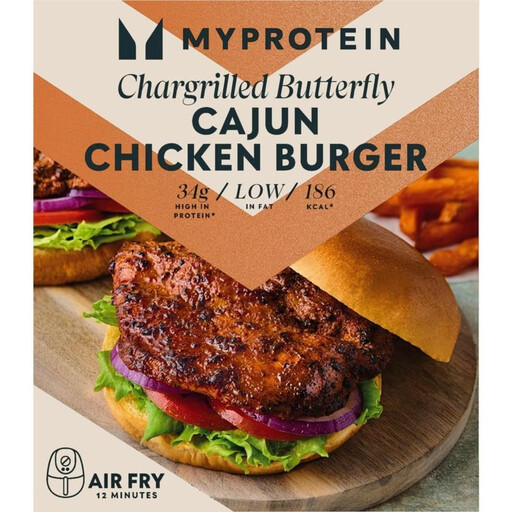
Myprotein Chargrilled Butterfly Cajun Chicken Burgers, 2 pack, 300g
For a canteen considering a chicken burger as part of a frozen lunch, compare the current pack’s fat declaration with the menu specification and confirm the cooking directions before service. This is not a complete meal. The product information identifies wheat as an allergen and warns that some bones may remain; retain the current pack information for staff and diners.
Joybuy
Common questions
Does a calorie-controlled frozen meal count as reduced fat?
No. A calorie-controlled description alone does not establish a reduced-fat claim. Check the individual pack’s claim and fat declaration; the low-fat claim condition published on legislation.gov.uk sets a separate limit of no more than 3 g fat per 100 g for solid foods.
What nutrition information should a canteen compare?
Compare fat, saturated fat, energy and salt per 100 g, then check the figures for the portion you intend to serve. Review portion weight, ingredients, allergens and cooking directions as well; a smaller portion can change per-serving totals without changing the per-100g values.
Does a workplace canteen need allergen information for meals it serves?
Yes. The Food Standards Agency says UK retail and catering food businesses must provide allergen information for both prepacked and non-prepacked food and drink. Keep current product information available to staff when the retail pack is no longer visible to diners.
Can reheated frozen meals go straight into hot holding?
Only after they have been properly reheated under the product instructions and the canteen’s procedures. Food Standards Agency guidance says to reheat thoroughly to a safe temperature at the centre, reheat only once and not put food into hot holding without proper reheating.
Is a retailer’s lighter-meal range name enough to approve a product?
No. Tesco’s Under 500cal Meals category, M&S Count On Us and Iceland’s frozen ranges can help locate candidates, but those range descriptions do not confirm that a particular product is reduced fat. Check each product’s current claim, nutrition, allergens and preparation instructions.


