Households planning fish and chips
Plain peas keep the vegetable side familiar; an unseasoned mix adds variety. Check the ingredients if you want to avoid butter, oil, cheese or sauce in the side.


Choose plain frozen peas for a familiar fish-and-chips side, or an unseasoned vegetable mix if you want more variety. If fat content is the deciding factor, compare the exact packs’ fat values per 100g on the same preparation basis; a “reduced fat” claim alone does not tell you the final fat content.
Plain peas keep the vegetable side familiar; an unseasoned mix adds variety. Check the ingredients if you want to avoid butter, oil, cheese or sauce in the side.
Fat per 100g is more useful for comparing similar packs than a claim on its own. The full nutrition panel also shows saturates and salt; GOV.UK explains that traffic-light labels indicate levels of fat, saturates, sugars and salt.
Consider the bag size alongside the other frozen parts of the meal. A pack that fits your freezer and lets you take the amount you need may be more practical than a larger bag.
Decide whether you want plain peas or a mix, then compare the exact packs and their cooking directions.
| Priority | What to check | Your needs |
|---|---|---|
| Fat content | Compare fat per 100g on the same stated basis, such as cooked as instructed. Check saturates and the ingredients as well as any front-of-pack claim. | I want to know what is in the vegetable side, rather than relying on “reduced fat” wording. |
| Vegetable choice | Check whether the pack contains only peas or a mix, and whether oil, butter, cheese or sauce appears in the ingredients. | Plain peas suit a familiar fish-and-chips plate; I might choose a mix when I want more vegetable variety. |
| Preparation | Check the exact pack’s microwave or hob directions and whether it says to cook from frozen. Follow its instructions for checking that the food is thoroughly heated. | I need a side I can cook with the equipment available while the fish and chips are being prepared. |
| Pack size and storage | Compare pack weights with your freezer space and the amount you plan to cook. Read the pack’s storage and refreezing directions. | A smaller bag may fit more easily beside the rest of the meal; a larger one may suit several meals if I have room to store it. |
A reduction is relative to a comparable food. As the nutrition-claims annex published by legislation.gov.uk makes clear, it is a different question from how much fat the product contains per 100g.
Read the nutrition table and ingredients before comparing the pack with plain vegetables.
NHS 5 A Day guidance treats potatoes differently from vegetables such as peas, carrots and sweetcorn in this context.
If you want a vegetable portion alongside fish and chips, the NHS gives three heaped tablespoons of frozen peas, carrots or sweetcorn as one portion.
Sainsbury’s states the fat value for its 910g garden peas per 100g cooked as instructed. A figure stated for a product in another condition should not automatically be treated as a like-for-like result.
Check what each pack’s per-100g value refers to before drawing a comparison, and account for anything you add during cooking.
Frozen vegetables can have product-specific cooking and storage instructions. Waitrose & Partners, for example, says its listed Birds Eye Garden Peas 375g must be cooked straight from the freezer and not eaten raw or defrosted.
Follow the directions on the bag you buy, including its storage and refreezing advice.
These examples illustrate formats and label details to compare; the figures apply to the named packs, not every product from each brand.
Garden peas are a familiar side for fish and chips. Waitrose & Partners lists a Birds Eye Garden Peas 375g pack.
Its Garden Peas 910g provide a larger plain-pea pack option.
Tesco Groceries lists Garden Peas and Petits Pois in its frozen fish-and-chips bundle.
M&S lists both Organic Garden Peas 500g and British Vegetable Medley 1kg.
Its Essential Frozen British Garden Peas come in a 1.25kg pack.
These Joybuy options include plain peas and mixed vegetables for a fish-and-chips side. Use the exact pack label to compare nutrition values and cooking directions.
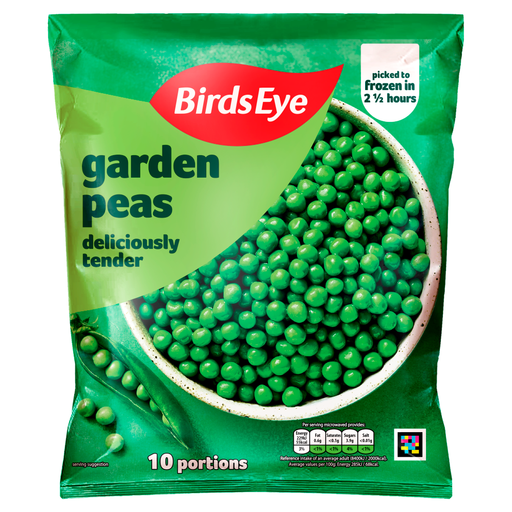 Image unavailable
A plain pea option for a familiar fish-and-chips side. Check this 800g pack’s nutrition basis and cooking directions when comparing it with other peas.
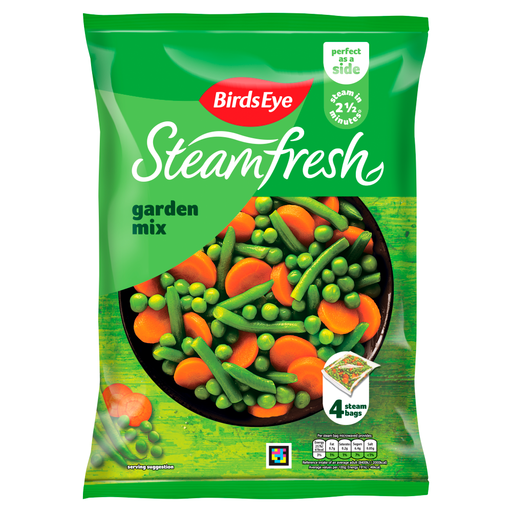 Image unavailable
A mixed-vegetable choice in steam bags if you prefer variety to plain peas. Check the ingredients and the cooking instructions on this 540g four-pack.
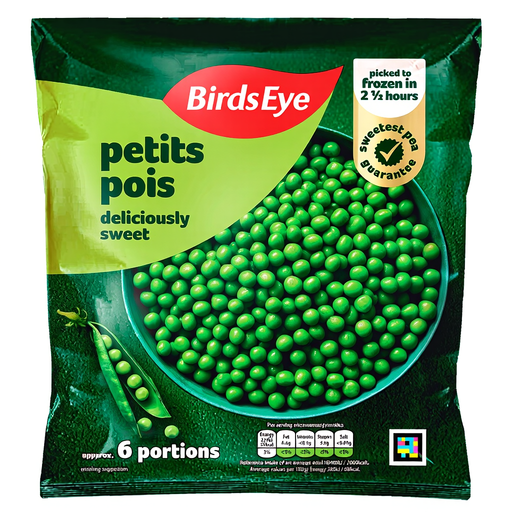 Image unavailable
Another plain-pea choice for a traditional side, in a 545g pack. Compare its on-pack fat value and stated preparation basis with the garden peas if those details decide your choice.
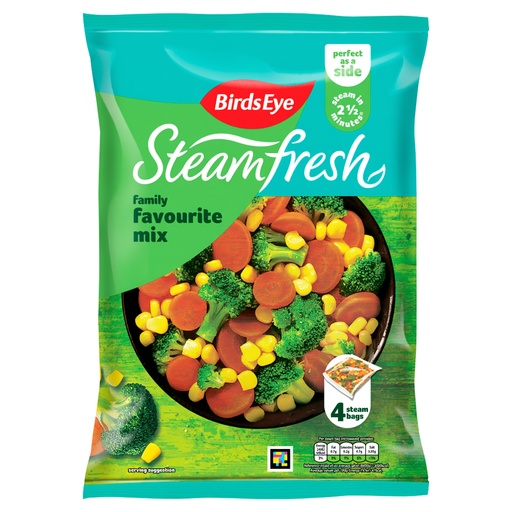 Image unavailable
A steam-bag vegetable mix for a meal where you want a side other than plain peas. Read this variant’s ingredients and preparation directions before choosing it.
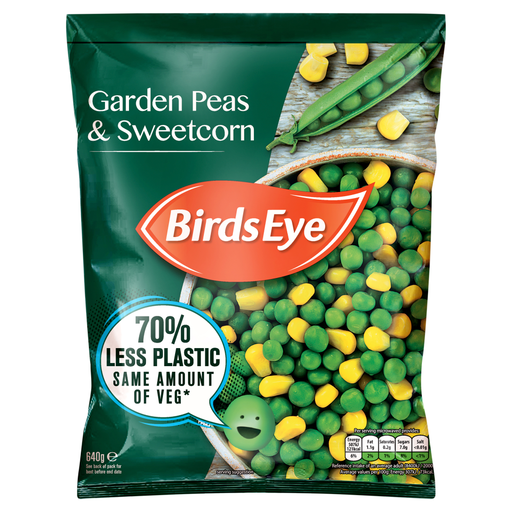 Image unavailable
This 640g mix keeps peas in the side while adding sweetcorn. If you are comparing fat content, use the value and preparation basis printed on this pack.
No. “Reduced fat” compares a product with a similar one; it does not, by itself, state a low absolute fat content. Check fat per 100g and the ingredients, comparing packs on the same preparation basis.
The NHS gives three heaped tablespoons of frozen peas, carrots or sweetcorn as one portion. Potatoes do not count towards 5 A Day in this context, so chips do not replace the vegetable side.
Follow the directions for the exact pack rather than assuming defrosting makes the peas ready to eat. Waitrose & Partners says its listed Birds Eye Garden Peas 375g must be cooked straight from frozen and must not be eaten raw or defrosted.
Read the ingredients and allergen information on the pack you are buying. Check its preparation directions too, particularly if you are comparing an unseasoned vegetable product with a side containing sauce or other additions.