World-food-night hosts comparing fat
If frozen pizza is part of the meal, compare total and saturated fat on the packs rather than treating a familiar brand or thin base as a nutrition shortcut.


Compare total fat and saturated fat per 100g on the exact frozen pizzas you are considering, then check the figures for the amount you expect to serve. A thin crust or a “reduced fat” claim does not, by itself, establish that a pizza is low fat: the NHS defines low total fat on food labels as 3g or less per 100g.
If frozen pizza is part of the meal, compare total and saturated fat on the packs rather than treating a familiar brand or thin base as a nutrition shortcut.
Use per-100g figures to compare pizzas of different sizes, then check the values for the portion you plan to serve.
Check the current ingredient and allergen information on every pizza you plan to serve. Goodfella's advises shoppers to check its packaging because product information can change.
Start with the claim and per-100g figures, then check the portion and serving details for the exact pizza. The survey figures below describe general food shoppers interviewed in Northern Ireland, not demand for frozen pizza.
| Priority | What to check | Your needs |
|---|---|---|
| Fat claims | Read the wording alongside total fat per 100g. The NHS describes 3g or less per 100g as low total fat; “reduced fat” does not by itself show that a pizza meets that level. | I want to know what a pack claim tells me before choosing. In the Food Standards Agency and Ipsos Northern Ireland's 2024 survey of 611 people, conducted from September to November, 35% named nutritional claims on the back of packaging as their primary source of nutritional information. |
| Nutrition comparison | Compare total fat and saturated fat per 100g on the exact packs. Where traffic-light labels appear, use their colours alongside the numerical values, not instead of them. | At the freezer, I want to compare pizzas on the same basis. In that Northern Ireland survey, 92% recognised traffic-light labelling, while approximately 49% actively used it when shopping for food; recognition and use were different measures. |
| Portion | Check whether the stated serving is a slice, part of a pizza or the whole pizza. Compare its fat and saturated-fat values with the amount you expect to serve. | If I plan to serve more than the labelled portion, I need figures that reflect that amount rather than the smaller serving alone. |
| Crust and toppings | Use descriptions such as thin crust, deep dish or stuffed crust to identify the pizza you want, then compare the nutrition panels. Check the exact ingredients rather than assuming a vegetable topping or thin base means less fat. | I want a flavour that fits the evening without letting the style of the pizza stand in for its fat figures. |
| Guests and preparation | Read the current allergen, storage and cooking instructions for each product. Check any dips or additions separately; their contents are not part of the pizza's nutrition panel. | When serving guests, I need to check whether each pizza suits them and how to prepare it as directed on its pack. |
Reduced-fat wording makes a comparison; it does not establish that the pizza meets an absolute low-fat level.
If low total fat is your criterion, check for no more than 3g per 100g on the nutrition panel, in line with NHS food-label guidance.
A portion figure may describe less pizza than you intend to serve, making it unsuitable as the sole basis for comparing your meal.
Compare products per 100g first, then use the pack's portion or whole-pizza figures for the amount you plan to eat.
A thin-crust description does not tell you the finished pizza's fat content. Dr. Oetker UK, for example, lists 7.8g total fat per 100g for Ristorante Pollo.
Shortlist the styles you like, then compare total fat and saturated fat on each exact product.
The pizza's nutrition figures do not include extra cheese, dips or sides added when serving.
Check those items separately if you are comparing the fat content of the whole meal.
These examples help identify products and formats to compare; a brand or crust style does not establish that an individual pizza is low fat.
Its Stonebaked Thin Margherita is one thin-base option to consider for a pizza-centred meal.
Ristorante Pollo provides a product-specific example of why its nutrition figures matter more than its thin-and-crispy style.
Chicago Town products include different crust and topping formats for shoppers choosing a style of pizza.
Its frozen-pizza category offers own-label products alongside branded pizzas for product-by-product comparison.
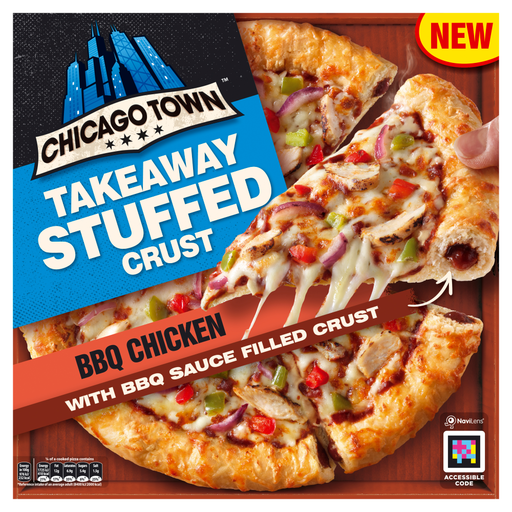
This stuffed-crust frozen pizza is an option for a world food night. Check its current nutrition panel if lower total or saturated fat is part of your choice; its name alone cannot settle that comparison.
 No image available
For a world food night, this frozen BBQ chicken pizza offers a stuffed crust filled with BBQ sauce. Compare the current pack's total fat and saturated fat per 100g, and check its allergen and cooking instructions before serving. Pack size: 668g.
No. Reduced-fat wording makes a comparison, while the NHS describes 3g or less total fat per 100g as low on food labels. Check the exact pizza's per-100g figure rather than treating the claim as proof that it is low fat.
Start with total fat and saturated fat per 100g so that different pack sizes are on the same basis, then check the amount you expect to eat. NHS food-label guidance describes more than 17.5g total fat per 100g as high, and describes saturated fat as low at 1.5g or less and high at more than 5g per 100g.
No. Thin crust describes a pizza style, not its complete nutrition profile. Compare the exact products' per-100g panels, including their total and saturated fat, before choosing between thin, deep-dish or stuffed-crust pizzas.
Check the current ingredient and allergen information on every pizza you intend to serve. Do not rely on the crust style, topping name or an older product description; Goodfella's specifically advises checking its packaging for possible changes to product information.
Follow the storage and cooking directions on the exact pack. Dr. Oetker UK and Chicago Town instruct shoppers to keep their referenced pizzas frozen until cooking and ensure they are thoroughly cooked; Goodfella's says not to refreeze its referenced pizza after defrosting.