What should you check?
Start with whether you need food or drink before this run, then compare a realistic portion and the ingredients in the particular smoothie.
| Priority | What to check | Your needs |
|---|
| Need for a drink |
Consider when you last ate and how demanding the session will be. UK Sports Institute says a sports drink is probably unnecessary for a parkrun after a carbohydrate-based breakfast; the British Dietetic Association says ordinary meals can meet general-fitness carbohydrate needs. |
If I have eaten breakfast, water may be all I want for a usual 5k. If I have missed a meal, a drinkable carbohydrate option may be more convenient. |
| Carbohydrate and portion |
Compare the same serving basis rather than bottle totals. Tesco Groceries lists 18g carbohydrate per 150ml for its 750ml Innocent Mangoes, Apples & Passion Fruits listing, with five servings per bottle. |
I want to know what my chosen portion contributes, not assume that a multi-serving bottle is one pre-run drink. |
| Sugars |
Read total sugars alongside any no-added-sugar wording. The NHS counts sugars naturally present in smoothies as free sugars; a no-added-sugar description does not mean zero sugar. |
A fruit-flavoured drink may appeal to me, but I still want to know how much sugar the portion contains. |
| Timing and ingredients |
Check the exact recipe for fibre, seeds or additions such as guarana, and try unfamiliar drinks during training. UK Sports Institute says most athletes eat one to three hours before running, although timing varies between individuals. |
If I am running soon after getting up, I need a timing and portion choice that I have found manageable. |
| After the run |
If another demanding session follows soon, consider what the rest of your food and drink will provide. Check protein as well as carbohydrate rather than assuming every fruit smoothie has the same composition. |
I may want a smoothie as part of what I have after a run, without treating the drink alone as a complete meal. |
| Label and storage |
Read the current ingredients and allergen declaration for the precise variant. Check whether it needs refrigeration and how long the opened bottle can be kept; Marks & Spencer specifies refrigerated storage for its Mango, Pineapple and Passion Fruit Smoothie. |
If I am buying ahead or avoiding an ingredient, I need the instructions and declaration on the bottle I will use. |
Brand and range references
These examples show why the exact product label matters; a brand name alone does not establish a smoothie’s ingredients or nutrition.
Innocent
Its listed fruit smoothies include different bottle sizes and recipes, including the Berry Energise variant.
- Tesco Groceries lists 18g carbohydrate and 15g sugars per 150ml for Innocent Mangoes, Apples & Passion Fruits.
- Waitrose & Partners lists guarana and flax seeds in Berry Energise; figures and ingredients from one variant should not be applied to another.
Tesco
Tesco’s grocery listing includes an own-label Strawberry Sensation Smoothie alongside branded smoothies.
- The listed 750ml format gives shoppers a bottle size to compare with other products.
- Check the current nutrition panel for the exact own-label variant rather than borrowing values from a branded smoothie in the same listing.
M&S
Its Mango, Pineapple and Passion Fruit Smoothie has a product-specific nutrition panel from Marks & Spencer.
- The listing states 13.5g carbohydrate, 12.9g sugars, 0.6g protein and 0.7g fibre per 100g.
- Those values are given by weight, not per 150ml; the listing also specifies refrigerated storage.
Naked
Tesco Groceries lists a Naked Protein Machine Supercharged Smoothie Strawberry Raspberry 750ml.
- Its distinct product name makes it possible to identify the variant when checking a bottle.
- Do not infer a protein amount or suitability around a run from the word ‘Protein’ in the name; read the exact nutrition and ingredient label.
Smoothie option at Joybuy
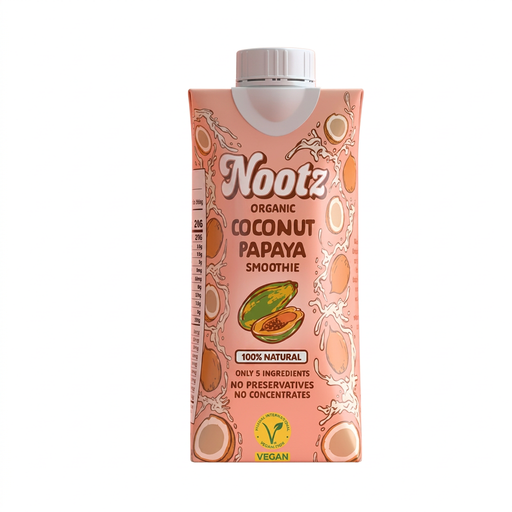
This papaya and coconut milk smoothie is a drinkable option to consider when you have missed breakfast before a 5k. Check its nutrition label and choose a portion that fits your plans rather than assuming the whole bottle is needed.
 No image available
Nootz Coconut Milk Smoothie Papaya 180ml
This 180ml papaya and coconut milk smoothie provides a drinkable option if you have missed breakfast. Check the current label for carbohydrate, sugars, ingredients and the amount you plan to drink before a run.
View at Joybuy
Questions about smoothies and 5k runs
Do I need a fruit smoothie to fuel a 5k?
Not necessarily if you have eaten a carbohydrate-based breakfast. UK Sports Institute guidance for parkrun says a sports drink is probably unnecessary after that kind of breakfast, while the British Dietetic Association says ordinary meals can meet general-fitness carbohydrate needs. A smoothie may be a convenient option if you have missed a meal and prefer a drink.
Does ‘no added sugar’ mean a smoothie contains no sugar?
No. The NHS says sugars naturally present in smoothies count as free sugars. Read the sugars and carbohydrate figures for the exact product rather than interpreting a no-added-sugar claim as zero sugar.
Should I drink the whole bottle before a run?
Check the labelled serving size first. Tesco Groceries lists five 150ml servings in its 750ml Innocent Mangoes, Apples & Passion Fruits bottle, so the whole bottle contains considerably more than one labelled serving. Try your chosen portion during training.
When should I try a smoothie before running?
Try it during ordinary training so you can judge the timing for yourself. UK Sports Institute says most athletes eat one to three hours before running, but individual timing varies; University College London Hospitals NHS Foundation Trust discusses a snack 60–90 minutes before exercise when a meal was not eaten two to three hours beforehand.
What if I use medication that lowers blood glucose?
Use an individual exercise plan rather than a general smoothie recommendation. Diabetes UK notes that exercise can raise or lower blood glucose depending on the activity and individual circumstances, and advises people using insulin or other glucose-lowering medicines to check levels around activity and plan with their healthcare team.


