First-shop buyers choosing a convenient fruit drink
If you want a ready-to-drink smoothie with a meal, bottle size matters: the NHS advises a combined limit of 150ml a day for fruit juice and smoothies.


Choose a fruit smoothie by its ingredients, sugars per 100ml and the portion you intend to drink, rather than treating “no added sugar” as sugar-free. The NHS advises limiting fruit juice and smoothies together to 150ml a day and having them with a meal; check ingredients and allergens if you are considering a breakfast-style blend.
If you want a ready-to-drink smoothie with a meal, bottle size matters: the NHS advises a combined limit of 150ml a day for fruit juice and smoothies.
“No added sugar” does not mean a smoothie contains no sugar. Compare the sugars figure on the nutrition panel as well as the wording on the front of the bottle.
If oats, yoghurt or other added ingredients appeal to you, check the exact product’s ingredients and suitability statement. Marks & Spencer states that its Revitalise Super Smoothie is not suitable for coeliacs or people with a wheat allergy.
Start with the label claim and the amount you plan to drink, then compare ingredients and dietary suitability for the particular bottle.
| Priority | What to check | Your needs |
|---|---|---|
| Sugar wording | Distinguish “no added sugar” from “sugar-free”. Compare sugars per 100ml and read the ingredients list. | I want to avoid added sugar without assuming the drink contains no sugar. Waitrose & Partners lists 9.6g sugars per 100ml for an innocent Fruit + Veg smoothie described as having no added sugar. |
| Portion size | Check bottle volume against the amount you intend to pour. The NHS advises limiting fruit juice and smoothies together to 150ml a day and having them with a meal. | A larger bottle could cover more than one serving for me; I need to plan how much I will drink at a time. |
| Fruit and vegetable ingredients | Read the ingredient list and any stated vegetable proportion. Compare nutrition on the same per-100ml or per-serving basis. | I would like vegetables in the blend, but I still want to know its sugar content. Waitrose & Partners lists 25% vegetables in its innocent Fruit + Veg smoothie, alongside 9.6g sugars per 100ml. |
| Breakfast ingredients | Check oats, yoghurt and other additions, the nutrition panel, and the exact allergen and suitability statements. | If I choose a breakfast-style smoothie, its ingredients must fit my diet. Marks & Spencer says its Revitalise Super Smoothie is unsuitable for coeliacs and people with a wheat allergy. |
| Storage | Check whether the bottle needs refrigeration and follow its instructions after opening. | If I will not finish the bottle at once, I need to be able to store the remainder as its label directs. |
Sugars from fruit and vegetables can still appear on the nutrition panel. Waitrose & Partners lists 9.6g sugars per 100ml for its no-added-sugar innocent Fruit + Veg smoothie.
Read the exact claim, then compare the sugars figure per 100ml and the volume you expect to drink.
A bottle can be larger than the NHS combined daily guide of 150ml for fruit juice and smoothies.
Check the volume before buying. If you plan to split a bottle, follow its storage and opened-pack instructions.
Added ingredients can change whether a particular smoothie suits your diet. Marks & Spencer states that its Revitalise Super Smoothie is not suitable for coeliacs or people with a wheat allergy.
Check the ingredients, allergens and suitability statement for the exact variant, not just its flavour or product-range name.
The NHS advises limiting fruit juice and smoothies together to 150ml a day and having them with a meal.
Decide when you will have the smoothie and portion it accordingly, rather than sipping from a larger bottle throughout the day.
These references can help you compare labels and formats; the details of one product do not apply to every smoothie in a range.
Fruit smoothies and fruit-and-vegetable blends.
A retailer listing own-label and branded smoothies in different pack sizes.
Fruit blends and breakfast-style smoothies, including products with oats.
A retailer with product-specific smoothie ingredient and nutrition information.
Smoothies including Fibre Machine and Protein Machine variants.
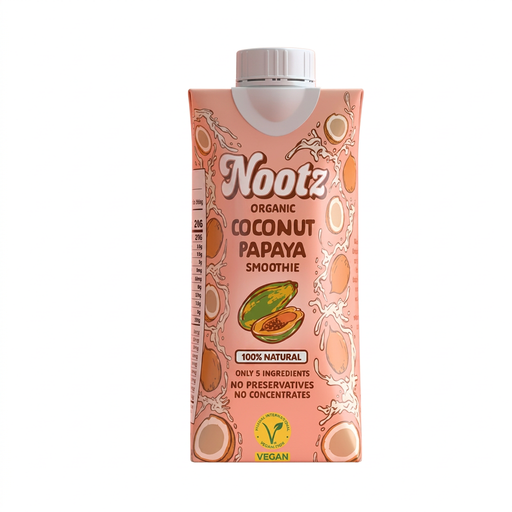
This coconut milk and papaya smoothie is an option to assess by its ingredients and bottle size when planning a first food shop.
 No image available
A ready-to-drink coconut milk and papaya smoothie for a fruit-flavoured choice. Its listed ingredients include cane sugar, so it is not a no-added-sugar option; check the pack’s allergen information if dietary suitability matters to you. The 180ml bottle exceeds the NHS combined 150ml daily guide for fruit juice and smoothies, so plan the portion accordingly.
No. A smoothie can contain sugars from its fruit and vegetables even when no sugar has been added. Waitrose & Partners lists 9.6g sugars per 100ml for its no-added-sugar innocent Fruit + Veg smoothie, so check the nutrition panel rather than treating the two claims as equivalent.
The NHS advises limiting fruit juice and smoothies together to one small glass of 150ml a day and having it with a meal. Check the bottle volume before buying, especially if you intend to drink it in one sitting.
Check the exact ingredients, allergens, sugars figure and bottle size rather than relying on a breakfast-style name. Marks & Spencer states that its Revitalise Super Smoothie is not suitable for coeliacs or people with a wheat allergy.
Follow that bottle’s refrigeration and after-opening instructions if you plan to drink it in portions. Check those directions before buying so they fit when you expect to finish it.