Commuters having breakfast on the go
A portable bottle is convenient, but its full contents may exceed the NHS guidance of 150ml of smoothie a day. Check the pack size if you plan to drink it with breakfast.


A fruit smoothie can be a measured drink with a weekday breakfast, but neither a no-added-sugar label nor a protein label makes it sugar-free. The NHS advises limiting fruit juice and smoothies to 150ml a day and having them with a meal; compare the sugars, protein and fibre for the serving you intend to drink.
A portable bottle is convenient, but its full contents may exceed the NHS guidance of 150ml of smoothie a day. Check the pack size if you plan to drink it with breakfast.
A no-added-sugar label does not mean zero total sugars. Read the nutrition panel rather than relying on the claim on the front of the bottle.
If protein matters to your breakfast choice, compare the amount per stated serving alongside sugars, fibre and serving size.
Start with the amount you intend to drink, then compare the nutrition information on that basis rather than treating a bottle or a front-of-pack claim as a serving.
| Priority | What to check | Your needs |
|---|---|---|
| Portion size | Compare pack volume with the NHS guidance of no more than 150ml of fruit juice or smoothie a day, taken with a meal. Check whether the label gives nutrition per 100ml or per serving. | I want a drink I can take to work without assuming that the whole bottle is one daily portion. |
| Sugars | Read the ingredients and the 'of which sugars' figure. Compare products on the same volume basis; a no-added-sugar claim does not establish zero total sugars. Diabetes UK explains that sugars in smoothies contribute to free-sugar intake. | If zero total sugar is essential to my choice, a no-added-sugar fruit smoothie does not meet that requirement simply because of its label. |
| Protein and fibre | Check both figures for the stated serving, alongside sugars. Tesco Groceries lists 10g protein, 0g fibre and 21g sugars per 300ml serving of Naked Pineapple & Mango Protein Machine. | I care about the stated protein amount, but I also want to know what else is in the portion I would actually drink. |
| Pack and storage | Check the volume, refrigeration instructions and time allowed after opening. Tesco Groceries says its 750ml Mango Passion Fruit Smoothie should be consumed within three days of opening. | A larger bottle works for my weekdays only if I can portion it and use the remainder as directed. |
The claim does not remove sugars naturally present in fruit. Diabetes UK notes that sugars in smoothies count towards free-sugar intake.
Check the 'of which sugars' figure on the exact product. If zero total sugar is a firm requirement, do not choose a smoothie on the strength of a no-added-sugar claim.
Even a portable 250ml bottle is larger than the NHS guidance of no more than 150ml of fruit juice or smoothie a day.
Check the bottle volume and measure a 150ml portion if following that guidance. Store any remainder according to its label.
Tesco Groceries lists 10g protein, 21g sugars and 0g fibre per 300ml serving of Naked Pineapple & Mango Protein Machine. Its protein content alone does not describe the whole serving.
Compare protein, sugars and fibre on the same serving basis, then check how much you intend to drink.
These range examples help identify different pack formats and labels; check the exact variant before applying a figure to another bottle.
Tesco Groceries lists an Innocent Mangoes, Passionfruits & Apples smoothie in a 250ml bottle.
Tesco Groceries lists its Mango Passion Fruit Smoothie in a 750ml bottle.
Naked includes a Protein Machine smoothie for shoppers comparing stated protein amounts.
The Waitrose & Partners smoothie listing includes own-brand mango and passionfruit and strawberry and banana options in 750ml bottles.
Marks & Spencer lists fruit smoothies in 350ml and 750ml bottles, as well as blends made with yoghurt, dates and oats.
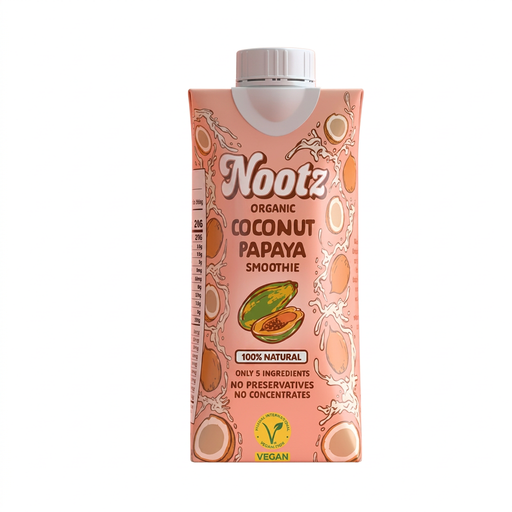
This papaya and coconut milk smoothie is an option to consider if you want a small ready-to-drink bottle. Its 180ml pack still needs portioning if you are following the NHS 150ml daily smoothie guidance.
 No image available
The 180ml bottle offers a papaya and coconut milk smoothie for a weekday breakfast. A full bottle exceeds the NHS 150ml daily guidance for smoothies; check the label's sugars and serving information when deciding how much to pour.
No. A no-added-sugar claim does not mean zero total sugars: Tesco Groceries notes that its Innocent Mangoes, Passionfruits & Apples smoothie contains naturally occurring sugars from fruit and vegetables. Check the 'of which sugars' figure on the bottle.
The NHS advises limiting fruit juice and smoothies to no more than one small glass, 150ml, a day and having them with a meal. Check the pack volume before treating a whole bottle as a portion.
No. Tesco Groceries lists 10g protein and 21g sugars per 300ml serving of Naked Pineapple & Mango Protein Machine. Compare both figures for the serving you plan to drink rather than judging it by the protein wording alone.
Diabetes UK explains that sugar in whole fruit does not count towards free-sugar intake in the same way as sugar in fruit juice or a smoothie. If that distinction matters to your breakfast choice, consider whole fruit alongside a drink rather than assuming a smoothie is equivalent.
Check its portion size and storage instructions. Tesco Groceries says its 750ml Mango Passion Fruit Smoothie should be consumed within three days of opening; follow the instructions on the exact bottle you buy.