Budget-focused smoothie shoppers
You want a chilled fruit smoothie and need to compare bottle sizes and what each recipe contains, rather than choosing by branding alone.


For a budget fruit-smoothie shop, compare bottle size, ingredients and the nutrition table rather than assuming “no added sugar” means sugar free. A lower-natural-sugar label and an added-fibre ingredient address different priorities; neither makes a smoothie sugar free. The NHS advises limiting fruit juice and smoothies to a combined 150ml a day, so portion larger bottles.
You want a chilled fruit smoothie and need to compare bottle sizes and what each recipe contains, rather than choosing by branding alone.
You want to distinguish a no-added-sugar claim from a lower-natural-sugar claim and check how much sugar a serving contains.
You want to use a smoothie as a measured fruit-and-vegetable portion rather than treat a large bottle as one drink.
Start with the label claim that matters to you, then check the ingredients, nutrition table and bottle volume before deciding how much to pour.
| Priority | What to check | Your needs |
|---|---|---|
| Sugar wording | Check whether the label says “no added sugar” or makes a specific lower-natural-sugar comparison. Read the sugars figure in the nutrition table and its serving basis. | I want to understand the sugar in the drink, not mistake “no added sugar” for sugar free. The Food Standards Agency notes that a no-added-sugar claim on a food with naturally present sugars must be accompanied by an indication that it contains naturally occurring sugars. |
| Bottle size | Compare the labelled volumes and the number of portions you intend to pour. A 750ml bottle contains five 150ml quantities. | A bottle that I can divide into planned servings may suit my shop better than one I would drink all at once. |
| Fibre | Check the ingredients and fibre figure for the particular smoothie. Sainsbury’s lists chicory root fibre in its Mango & Passionfruit smoothie; Tesco lists 4.2g of fibre per serving for Naked Fibre Machine. | If fibre is a priority for me, I want a figure for the product I am choosing rather than assuming every fruit smoothie has the same formulation. |
| Portioning | The NHS advises limiting fruit juice and smoothies to a combined 150ml a day, counted as one 5 A Day portion. Check the pack’s storage instructions for the remainder. | I want to pour a measured portion instead of treating a full large bottle as one serving. |
Fruit smoothies can contain naturally occurring sugars even when no sugar has been added, so the two descriptions do not mean the same thing.
Read the qualifying wording and compare the sugars line and serving size on the current pack.
The NHS advises a combined limit of 150ml a day for fruit juice and smoothies; a 750ml bottle contains more than one such portion.
Pour a measured serving and follow the pack’s instructions for storing the remainder.
Recipes differ: the listed Sainsbury’s Mango & Passionfruit smoothie contains chicory root fibre, while the M&S Revitalise Super Smoothie is described as containing oats and linseed.
Check the current ingredients, allergen information and nutrition table for the exact product you intend to buy.
These examples show why the exact recipe and label matter more than a brand name on its own.
Tesco describes its Mango Passion Fruit Smoothie as a pasteurised blend of fruit juices and purées.
Sainsbury’s lists chicory root fibre among the ingredients of its 750ml Mango & Passionfruit Smoothie.
innocent describes its smoothies as having no added sugar; a separate Tropical Light product is listed by Waitrose as 30% lower in natural sugar.
Tesco lists Naked Fibre Machine as containing added chicory root fibre, apple cider vinegar and vitamins.
M&S lists fruit smoothies, including a Revitalise Super Smoothie described as containing oats and linseed.
Waitrose lists a range of smoothies, including innocent Tropical Light Super Smoothie.
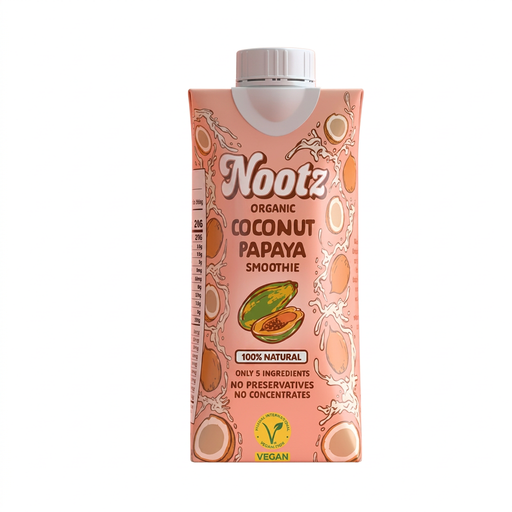
This coconut milk and papaya smoothie is an option to consider if a smaller bottle suits your portion plan. Check its current ingredients and nutrition label against your sugar priorities.
 No image available
The 180ml bottle offers a defined quantity for portion planning. The product information mentions cane sugar, so check the current ingredients and sugars figure if avoiding added sugar. The NHS advises limiting fruit juice and smoothies to a combined 150ml a day; do not assume the full bottle is one recommended portion.
No. Fruit smoothies can contain naturally occurring sugars without added sugar. The Food Standards Agency notes that, where sugars are naturally present, a no-added-sugar claim must be accompanied by an indication that the food contains naturally occurring sugars. Check the sugars figure and serving size on the nutrition label.
The NHS counts 150ml of fruit or vegetable juice or smoothie as one portion and advises limiting juice and smoothies to a combined 150ml a day. Measure out a portion rather than treating a 750ml bottle as a single serving.
Yes, check the current pack for the exact product, particularly if you avoid an ingredient such as oats, seeds or a particular fruit. Smoothie recipes differ, so a brand name alone does not tell you what is in every bottle.