Students setting up a tea cupboard
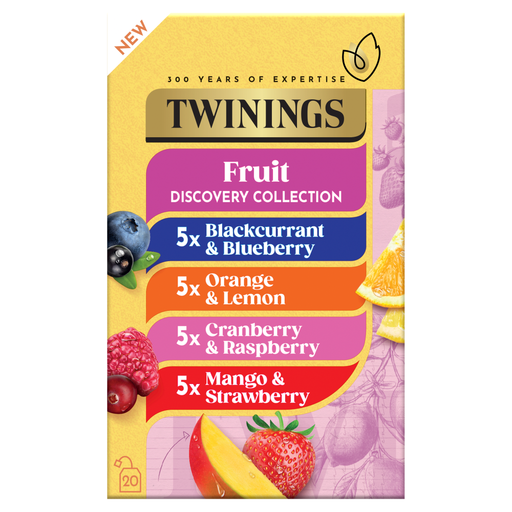
A small mixed box lets you try several flavours without finding room for a full box of each one. Twinings’ Fruit Discovery Collection, for example, contains 20 individually wrapped envelopes across four blends.


For a student moving in who wants to try fruit flavours without storing several boxes, a small mixed selection of tea bags is a practical starting point. Choose a tea jar if reusable storage is the point of the purchase; choose a jarred fruit concentrate only if you want that different kind of drink, and check its ingredients and nutrition panel.
The useful starting point is whether you want a cup-by-cup infusion, a place to store tea or a sweetened drink made from a jar.
A small mixed box lets you try several flavours without finding room for a full box of each one. Twinings’ Fruit Discovery Collection, for example, contains 20 individually wrapped envelopes across four blends.
Check the exact blend rather than relying on the words ‘fruit tea’. Twinings Strawberry & Elderflower, Clipper Berry Burst, Pukka Elderberry & Echinacea and Teapigs Super Fruit are each described by their manufacturers as naturally caffeine-free.
Decide whether ‘jar’ means storage for tea or a fruit-based concentrate. A filled tea jar can contain envelopes, while a concentrate has its own ingredients, preparation and nutrition information.
Choose the drink format first. Then compare pack size, ingredients and preparation details for the exact product you plan to buy.
Choose when: You want to make one cup at a time and try fruit flavours without buying several full boxes.
Bear in mind: A mixed box can contain different botanicals in each blend, so check each ingredient list.
Choose when: You specifically want a reusable container for tea in your room or shared kitchen.
Bear in mind: A filled jar does not necessarily contain fruit tea; check its contents and size before ordering.
Choose when: You want a sweet fruit drink made from a jar rather than a dried infusion bag.
Bear in mind: Ingredients and nutrition differ by product. Longdan lists 57.6 g sugars per 100 g for its K EATS Jujube Tea jar.
| Priority | What to check | Your needs |
|---|---|---|
| Pack and flavours | Compare the number of bags or envelopes and the flavours included. Check whether a filled jar contains the blends you want. | I would rather try a few flavours than make room for several boxes before I know what I like. |
| Drink format | Check whether the product is a brewable tea bag, an empty or filled storage jar, or a fruit concentrate. Read its preparation directions. | For a quick cup in a shared kitchen, I want to know exactly what I need to prepare it. |
| Caffeine and sugars | Look for caffeine information on the exact infusion. For concentrates, read the ingredients and nutrition panel; a per 100 g figure for concentrate is not a per-cup figure for brewed tea. | If I want a caffeine-free infusion, I need that stated for the blend I am buying. If I choose a sweetened concentrate, I want to understand what goes into the drink. |
| Ingredients | Read each blend’s current ingredient list, including botanicals and flavourings. Check the pack if an ingredient or allergen matters to you. | A fruit flavour name is not enough for me to tell whether the blend contains something I avoid, such as liquorice root. |
A storage jar and a fruit concentrate serve different purposes. Longdan lists sugar and fructose among the ingredients of its K EATS Jujube Tea jar and gives its sugar content as 57.6 g per 100 g.
Check whether you are buying tea to brew, a container to keep it in or a concentrate to prepare as a drink. Compare nutrition information using the serving basis shown on the product.
A jar may be useful for storage, but its contents still need checking. Twinings offers filled jars holding 20, 30 or 70 envelopes, as well as empty jars; its separate 20-envelope Fruit Discovery Collection contains four fruit blends.
If tasting different flavours is the main aim, compare a mixed box with the contents of a filled jar before choosing the container.
Fruit and herbal infusions can include other botanicals. Clipper lists liquorice root in Berry Burst and Lemon & Ginger, for example; a product name does not provide the full ingredient list.
Read the current pack for the exact blend. Do not use tea in place of medical care or prescribed treatment; ask a pharmacist or clinician about ingredients if you have a medication or health-related concern.
These brands offer different fruit or herbal infusion formats; check individual products rather than assuming every blend or pack has the same contents.
An option for fruit-infusion bags, mixed selections and separate glass tea-storage jars.
Offers organic fruit and herbal infusions, including Berry Burst and Lemon & Ginger.
Offers organic herbal and fruit-tea blends, including Elderberry & Echinacea.
Offers the berry-led Super Fruit infusion in a 15-tea-temple format.
This fruit-infusion selection suits a student who wants to try several flavours from one box; it is not a storage jar or a fruit concentrate.
 No image available
The 20-bag box offers four named fruit infusions to try: Cranberry & Raspberry, Mango & Strawberry, Blackcurrant & Blueberry, and St Clements. The listing directs you to infuse a bag in hot water. Three of the four blend ingredient lists include liquorice root, so check the ingredients for the flavour you choose.
No. A tea jar can be a container sold empty or filled with tea: Twinings offers both formats. A jarred fruit concentrate is a different drink product; Longdan’s K EATS Jujube Tea lists jujube ingredients, sugar and fructose.
Some named blends are described as naturally caffeine-free, but check the exact product. Their manufacturers make that statement for Twinings Strawberry & Elderflower, Clipper Berry Burst and Lemon & Ginger, Pukka Elderberry & Echinacea, and Teapigs Super Fruit.
A mug and hot water are enough for the Twinings Fruit Selection bags listed here; follow the preparation directions on the pack. A storage jar is optional and serves a different purpose.
No tea should replace medical care or prescribed treatment. If a botanical ingredient raises a concern because of pregnancy, breastfeeding, a health condition or medicines you take, check the blend and ask a pharmacist or clinician for personal advice.
Read the current pack for the exact product, particularly if an allergen or botanical matters to you. Sainsbury’s advises checking packaging because product ingredients can change.