Choose a filled jar when the presentation matters and a mixed tea assortment is acceptable: Twinings’ filled jar contains 70 individually enveloped black, green, fruit and herbal teas, not fruit infusions alone. Loose fruit tea suits a shop prepared to portion it and use a food-contact-suitable jar; individually wrapped bags suit single-serving use when protecting unopened tea from air, moisture and nearby odours matters more than displaying loose ingredients.
Who is each format for?
Start with how customers will encounter the tea: as a gift, a self-service drink or a loose infusion prepared by staff.
Gift and countertop shoppers
A filled jar gives the tea a ready-to-display container. Twinings’ 70-envelope jar is an example for a mixed-tea gift or counter display, but its black and green teas make it unsuitable when every serving must be a fruit infusion.
Single-serving fruit-infusion buyers
Individually wrapped bags make it straightforward to offer one serving at a time without opening the remaining portions. Pukka says its envelopes protect unopened tea bags from air, moisture and odours from nearby foods; check the packaging of the particular blend you choose.
Shops preparing loose fruit tea
A separate jar can show the loose ingredients, but staff also need a way to portion and infuse the tea. If the shop transfers tea into its own jars, check that the containers are suitable for food contact rather than choosing them for appearance alone.
What should you check before choosing?
Decide whether the jar will hold a ready-made assortment or loose tea, then check the contents, serving method and packaging for that choice.
| Priority |
What to check |
Your needs |
| Display format |
Check whether a filled jar contains loose tea or envelopes, and whether the assortment is exclusively fruit infusions. Twinings lists 70 mixed tea and infusion envelopes in its filled jar. |
I want a jar customers can see or give as a present, and a mixed tea selection would suit that purpose. |
| Blend contents |
Read the ingredient list and any caffeine statement for the exact blend. Teapigs lists hibiscus, berries, currants and natural flavouring in Super Fruit and describes that blend as naturally caffeine-free. |
Every serving needs to fit the fruit-infusion menu; I cannot assume that teas in an assorted jar have the same ingredients or caffeine status. |
| Portioning |
For loose tea, plan how it will be measured and infused. Teapigs gives separate Super Fruit directions for tea temples and loose tea; an enveloped serving follows a different handling process. |
Staff can prepare measured loose portions, or I would rather offer a bag that is ready to serve individually. |
| Jar suitability |
If the shop transfers loose tea into jars, check that they are suitable for food contact. Business Companion’s guidance for England and Wales points to food-contact wording or the glass-and-fork symbol on suitable packaging. |
I plan to fill the jars myself, so their suitability for storing food matters as much as their appearance. |
| Wrapped servings |
Check whether bags are individually enveloped rather than assuming all boxed bags are. Pukka says its individual envelopes protect tea bags from air, moisture and nearby-food odours. |
Customers will take one serving at a time, while the remaining tea stays packaged. |
| Packaging disposal |
Read instructions for each component. Pukka distinguishes its home-compostable tea bags from recyclable paper envelopes and tags intended for paper recycling. |
I need disposal information I can explain clearly without treating the bag, tag and envelope as the same material. |
Mistakes to avoid
-
Assuming a filled jar contains only fruit tea
Twinings’ filled jar includes black, green, fruit and herbal envelopes. Its presentation does not tell you that every serving fits a fruit-only offer.
Check the complete assortment and serving count. If the menu must contain only fruit infusions, choose the blend and a suitable jar separately.
-
Using a decorative jar for loose tea without checking it
A shop-filled jar holds food, not just a display prop. Business Companion’s guidance for England and Wales says businesses packaging food should use packaging suitable for food use.
Check the container’s food-contact marking or suitability information before transferring tea into it.
-
Giving one disposal instruction for every component
Pukka describes different routes for its tea bags, tags and envelopes. An instruction for one component should not be applied to the whole pack.
Read the chosen product’s component-level instructions and make them clear to customers where relevant.
-
Brewing every fruit infusion for the same time
Teapigs specifies at least three minutes for Super Fruit, while Clipper gives a 2–5 minute infusion range for Organic Berry Burst.
Use the chosen blend’s directions when preparing tasting samples or writing counter instructions.
Relevant brand references
These examples illustrate different jar, bag and service formats; a brand’s range should not be treated as one interchangeable fruit-tea product.
Twinings
Twinings offers empty tea-storage jars and a filled glass jar for a mixed-tea display.
- Its filled jar has a stainless-steel lid and contains 70 individually enveloped teas, according to Twinings.
- The assortment includes black and green teas as well as fruit and herbal infusions, so it is not a fruit-only jar.
Pukka
Pukka’s fruit-tea range is relevant when individually wrapped servings are more important than a display jar.
- Pukka says its individual paper sachets protect tea bags from air, moisture and nearby-food odours.
- Check each blend’s ingredients and each packaging component’s disposal instructions rather than applying one description to the whole range.
Teapigs
Teapigs’ Super Fruit information provides an ingredient list and separate preparation directions for tea temples and loose tea.
- The listed blend contains hibiscus, elderberries, currants, natural flavouring, cranberries and blueberries; Teapigs describes it as naturally caffeine-free.
- The Super Fruit tea-temple product is not a filled display jar. A loose-tea service also needs a portioning and infusion method.
Clipper
Clipper’s Organic Berry Burst catering pack represents an enveloped option for a counter serving many portions.
- Clipper lists 250 envelopes and gives a 2–5 minute infusion range for this pack.
- The catering pack does not itself provide a decorative jar presentation.
Fruit tea options on Joybuy
This boxed fruit-infusion assortment is an option for offering several fruit flavours in tea bags. It is not the filled display jar or loose-tea jar discussed above.
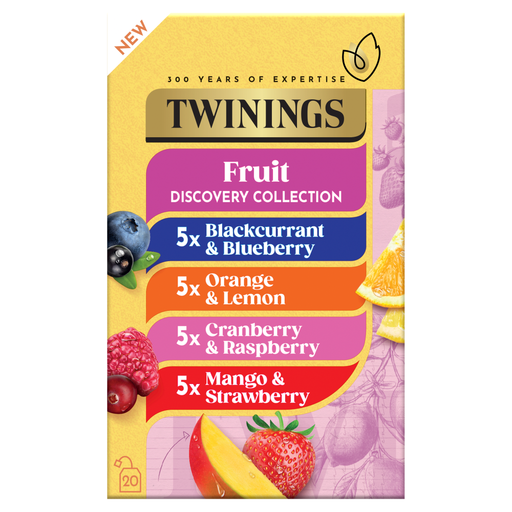 Image unavailable
Twinings Fruit Selection 20 Tea Bags 40g
A fruit-infusion assortment for a shop wanting several flavours in tea-bag portions. The Joybuy listing names Cranberry & Raspberry, Mango & Strawberry, Blackcurrant & Blueberry, and St Clements. It is supplied as a boxed assortment rather than a jar; check whether the bags are individually wrapped if that matters for self-service.
View on Joybuy
Common questions
Does a filled tea jar necessarily contain only fruit tea?
No. Twinings’ 70-envelope filled jar contains black, green, fruit and herbal teas. Check the complete assortment if every serving in your shop needs to be a fruit infusion.
Can a shop put loose fruit tea into decorative jars?
Use a jar suitable for food contact, not one selected solely for decoration. Business Companion’s guidance for businesses packaging food in England and Wales points to food-contact wording or the glass-and-fork symbol as ways to identify suitable packaging; check the container before transferring tea.
Does a compostable tea bag mean its whole pack has the same disposal route?
No. Pukka says its tea bags are home compostable, while it directs customers to put tags in paper recycling and describes the individual paper envelopes separately as recyclable. Follow the chosen product’s instructions for each component and check local collection arrangements.
How long should fruit tea brew at a tasting counter?
Follow the exact blend’s directions rather than setting one time for every fruit infusion. Teapigs specifies at least three minutes for Super Fruit tea temples and loose tea; Clipper gives a 2–5 minute range for Organic Berry Burst.


