People avoiding caffeine at their snack break
If you are replacing another mid-morning drink, look for a caffeine-free statement on the specific pack. A fruit flavour in the name is not enough to establish its caffeine content.


For a mid-morning snack, choose a fruit infusion whose flavour appeals to you and whose pack explicitly says caffeine-free. A single berry, citrus-and-ginger or apple-and-cinnamon blend suits a known preference; a mixed box lets you try several. If sugar or particular ingredients matter, check the declaration and full ingredient list for the exact blend.
The useful starting point is what you want from the cup alongside your snack: a stated caffeine-free infusion, a particular flavour or an ingredient list you can check.
If you are replacing another mid-morning drink, look for a caffeine-free statement on the specific pack. A fruit flavour in the name is not enough to establish its caffeine content.
You can compare blends for flavour without sweetening the cup yourself. If the drink’s sugar content also matters, read the exact product’s sugar declaration and check whether its nutrition information describes the brewed infusion.
A blend named after one or two fruits may also contain herbs, spices, roots or flavourings. Read the full ingredient and allergen information for the pack you intend to buy, particularly if you need to avoid an ingredient.
Start with the pack’s caffeine statement, then choose a flavour direction and check the ingredients behind its name.
| Priority | What to check | Your needs |
|---|---|---|
| Caffeine | Look for an explicit caffeine-free statement on the exact pack. Check whether it is a fruit-and-herbal infusion or a fruit-flavoured tea containing tea leaves. | I want a fruity cup without adding caffeine to my mid-morning break. |
| Flavour | Compare the named blends and their ingredients: berry blends, lemon and ginger, and apple and cinnamon offer different flavour directions. A selection box contains several blends rather than a full box of one flavour. | A berry blend appeals if I want fruit-led flavours; citrus and ginger or apple and cinnamon may suit me when I want spice as well. If I am undecided, I would rather try several blends. |
| Sugar and ingredients | Check the exact product’s sugar statement and the basis of any brewed nutrition information. Read the complete ingredients, including botanicals and flavourings, plus the allergen information. | I do not want to assume that a fruit name tells me what is in the bag, or that one blend’s sugar declaration applies to another. |
| Acidity concerns | Do not use a sugar-free statement as a measure of acidity. Oxford Health NHS Foundation Trust identifies fruit-flavoured drinks among acidic drinks, but does not assess every fruit-tea blend individually. | If acidity is a concern for me, a sugar-free label alone does not answer that question. |
Clipper says most of its infusions are caffeine-free, not all. The category or flavour name therefore cannot stand in for the product’s own declaration.
Choose a pack explicitly labelled caffeine-free if that is a requirement for your mid-morning drink.
Named-fruit blends can also include ingredients such as hibiscus, citrus peel, ginger or liquorice root. Those ingredients matter when you are comparing flavours or avoiding particular botanicals.
Read the complete ingredients for each blend, including individual varieties in a mixed box.
A sugar declaration does not measure acidity. Oxford Health NHS Foundation Trust includes fruit-flavoured drinks in its guidance on acidic drinks, without assessing every fruit infusion individually.
Keep the sugar statement and acidity question separate rather than treating one label claim as an answer to both.
These ranges offer different ways to narrow your flavour choice; check individual packs rather than applying a range-wide description to every blend.
Twinings offers individual fruit infusions and mixed fruit collections for comparing flavours.
Clipper’s organic infusion range includes fruit, herbal and spice-led options, including Lemon & Ginger.
Pukka includes fruit-and-spice combinations for shoppers considering a flavour beyond berries or citrus.
teapigs offers a pick-and-mix format for exploring different teas and infusions.
Tesco’s own-label fruit-and-herbal range includes Red Berries tea bags.
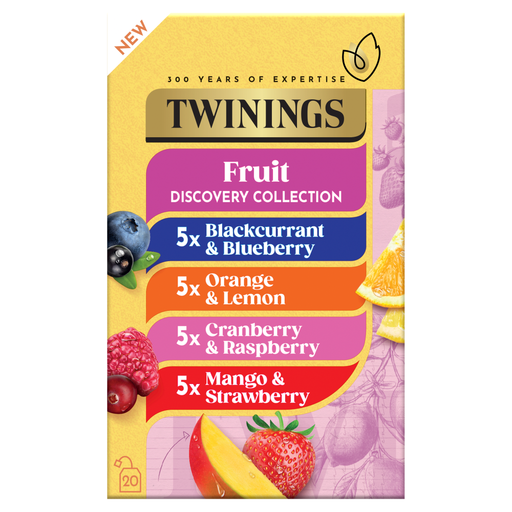
This mixed box suits a mid-morning break if you want to try several fruit-infusion flavours before settling on one blend. Check each variety’s ingredients if you avoid particular botanicals.
 No image available
A selection for trying several fruit flavours with a mid-morning snack. The 20-bag box contains Cranberry & Raspberry, Mango & Strawberry, Blackcurrant & Blueberry, and St Clements infusions; the product description identifies them as naturally caffeine-free. Check the pack’s sugar information if that matters to you, and read the individual ingredient lists if you need to avoid liquorice root.
No. Clipper says most of its infusions are caffeine-free, which is not a guarantee for every product described as fruit tea. If you want to avoid caffeine, choose a pack that explicitly says caffeine-free and check its ingredients.
It depends on the product and on anything added to the cup. Twinings labels its Cranberry & Raspberry infusion sugar-free, but that statement does not establish the sugar content of another blend or a sweetened prepared drink. Check the exact pack’s declaration and the basis of its nutrition information.
Read the ingredients and allergen information for the exact blend each time you buy it. GOV.UK says that any of the 14 regulated allergens present as ingredients in prepacked food or drink must be clearly labelled. If the product is not prepacked, ask the seller for its allergen information.
No. A sugar-free statement does not measure acidity. Oxford Health NHS Foundation Trust identifies fruit-flavoured drinks among acidic drinks in its dental guidance, but that guidance does not establish the acidity of an individual fruit-tea blend.