For a quick hot drink without tea-leaf caffeine, choose a fruit infusion explicitly labelled caffeine-free and check the ingredients of the exact blend. A jar is a choice for presentation or storage, not a requirement for fruit tea: a mixed box helps when flavours are uncertain, while a larger single-flavour box suits a household that already knows what it likes.
Who is this for?
Parents changing their evening drink
If you want something other than ordinary black or green tea, look for an explicit caffeine-free declaration on the fruit infusion you choose. A mixed box lets you try flavours; a single-flavour box makes sense once you have a favourite.
Breastfeeding parents keeping track of caffeine
A caffeine-free fruit infusion can replace a caffeinated cup of tea, but other drinks and foods may still contribute caffeine. The NHS advises breastfeeding parents who consume caffeine to try not to exceed 300mg a day in total.
People putting together a new-parent hamper
A selection box offers several flavours without requiring the recipient to choose a large box of one. Consider a filled jar when its container and presentation are part of the gift, and check which infusions it actually contains.
What should you check?
Choose the infusion itself before choosing its container: caffeine labelling, ingredients and flavour format affect what goes in the cup, while a jar mainly changes how it is presented or stored.
| Priority |
What to check |
Your needs |
| Caffeine |
Look for an explicit caffeine-free declaration. Check the blend rather than assuming every fruit or herbal infusion is caffeine-free; Twinings identifies mate and guarana as exceptions. |
I want an evening drink without replacing ordinary tea with another caffeinated blend. |
| One-cup preparation |
Check whether the pack contains individual bags or envelopes and follow its stated infusion time. Preparation directions vary by product. |
When the day is interrupted, I want to make one cup without measuring loose tea. |
| Flavour and pack size |
Compare the flavours and servings per flavour in a selection with the bag count in a single-flavour box. Twinings lists four blends and 20 envelopes in its Fruit Discovery Collection; Tesco lists 40 bags for Red Berries. |
If nobody has a favourite yet, I would rather try several flavours. Once we know which one gets used, a larger box of that flavour may be more practical. |
| Ingredients |
Read each blend’s ingredient list, particularly in a selection box. Fruit infusions can contain flowers, flavourings and botanicals such as liquorice root. |
I need to recognise any ingredient someone in the household avoids, rather than relying on the words ‘fruit tea’ on the front. |
| Container |
Check whether the product is a box of tea bags, individually sealed envelopes or a filled jar, and inspect the jar’s blend list. |
For a hamper, I might value a reusable container; for the cupboard, the tea and its packaging matter more to me than a jar. |
Common buying mistakes
-
Assuming ‘fruit’ or ‘herbal’ always means caffeine-free
Caffeine status depends on the blend. Twinings notes that infusions containing mate or guarana can naturally contain caffeine.
Check the exact product’s caffeine declaration and ingredients instead of judging it by its flavour or name.
-
Choosing a jar before choosing the tea
Twinings lists a filled jar of caffeine-free infusions, but that description does not establish that every envelope is fruit tea. A jar also does not establish how suitable the blends are for someone avoiding caffeine.
If the container is for a gift or storage, check what is inside it. Otherwise, compare the tea bags, flavours and ingredients first.
-
Checking only the front of a mixed box
Blends within one selection can have different ingredients. Twinings’ Fruit Discovery Collection includes liquorice root in several of its fruit blends.
Read the ingredient list for each flavour if the recipient avoids a particular botanical.
Brand and product-line references
These examples show how fruit-infusion ranges differ; a brand name alone does not establish the ingredients or caffeine status of every blend.
Twinings
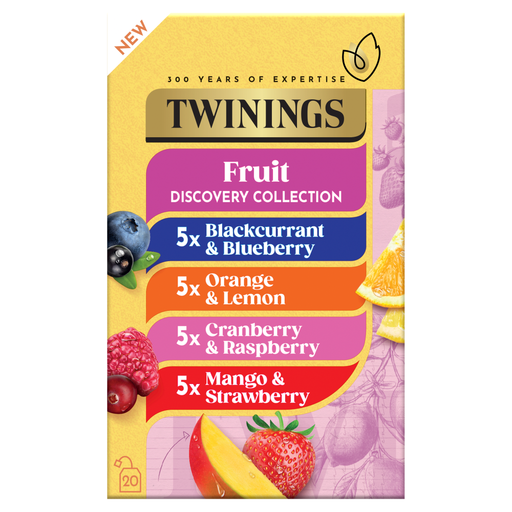
Its Fruit Discovery Collection offers four fruit blends in 20 individually sealed envelopes; Twinings also lists a filled jar of caffeine-free infusions.
- The selection format allows several flavours to be tried from one box.
- Some Fruit Discovery blends contain liquorice root, and the filled jar is not identified as an all-fruit-tea selection.
Tesco
Red Berries is a single-flavour hibiscus and fruit infusion sold in a 40-bag box.
- Tesco describes Red Berries as naturally caffeine-free.
- Check the current pack’s ingredients and allergen information, as product details can change.
Pukka
Wild Apple & Cinnamon is a fruit-and-spice herbal tea that Pukka describes as naturally caffeine-free and made with organically grown ingredients.
- The declared ingredients include wild apple, cinnamon and ginger.
- Its spiced profile is a different flavour choice from a berry infusion.
Clipper
Blackcurrant & Blueberry is an organic infusion with a declared blend of fruit ingredients, flowers, herbs and flavourings.
- Clipper lists individual ingredients, including hibiscus, rosehip and fruit pieces.
- The blend also contains liquorice, which matters if the recipient avoids it.
Teapigs
Super Fruit is a berry-and-hibiscus infusion offered in a 15-tea-temple pack.
- Teapigs describes Super Fruit as naturally caffeine-free and lists its berry ingredients.
- The 15-tea-temple pack contains fewer servings than Tesco’s 40-bag Red Berries box.
Fruit tea on Joybuy
This Twinings tea-bag selection is an option for trying fruit flavours in a new-parent household. If a filled jar is important, check the outer packaging before choosing it.
 No image available
Twinings Fruit Selection, 20 tea bags, 40g
A fruit-infusion selection for a household still trying different flavours. The Joybuy listing identifies 20 tea bags and lists liquorice root in its Cranberry & Raspberry blend. Check each blend’s ingredients and the current caffeine declaration if either affects your choice; check the outer packaging if you want a jar.
View on Joybuy
Frequently asked questions
Is fruit tea always caffeine-free?
No. Many fruit infusions are naturally caffeine-free, but Twinings notes that blends containing mate or guarana can contain caffeine. Check the declaration and ingredients on the exact product.
Can a caffeine-free fruit infusion replace ordinary tea while breastfeeding?
It can replace a caffeinated cup of ordinary tea if the specific infusion is labelled caffeine-free. Caffeine from other sources still counts: the NHS advises breastfeeding parents who consume caffeine to try not to exceed 300mg a day in total.
Does fruit tea need to come in a jar?
No. Fruit infusions are also sold in boxes of tea bags or envelopes. A filled jar may appeal as a gift or reusable container, but check its blend list: Twinings’ listed caffeine-free infusions jar is not identified as containing only fruit tea.
Should I check every flavour in a selection box?
Yes, if ingredients matter to the recipient. Blends in the same box can differ; Twinings’ Fruit Discovery Collection includes liquorice root in several blends. Read each flavour’s ingredient list rather than treating the box as one uniform recipe.
How should I store and brew fruit tea?
Follow the directions for the particular product. Tesco says to keep Red Berries in a cool, dry place and use an airtight container once opened; its stated infusion time is three to five minutes. Directions for other blends can differ.


