What should you check?
Start with how often you will use the tea and whether you want one familiar flavour or several. Then choose a pack and storage method that keep each blend identifiable.
| Priority |
What to check |
Your needs |
| Freshness between cups |
Check whether bags are individually wrapped. If decanting unwrapped bags or loose tea, use a clean, fully dry, food-safe jar with a secure lid and store it in a cool, dry, dark cupboard. |
I drink fruit tea occasionally and want the remaining bags protected between uses. |
| Blend identification |
Keep different blends separate and label each jar. Retain the carton or a legible record of the ingredients, brewing directions and best-before information. |
Several flavours share my cupboard, so I need to know which bag I am choosing. |
| Ingredients and caffeine |
Read the current ingredient list and any caffeine statement for the exact blend. Some named fruit infusions contain liquorice root; a category name does not establish the contents of every pack. |
If I am avoiding caffeine or checking a particular ingredient, I want an answer for the blend I will actually drink. |
| Pack size and variety |
Compare the bag count and whether the pack contains one flavour or a selection. Check the current listing and packaging rather than assuming similarly sized packs contain equivalent blends or wrapping. |
A mixed pack appeals when tastes vary; for a known favourite, I would rather top up that single blend. |
Brand and retailer references
These examples show formats worth distinguishing during a top-up shop; the details of one blend or pack should not be assumed for another.
Twinings
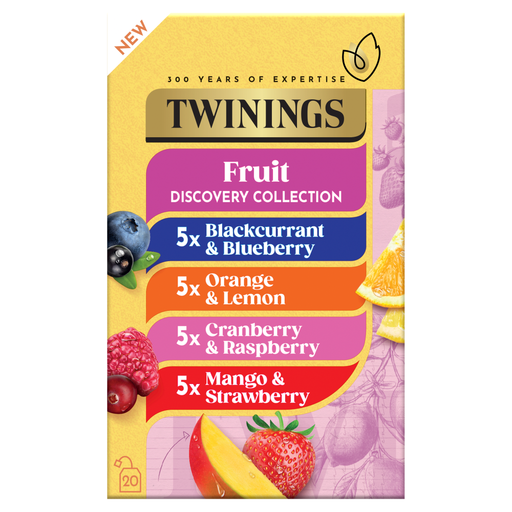
Its fruit-infusion range includes single-flavour packs and a 20-envelope Fruit Discovery Collection with four blends.
- Twinings says each bag in that collection is individually sealed and describes the collection as naturally caffeine-free.
- The blends have different ingredient lists; several include liquorice root. Check the particular blend before drinking or decanting it.
Clipper
An organic fruit-infusion option that includes Berry Burst in a 250-envelope catering format.
- Clipper describes Berry Burst as naturally caffeine-free and lists its organic ingredients.
- Berry Burst contains liquorice root. Clipper says its plant-based heat-seal bags are industrially compostable; that does not establish acceptance in household composting or local collections.
Pukka
Its organic fruit and herbal range includes blends such as Elderberry & Echinacea and Wild Apple & Cinnamon.
- Pukka says its fruit-tea bags have protective recyclable paper sachets and describes Elderberry & Echinacea as naturally caffeine-free.
- Check the ingredients and packaging of the exact blend; a statement about one product does not establish another product’s recipe or caffeine status.
teapigs
Super Fruit is offered in portioned tea temples and loose-leaf pouches, giving shoppers two preparation and storage formats to consider.
- The loose-leaf format suits someone who wants to portion tea from a labelled storage container.
- Check the current pack for its full ingredients and storage directions before choosing a format.
Tesco
Its fruit and herbal tea category offers a supermarket route for comparing branded pack sizes and formats in a top-up shop.
- The category includes fruit infusions alongside other herbal teas, so the exact product listing helps distinguish them.
- Check the current listing and pack; an online marketplace item need not be supplied through the usual grocery order.
Sainsbury's
Its fruit and herbal tea category includes branded products and an own-label Strawberry, Raspberry & Cranberry 20-bag pack.
- The own-label pack provides a single-blend alternative to a mixed selection.
- Check its current ingredients, bag format and availability rather than assuming they match a branded pack.
Fruit-tea options on Joybuy
These two 20-count packs offer a mixed fruit selection and a berry-led blend for a small top-up. Check the current packaging before relying on either pack to provide individually sealed portions.
 No image available
Twinings Fruit Selection 20 Tea Bags 40g
A 20-bag selection of four blends suits a top-up when the household wants several fruit flavours rather than one. The product description lists ingredients by blend; liquorice root appears in three of them. Keep those identities clear if you move bags into jars, and check the pack if individually wrapped bags matter to you.
View on Joybuy
 No image available
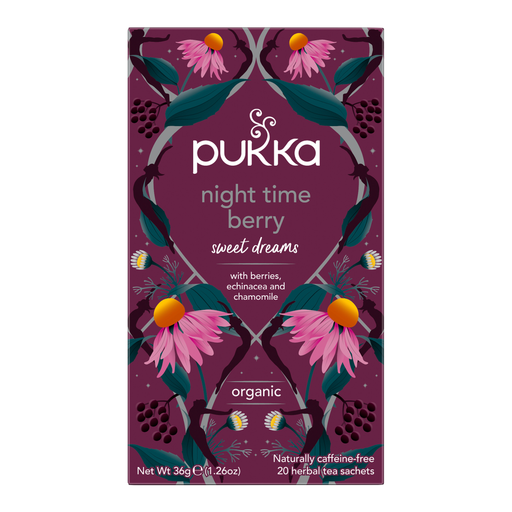
Pukka Night Time Berry Organic 20 Tea Sachets 36g
This 20-sachet berry-and-herb blend is a single-product top-up rather than a mixed selection. Its listed ingredients include liquorice root. Check the current pack for its caffeine statement, individual wrapping and opened-pack storage directions before deciding whether to keep the sachets in their packaging or use a labelled jar.
View on Joybuy
Fruit-tea questions
Should I put fruit tea bags into a jar?
Use a jar if it is clean, fully dry, food-safe, clearly labelled and securely closed, and you can keep it in a cool, dry, dark cupboard. Leave individually wrapped bags sealed inside it, and retain the carton or a legible record of the ingredients and instructions.
Can I use a clear glass jar?
Yes, if you keep it in a dark cupboard rather than leaving the tea exposed to light on a worktop. An opaque lidded container is another option; whichever you use, keep it clean and dry.
Are all fruit teas caffeine-free?
Do not assume so from the category name. Twinings describes its Fruit Discovery Collection, Clipper its Berry Burst and Pukka its Elderberry & Echinacea as naturally caffeine-free; check the statement on the exact pack you choose.
Why keep the packet after decanting?
The packet identifies the blend and preserves its ingredient and preparation information. Fruit infusions have different recipes, so retain the carton or a legible record that you can match to the jar.
Does pregnancy change what I should check?
Yes. NHS guidance says that during pregnancy it is safest to limit herbal tea to no more than four cups a day and to avoid teas containing liquorice root. Read the exact blend’s ingredient list, and ask a midwife, GP or pharmacist about individual concerns.


