Occasional drinkers who like variety
Consider individually wrapped selections if you rotate flavours or leave tea in the pantry for a while. Pukka explains that individual envelopes protect its blends from air, moisture and nearby food smells.


For occasional use or several flavours, individually wrapped fruit-tea bags let you keep each blend in its envelope; an empty jar can organise the sachets but does not replace their protective packaging. A large pack makes more sense once you regularly use one blend, while loose leaf suits anyone willing to measure the tea and check that they have suitable brewing and storage equipment.
Consider individually wrapped selections if you rotate flavours or leave tea in the pantry for a while. Pukka explains that individual envelopes protect its blends from air, moisture and nearby food smells.
A larger pack is worth considering when one blend is used predictably. Check the exact pack for its ingredients and caffeine statement rather than assuming every fruit infusion is the same.
An empty jar can hold or organise tea, but check its size, lid and storage position before moving tea out of its packaging. A jar’s appearance alone does not establish how well it protects the contents.
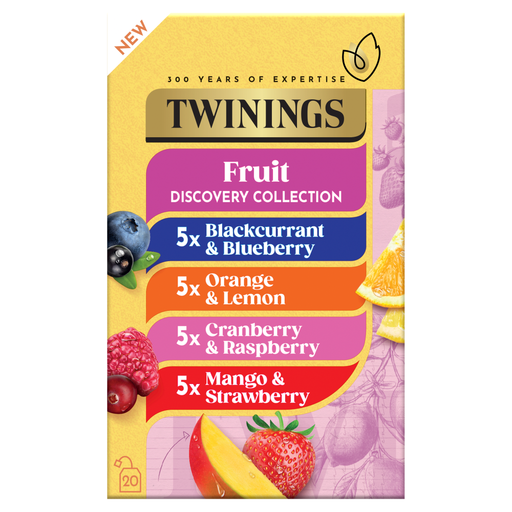
Choose when: You want several flavours or expect to use them slowly; Twinings’ Fruit Discovery Collection contains 20 individually sealed envelopes across four flavours.
Trade-off: An empty storage jar is a separate accessory, not a pre-filled version of the selection.
Choose when: One flavour is already a regular choice; Clipper sells Berry Burst as a 250-envelope catering pack.
Trade-off: You commit pantry space to a substantial quantity of that blend, so check the pack’s date and storage instructions.
Choose when: You want to measure each serving; Teapigs lists Super Fruit among its loose-leaf teas.
Trade-off: Check that you have an infuser and a suitable way to store the opened tea.
| Priority | What to check | Your needs |
|---|---|---|
| Storage | Check whether bags have individual envelopes. If using a jar, check its lid and position, and follow the tea pack’s storage instructions. | I use fruit tea slowly and want to keep different flavours away from moisture and nearby food smells. |
| Variety or quantity | Compare the number of flavours and servings with how often you use each blend. Check the date on a larger pack before stocking it. | Several flavours appeal to me more than a large quantity of one I have not tried; a repeat favourite may justify the larger pack. |
| Ingredients | Read each blend’s ingredient panel, allergen information and caffeine statement. Do not apply one flavour’s details to the whole range. | Someone in my household avoids particular ingredients, or I need to know whether the exact tea is caffeine-free. |
| Preparation | Check whether the tea is ready-portioned or loose leaf, and whether you need a separate infuser or container. | I may prefer a bag for quick preparation, or loose leaf when I want to measure the amount myself. |
Twinings’ small and large ribbed glass storage jars are sold empty, separately from its fruit tea.
Choose the tea first, then check whether a jar’s size, lid and position suit what you plan to store.
Pukka explains that individual envelopes protect its blends from air, moisture and nearby smells. Removing them gives up that packaging benefit.
Keep individually wrapped bags in their envelopes, whether they stay in the box or go into an organiser.
A 250-envelope pack commits pantry space to one blend, even if household preferences change.
Try a smaller or mixed selection before choosing a large pack of a repeat favourite.
Fruit infusions can contain different botanicals and flavourings; Twinings’ Cranberry & Raspberry blend, for example, lists liquorice root. Caffeine statements also belong to specific products.
Check the ingredients, allergen information and caffeine statement for each tea you buy.
Offers fruit-infusion bags and separate empty tea-storage jars.
Offers fruit infusions including an organic Berry Burst 250-envelope catering pack.
Offers organic fruit teas in individually wrapped sachets.
Lists Super Fruit in tea-temple and loose-leaf formats.
These options cover a mixed fruit-tea bag selection and peach oolong tea in a caddy. Check the packaging and ingredients of the exact option you choose, particularly if individual wrapping or caffeine content matters.
 No image available
A mixed selection for keeping several fruit-infusion flavours in the pantry; the Joybuy product listing names Cranberry & Raspberry, Mango & Strawberry, Blackcurrant & Blueberry and St Clements.
Check the ingredients for each flavour. If individual envelope protection matters for slow use, confirm how the bags are packed before buying.
 No image available
This peach oolong option comes in an 80g caddy for pantry storage. Check that loose-tea preparation suits you and whether you need a separate infuser.
Check the caddy closure before relying on it for opened-tea storage, and confirm the caffeine information if that affects your choice.
Fruit tea is often sold as a fruit or herbal infusion rather than tea made from traditional tea leaves. Clipper describes an infusion as plants or fruit steeped in water; check the exact blend’s ingredients and caffeine statement rather than relying on its category name.
Keep individually wrapped bags in their envelopes if you want the protection that packaging provides. Pukka says its envelopes shield blends from air, moisture and flavour or smell transfer from nearby foods; a jar can organise the wrapped bags.
A glass jar alone does not establish how well tea inside will be protected. For Twinings’ empty storage jars, check the lid and usable size, choose a suitable pantry position and follow the tea pack’s storage instructions.
Check the date and storage instructions on the exact pack. GOV.UK explains that a best-before date concerns quality, while a use-by date concerns safety; do not assume decanting tea gives it a new storage life.
Check the exact tea’s ingredient and allergen information before buying, and check the pack again if its labelling changes. GOV.UK guidance says food businesses must provide allergen information and identifies 14 allergens that must be declared as allergens under applicable food rules.