Gym-goers choosing a sweet treat
If you want fudge after training, decide whether the snack is simply a treat or whether its protein content matters to your choice.


Choose a fudge multipack if you want a portioned sweet treat after exercise, rather than a snack chosen for its protein content. If protein is the priority, compare protein per serving on a protein-focused product instead; check sugars per piece, allergens and the number of portions before buying fudge.
If you want fudge after training, decide whether the snack is simply a treat or whether its protein content matters to your choice.
An individually wrapped bar has a stated per-bar amount. With loose fudge, you will need to decide how much to take from the pack.
Check the ingredients and allergens for the intended eater. A home-packed lunchbox and food supplied by a school also raise different questions about school food rules.
Start with the role of the snack, then compare the amount you would actually eat with the nutrition information on the pack.
Choose when: You want a fixed sweet portion to take after training.
Trade-off: The Cadbury four-pack has separate 22g bars, but its listing gives only 1.7g protein per 100g.
Choose when: Traditional fudge or sharing matters more to you than a fixed serving.
Trade-off: You must portion it yourself; the M&S clotted-cream fudge listings give 0.8g and 1.1g protein per 100g for their respective packs.
Choose when: The snack’s declared protein per serving is your priority, rather than traditional fudge.
Trade-off: Waitrose lists 22g protein per 60g Grenade Fudged Up bar, but it is a different type of product and its ingredients and warnings need checking.
| Priority | What to check | Your needs |
|---|---|---|
| Protein | Compare protein per actual serving, not just per 100g. Check whether the product is traditional fudge or a protein bar with a fudge flavour. | If I am choosing the snack for its protein content, I need the serving figure before I decide. |
| Portions | Look for the number and weight of pieces and whether each is wrapped. Waitrose lists the Cadbury Fudge multipack as four 22g bars. | A separate bar would help me plan one sweet portion; with a loose pack, I would portion it myself. |
| Sugars | Read sugars per piece alongside sugars per 100g. Waitrose lists 14g sugars per 22g Cadbury bar; NHS guidance describes 22.5g or more total sugars per 100g as high in sugar. | I want to know what is in the amount I would eat, not just the whole pack. |
| Ingredients | Check the current pack for allergens and, on protein bars, any sweetener, polyol or age-suitability warnings. | If I am sharing the pack, I need to check that each person can have the specific product. |
| School use | For food supplied by a school, confirm the applicable standards and serving arrangements with the school or caterer. England-specific rules should not be assumed to cover every UK school. | For a lunchbox, I want to distinguish food packed at home from food the school supplies. |
Waitrose lists 1.7g protein per 100g for its Cadbury Fudge four-pack listing. A fudge-flavoured protein bar is a different product, so the shared flavour name does not establish a similar protein content.
Decide whether you want a sweet treat or a particular protein contribution, then check protein per serving.
A four-bar pack gives a stated amount per bar, while a loose bag or box leaves the serving amount to you. Waitrose lists 14g sugars in each 22g Cadbury Fudge bar.
Check the piece count and per-piece information, or plan a portion from a loose pack.
A fudge flavour does not tell you which allergens, sweeteners or polyols a bar contains. These details can matter when buying for someone else.
Read the current pack’s ingredients, allergen information and warnings before purchase.
The Department of Health and Social Care scopes its HFSS promotion guidance to businesses operating in and selling to England. Separately, the Department for Education says updated school food standards proposed for September 2027 are subject to Parliamentary approval.
For school-supplied food, ask the school or caterer which current standards apply to its location and arrangements.
These examples illustrate different fudge formats and label details; they do not indicate which brands are stocked on Joybuy.
Thorntons lists an 85g vanilla fudge bag and a 300g assorted-fudge pack for shoppers considering traditional fudge.
M&S provides nutrition figures for its clotted-cream fudge packs and Blond Fudge Bites.
Waitrose lists its own clotted-cream fudge in 150g and 200g packs, alongside other fudge-related products.
The Cadbury Fudge four-pack listed by Waitrose contains four 22g bars.
A Cornish Fudge Co. listing describes a case of 12 assorted 300g fudge boxes, a format oriented towards buying several boxes.
These options cover a four-bar fudge multipack and Cadbury Fudge Minis for shoppers considering a sweet treat after exercise.
 No image available
Consider this four-bar pack when you want a separate sweet portion after exercise. The matching Waitrose listing gives four 22g bars, with 98 kcal and 14g sugars per bar and 1.7g protein per 100g. Check the current pack for allergens.
 No image available
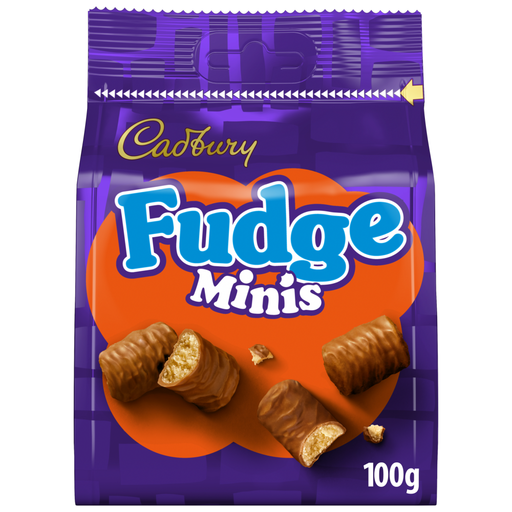
Consider the 100g minis if you plan to choose your own sweet portion. Check the pack for the piece count, nutrition for the amount you intend to eat and current allergen information.
The cited traditional fudge examples have modest declared protein per 100g: M&S lists 0.8g and 1.1g for two clotted-cream fudge packs, while Waitrose lists 1.7g for its Cadbury Fudge four-pack. If protein content drives your choice, compare it per serving on the product you would actually eat.
Check how many pieces the pack contains and the weight of each, then compare sugars per piece and per 100g, protein per serving and allergens. The NHS describes 22.5g or more total sugars per 100g as high in sugar; Waitrose lists 65g per 100g for its Cadbury Fudge four-pack.
No. Waitrose lists Grenade Fudged Up as a 60g protein bar with 22g protein and 1.3g sugars per bar; it is a different product from traditional fudge. Compare the serving information and check its ingredients and warnings before choosing it.
The Department of Health and Social Care’s HFSS promotion guidance addresses businesses operating in and selling to England, not a general prohibition on a consumer packing a lunchbox. Check a school’s own arrangements separately rather than applying a business-promotion rule to food brought from home.
A state-funded school in England should check its applicable School Food Standards and the particular product before serving it. The Department for Education says compliance with those standards is a legal requirement for state-funded schools; the 2014 England regulations define confectionery to include non-chocolate confectionery and chocolate-containing products. The department says updated standards proposed for September 2027 remain subject to Parliamentary approval, so schools should use the standards currently in force and confirm their arrangements with their caterer.