What should you check before choosing?
Start with the portion you intend to serve, then compare its label information and where the snack will be eaten. A single retail pack, a multipack and a bar marked with several portions need not be served in the same way.
| Priority |
What to check |
Your needs |
| Portion format |
Check the weight of the piece to be served, the number of pieces or portions in the pack, and whether the nutrition panel uses that same portion. |
I want to offer one defined portion rather than treat a large bar or an entire multipack as one snack. |
| Sugars per portion |
Compare sugars for the portion actually offered. Tesco lists 8.8g sugars in a 13.5g Cadbury Fudge Treat Size bar; Sainsbury’s lists 7.7g in a 20g portion of NOMO Choc Fudge XL Bar. These are different products and portion sizes. |
For an occasional sweet treat, I want to read the per-serving figures rather than judge it by the word ‘bar’ or the total pack weight. |
| Allergens |
Read the current pack’s ingredients, declared allergens and precautionary statements. Joybuy’s Cadbury Fudge Bar 4 Pack listing declares milk; Sainsbury’s lists NOMO Choc Fudge XL Bar as free from dairy, gluten, eggs, peanuts and tree nuts. |
If an ingredient must be avoided, I need the exact product and current pack to meet that requirement; the name ‘fudge’ alone cannot settle it. |
| School or club rules |
Confirm the setting’s rules for food brought in and its allergy arrangements. Department for Education guidance says schools in England must publish an allergy safety policy. |
A bar I would serve at home may not fit the rules where my child will eat it after school. |
Relevant brands and retailers
These references describe particular listed products and formats, not every item made or sold under each name.
Cadbury
Cadbury Fudge appears in the cited Tesco listings as a treat-size bar and a single bar, and on Joybuy as a four-bar pack.
- Tesco lists a 13.5g Fudge Treat Size bar with 60 kcal and 8.8g sugars per bar.
- The treat-size figures do not describe the individual bars in Joybuy’s 88g four-pack. The cited Cadbury ingredient information includes milk.
NOMO
Sainsbury’s lists NOMO Choc Fudge XL Bar as a chocolate bar with a fudge-flavour centre, rather than a small dairy-fudge piece.
- Sainsbury’s describes this product as free from dairy, gluten, eggs, peanuts and tree nuts.
- The 120g bar is labelled as six 20g portions, so it needs dividing if one portion is to be served. Check the current pack for its ingredients and allergen statements.
Tesco
Tesco’s Cadbury Fudge listings show why it matters to distinguish a 25.5g single bar from a 13.5g treat-size bar sold in a multipack.
- The treat-size listing gives nutrition per 13.5g bar, including sugars and energy.
- Tesco notes that food ingredients, nutrition and allergen information can change; check the pack being purchased.
Fudge options on Joybuy
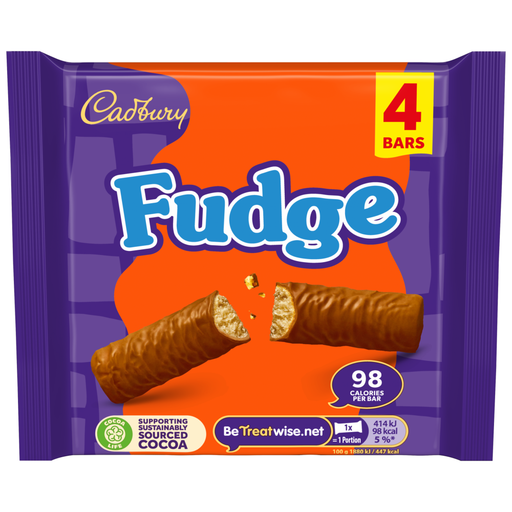
This four-bar Cadbury fudge pack is an option to consider for an occasional treat at home. It is a multipack, not a single-bar retail pack, so check the individual bar and serving information if portion size is decisive.
 No image available
Cadbury Fudge Bar 4 Pack 88g
The four-bar format offers separate pieces for an after-school treat at home, rather than one 88g bar. Joybuy’s listing gives 65.00g sugars per 100g and declares milk; check the purchased pack for each bar’s weight, per-bar nutrition and current allergen and precautionary statements. If it will go to a school or club, check that setting’s food and allergy policy.
View on Joybuy
Frequently asked questions
Does every fudge bar contain nuts?
No: the category name does not tell you a product’s allergens. Joybuy’s Cadbury Fudge Bar 4 Pack listing declares milk, while Sainsbury’s describes NOMO Choc Fudge XL Bar as free from peanuts and tree nuts, among other ingredients. Check the current physical pack, including any precautionary statement, for the specific product you buy.
Is a fudge bar automatically classed as HFSS?
Its name alone does not establish a product-specific HFSS classification. The Department of Health and Social Care’s guidance for England describes promotion and placement restrictions for certain in-scope foods sold by affected businesses; it does not make eating fudge at home unlawful. Use the pack’s nutrition information to compare the portion you intend to serve.
Can I send a fudge bar to school or an after-school club?
Check the particular school or club’s food and allergy policy before sending it. Department for Education guidance says schools in England must publish an allergy safety policy; permission to bring in a particular snack cannot be inferred from its retail label or from what you would serve at home.
How do the small Cadbury treat-size bar and NOMO XL bar differ?
Tesco lists the Cadbury Fudge Treat Size bar as a 13.5g piece with 8.8g sugars. Sainsbury’s lists NOMO Choc Fudge XL Bar as a 120g bar divided into six 20g portions, with 7.7g sugars per portion, and describes it as free from dairy, gluten, eggs, peanuts and tree nuts. Compare the portion you will actually serve and check the current pack against any allergen requirement.


