Choose a fudge bar multipack when a fixed-size bar makes a mid-morning snack easier to pack, but check that each bar is wrapped if it needs to travel as a sealed portion. Sainsbury’s lists Cadbury Fudge as four 22 g bars; its 125 g All Butter Fudge has five stated servings and suits portioning at home. For a school snack, check the school’s rules and distinguish food brought from home from food provided by the school.
Who is each format for?
People packing a single mid-morning treat
A pack of separate bars gives you a fixed-size unit without dividing a larger block of fudge. Sainsbury’s lists its Cadbury Fudge multipack as four 22 g bars. If the bar must remain sealed in a lunchbox, check how the individual bars are wrapped.
Households portioning fudge at home
A shared pack works when you can separate a serving before snack time. Sainsbury’s lists five servings for its 125 g All Butter Fudge, with nutrition given for a two-piece serving.
Parents and school-food organisers
The Department for Education’s school-food guidance concerns food provided in state-funded schools in England. For a snack brought from home, check the individual school’s policy; Welsh Local Government Association guidance notes that a local authority or school governing body can restrict food brought in for personal consumption.
What should you check before buying?
Start with the portion you intend to pack, then check its nutrition, the current allergen label and any school rules that apply.
| Priority |
What to check |
Your needs |
| Pack format |
Check the number of bars or stated servings, the portion size and whether each portion is individually wrapped. Total pack weight alone does not establish the wrapping format. |
I want to pack one portion without dividing fudge just before leaving, or I can portion a shared pack at home. |
| Nutrition per portion |
Sainsbury’s lists 14 g sugars per 22 g Cadbury Fudge bar and 17.5 g sugars per two-piece serving of its All Butter Fudge. Compare the serving you would actually pack; these figures use different portion sizes. |
A single bar or two pieces may be my planned snack, so the nutrition for that amount matters more to my choice than pack weight alone. |
| Ingredients and allergens |
Read the current pack’s ingredients, allergen declarations and precautionary statements. The Cadbury example contains milk; Sainsbury’s labels its All Butter Fudge unsuitable for customers with peanut, nut or egg allergy due to manufacturing methods. |
If I am packing fudge for someone else, I need to check the particular pack against their allergen requirements before serving it. |
| School rules |
Check whether the snack will be provided by a school or brought from home, then consult the applicable school-food rules and the school’s current policy. The Department for Education’s England guidance covers food provided in state-funded schools; Welsh Local Government Association guidance describes possible local restrictions on food brought from home. |
Before putting fudge in a school lunchbox or arranging a school-provided snack, I need to know which rules apply to that situation. |
Common mistakes when comparing fudge
-
Treating every product named “fudge” as the same food
Sainsbury’s describes Cadbury Fudge bars as fudge covered with milk chocolate. Tesco describes Thorntons Chocolate Fudge Brownie Bites as chocolate-dipped brownies containing fudge pieces. Neither description means plain, uncoated fudge.
Read the product description and ingredients before comparing pack formats or nutrition.
-
Comparing only total pack weight
A four-bar pack and a shared pack call for different packing routines. Their stated nutrition may also be based on a bar in one case and a serving of pieces in the other.
Compare the amount you intend to pack, using nutrition for that bar or stated serving.
-
Confusing retail HFSS rules with lunchbox rules
Department of Health and Social Care guidance addresses restrictions on promotions and placement of certain foods high in fat, salt or sugar in retail settings. It does not, by itself, settle what a child may bring from home. School-provided food and individual school policies are separate considerations.
Check the relevant school-food standards for food the school provides, and the school’s current policy for food packed from home.
-
Using an online listing as the final allergen check
Ingredients and precautionary allergen information matter for the particular product being served. For example, Sainsbury’s All Butter Fudge carries a warning concerning peanut, nut and egg allergy because of manufacturing methods.
Read the current physical pack before serving fudge to someone with an allergy or intolerance.
Brand and product references
These examples illustrate different fudge and fudge-named products; a brand name alone does not establish the portion or wrapping format.
Cadbury
Sainsbury’s lists Cadbury Fudge Chocolate Bar Multipack as four 22 g bars.
- A fixed bar size gives a clear unit to compare and pack.
- The listed product is fudge covered with milk chocolate, not plain fudge. Sainsbury’s gives 14 g sugars per bar; check the current pack for allergens and individual wrapping.
Sainsbury’s
Sainsbury’s All Butter Fudge is a 125 g shared pack with five stated servings.
- Its two-piece serving provides a basis for planning a portion at home.
- The listing labels it unsuitable for customers with peanut, nut or egg allergy due to manufacturing methods. Check the pack if individual wrapping matters.
M&S
Marks & Spencer describes its 135 g Clotted Cream Fudge as made with Cornish clotted cream.
- It offers a clotted-cream fudge format to compare with chocolate-covered bars.
- Marks & Spencer warns that this product is not suitable for children under 36 months because of a potential choking hazard. Check the current label before serving.
Waitrose
Waitrose & Partners lists Clotted Cream Fudge in a 150 g pack and Dark Chocolate & Caramel Fudge in a 130 g pack.
- The listed pack sizes let you distinguish the two products when comparing formats.
- Check serving information and wrapping on the particular pack before treating either as a source of sealed single portions.
Thorntons
Tesco lists Thorntons Chocolate Fudge Brownie Bites as a 10-pack of chocolate-dipped brownies containing fudge pieces.
- The description makes the brownie format clear.
- Brownie bites are not an equivalent format to a traditional fudge multipack, despite “fudge” in the name.
Fudge options on Joybuy
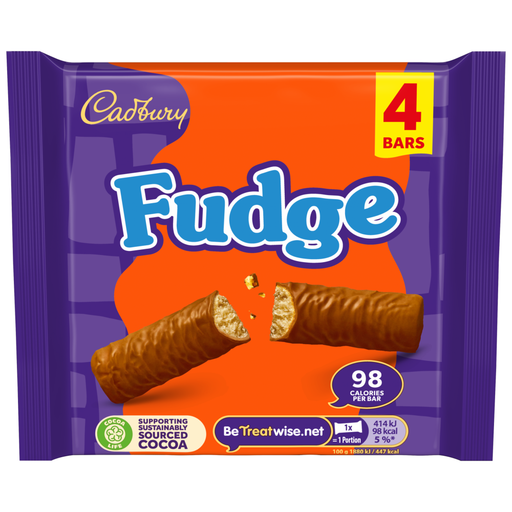
This four-bar Cadbury option is relevant if you are considering separate fudge bars for a mid-morning snack. Check the pack before relying on individually sealed portions.
 No image available
Cadbury Fudge Bar 4 Pack 88g
The four-bar format is relevant when you want separate bars for mid-morning snacks. The stated total weight is 88 g, and the product description declares milk. Check the current pack for individual wrapping and nutrition per bar if you intend to pack one sealed portion.
Joybuy
Questions about fudge for snack time
Do HFSS promotion rules prohibit fudge in every UK lunchbox?
Retail HFSS promotion rules do not establish a UK-wide lunchbox prohibition. Department of Health and Social Care guidance concerns promotions and placement of certain foods in retail settings; the Department for Education’s England school-food guidance concerns food provided in state-funded schools. Check the individual school’s current rules for food brought from home.
How should I compare a fudge bar with pieces from a shared pack?
Compare nutrition for the amount you would actually pack. Sainsbury’s lists 14 g sugars per 22 g Cadbury Fudge bar and 17.5 g sugars per two-piece serving of its All Butter Fudge. Those figures describe different portions, so also check their weights and the current labels.
What allergen information should I check when buying fudge for someone else?
Read the current pack’s ingredients, allergen declarations and any precautionary statements for the intended eater. The Cadbury Fudge example contains milk, while Sainsbury’s labels its All Butter Fudge unsuitable for customers with peanut, nut or egg allergy due to manufacturing methods.
Do the same school-food rules apply throughout the UK?
Check the rules for the relevant nation rather than applying England’s school-food guidance across the UK. The Scottish Government and Northern Ireland Department of Education publish their own school-food frameworks. Welsh Local Government Association guidance also notes that a local authority or school governing body can restrict food brought into school for personal consumption.


