Parents choosing an everyday snack
If you need something to offer regularly between meals, the important distinction is between a convenient pack format and the frequency with which a sugary food is served.


For a routine toddler snack, choose a non-confectionery option rather than a fudge multi-pack: Royal United Hospitals Bath NHS Foundation Trust advises minimising the amount and frequency of sugary foods and drinks for children. If you buy fudge for an occasional, adult-portioned treat, check the exact pack’s ingredients and allergen warnings. For a lunchbox, check the nursery or school’s own policy as well.
If you need something to offer regularly between meals, the important distinction is between a convenient pack format and the frequency with which a sugary food is served.
Check the setting’s packed-lunch and allergen policy. The Department for Education describes England’s school-food legal requirements as applying to food and drink provided in state-funded schools; that scope does not itself decide what may go in a family-packed lunchbox.
Fudge recipes and precautionary warnings differ by product. Read the current pack when milk, peanuts or tree nuts are a concern rather than relying on the category name.
Decide first whether you need a regular snack or an occasional sweet, then check the exact pack and the place where it will be served.
| Priority | What to check | Your needs |
|---|---|---|
| Snack frequency | Compare the intended use with guidance on minimising sugary foods and drinks. Check the pack’s declared sugars per 100g and per serving where given. | I need something for regular between-meal snacks, not simply several sweets in one pack. Royal United Hospitals Bath NHS Foundation Trust advises minimising both the amount and frequency of sugary foods and drinks for children. |
| Pack format | Check the number of pieces, total pack weight and whether pieces are individually wrapped. Confirm any stated weight per piece before using it to plan a portion. | If I buy an occasional treat, I want to know what the multi-pack contains so an adult can allocate it. |
| Allergens | Read the current ingredients, highlighted allergens, precautionary statements and product-specific suitability wording. | I need to check the exact fudge before serving it to a child with a relevant allergy; a nut-free assumption based on the word “fudge” is not enough. |
| Lunchbox rules | Ask the nursery or school about its packed-lunch and allergen policy. Distinguish food packed by a family from food provided by a state-funded school in England. | For a lunchbox, I need to know what this particular setting allows rather than assume one rule applies across the UK. The Department for Education’s school-food guidance concerns food provided in state-funded schools in England. |
Several portions in one pack can make it easy to offer fudge repeatedly. Royal United Hospitals Bath NHS Foundation Trust advises minimising how often children have sugary foods and drinks.
Choose a non-confectionery option for routine between-meal snacks; keep any fudge purchase for an occasional, adult-portioned treat.
Thorntons warns of nut cross-contact even in products without added nuts, while the M&S clotted cream fudge listing states that it is not suitable for people with a nut allergy.
Check the current physical pack’s ingredients, allergen emphasis and precautionary wording. Check the setting’s allergen policy separately.
The Department for Education states that the school-food legal requirements it describes apply to food and drink provided in state-funded schools in England. That is a different question from a family-packed lunchbox.
For a packed lunch, ask the individual nursery or school about its confectionery and allergen rules.
These examples show why the exact product label matters more than a brand name when choosing an occasional treat.
Thorntons lists vanilla and assorted fudge in different bag sizes, including 85g and 300g.
M&S lists clotted cream fudge as a confectionery pack, rather than a toddler-specific snack.
Waitrose lists Cooks’ Ingredients fudge chunks for baking, rather than as an individually portioned toddler snack.
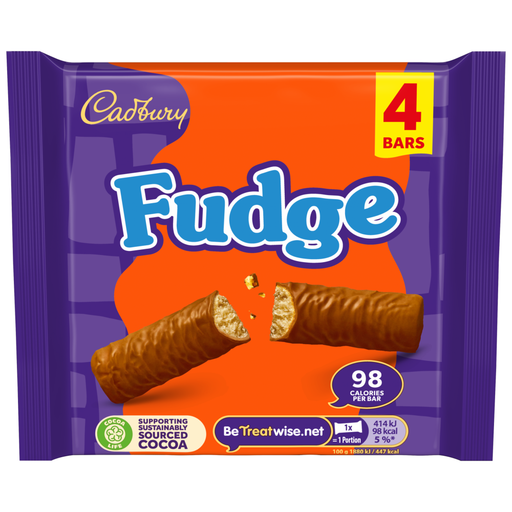
This fudge 4-pack is an option to examine if you are considering an occasional, adult-managed sweet, not a recommendation for routine toddler snacks.
 No image available
The stated 4-pack format may be worth considering for an occasional treat allocated by an adult, rather than a regular between-meal snack. Check the current pack for sugars per 100g, allergens, precautionary warnings and whether the bars are individually wrapped; check any nursery or school policy before putting one in a lunchbox.
Choose a non-confectionery option for routine between-meal snacks. Royal United Hospitals Bath NHS Foundation Trust advises minimising the amount and frequency of sugary foods and drinks for children; putting fudge in a multi-pack does not change how often it is offered.
Check that setting’s packed-lunch and allergen policy before sending it. The Department for Education describes England’s school-food legal requirements as applying to food and drink provided in state-funded schools, so those requirements alone do not answer the question for every family-packed lunchbox.
No: an absence of added nuts does not settle the allergy question. Thorntons warns of nut cross-contact in products without added nuts, and the M&S clotted cream fudge listing says it is not suitable for people with a nut allergy. Read the exact pack’s ingredients and warnings.
Check the complete current label for allergens relevant to the child, including milk, peanuts and tree nuts where applicable. The Food Standards Agency says food businesses must provide information when they use any of the 14 regulated allergens as ingredients; precautionary cross-contact wording also needs checking on the exact product.
No. Wrapping may help an adult allocate a piece, but it does not change the product’s declared sugar content. Compare the exact pack’s nutrition information, and confirm that its pieces are individually wrapped before relying on that format.