Who is this choice for?

Parents planning an occasional home treat

A pack’s weight is not a serving size. Decide how much to offer after school, then use the nutrition panel for that amount. NHS guidance advises keeping the frequency and amount of sugary foods and drinks as low as possible.

Families checking nut or peanut warnings

Check the exact pack rather than assuming plain fudge is suitable. M&S marks its Clotted Cream Fudge as unsuitable for people with nut or peanut allergies, while Thorntons warns of nut cross-contact in its production facility.

Buyers choosing between a treat and a gift

A smaller pack and an assortment serve different occasions. Thorntons lists an 85g Vanilla Fudge Bag and a 300g Assorted Fudge product; the larger format is a sharing or gifting choice, not a pre-decided individual serving.

What should you check?

Smaller fudge pack

Consider it: For an occasional treat at home when a fixed pack size is useful.

Bear in mind: A small pack still needs a chosen serving and an allergen check.

Assorted fudge

Consider it: When several people will share it or the fudge is a gift.

Bear in mind: Decide portions before opening and check the ingredients of each variety.

Boxed chocolates

Consider it: For sharing or gifting when different chocolate centres are wanted instead of a fudge-focused selection.

Bear in mind: Check the current box label for ingredients and allergens across the selection.

Priority What to check When it matters to me
Serving size Compare pack weight with the stated serving amount. Decide the amount to serve before opening a sharing pack. I want a defined after-school serving, not an unplanned second helping. In a survey reported by the British Nutrition Foundation in 2025, 76% of more than 2,500 UK schoolchildren aged 10–13 said they normally snacked after school during the week; 79% reported having at least two snacks a day. Neither figure measures a preference for fudge.
Sugars Read sugars per 100g to compare packs on the same basis, then check the amount for the serving you plan to offer. NHS guidance distinguishes the total sugars shown on labels from free sugars. If I choose fudge or chocolate, I want to know how much sugar is in the amount served. The British Nutrition Foundation reported in 2025 that 32% of more than 2,500 UK schoolchildren aged 10–13 named chocolate and 28% named sweets among foods they ate most often as snacks. These snack-choice responses can overlap; they are not boxed-confectionery purchase figures.
Allergens Read the current ingredients list and any precautionary warnings. With an assortment, check the information for every included variety. I need the exact product to meet the child’s allergy requirements and the rules of the setting where it will be eaten. An absence of nuts from a product name does not settle that question.
Pack format Check whether it is ready-to-eat fudge, pieces sold for baking, or a mixed gift box. Compare the pack weight and the varieties included. For one home treat, I want to choose an amount deliberately; for a gift, I may want several flavours. Tesco describes its 100g Fudge Chunks as pieces for baking, so their format needs checking before treating them as a ready-to-eat snack choice.
School setting Find out whether the food will be provided by a school or brought from home, and check the individual school’s packed-food and allergy policy. If I plan to send a treat into school, I need the rules for that setting. England’s Requirements for School Food Regulations 2014 define chocolate and non-chocolate confectionery in the school-food context; that does not, by itself, decide what a pupil may bring from home.

Common mistakes to avoid

  • Treating a gift box as one controlled serving

    A larger assortment is intended for sharing or gifting, while an after-school serving needs its own decision. The box weight alone does not tell you how much will be eaten at once.

    Choose the amount to serve before opening the box, and keep the remaining product according to its storage instructions.

  • Assuming plain fudge is suitable in a nut-free setting

    M&S states that its Clotted Cream Fudge is unsuitable for people with nut or peanut allergies. Thorntons also warns of a definite nut cross-contamination risk for products without added nuts in its production facility.

    Read the exact current pack, including “may contain” and “not suitable for” statements. Do not rely on the flavour name or on the label for another product in an assortment.

  • Applying school-food rules to every home snack

    The Department for Education’s school-food guidance concerns food provided in state-funded schools in England. It does not establish the packed-food policy of an individual school or a UK-wide rule for food brought from home.

    For a treat eaten at home, use the product label to make the serving and allergen decision. Before sending one into school, check that school’s policy.

Brand and product references

These examples show why the exact product and pack matter more than a brand name alone.

Thorntons

Thorntons lists an 85g Vanilla Fudge Bag and a 300g Assorted Fudge product, giving buyers different pack formats for a home treat or sharing.

  • The stated pack weights help distinguish a smaller bag from an assortment.
  • Thorntons warns that tree nuts are widely used in its production facility and that products without added nuts can face cross-contamination. Check the exact pack warning.

M&S

M&S lists a 175g Clotted Cream Fudge with product-specific nutrition, allergen and storage information.

  • Its label states 66.6g sugars per 100g, providing a basis for comparing the same measure on another pack.
  • M&S says this product is not suitable for people with nut or peanut allergies.

Tesco

Tesco’s 100g Fudge Chunks are described as pieces for baking, rather than a specifically presented after-school snack.

  • Tesco states 7.0g sugars per 10g and 70.2g sugars per 100g, making the quantity used important when reading the figures.
  • The listed ingredients include milk, and the product carries a may-contain-soya warning.

Waitrose

Waitrose lists a Clotted Cream Fudge in its confectionery range.

  • The listing identifies milk ingredients.
  • It also states “May contain: peanuts”; check the current pack when peanut exposure matters.

The Cornish Company

Its fudge collection lists 175g Cornish Clotted Cream Fudge and Cornish Assorted Fudge formats suited to a sharing or gifting decision.

  • The collection distinguishes a single-style fudge from an assorted format.
  • Check the exact product’s ingredients, allergens and nutrition label before choosing it for a child or an allergy-sensitive recipient.

Joybuy fudge options

These Cadbury fudge packs are options for an occasional treat at home. Compare their pack formats, then use the current labels to decide the serving and check allergens; they are not assorted fudge or boxed-chocolate gift selections.
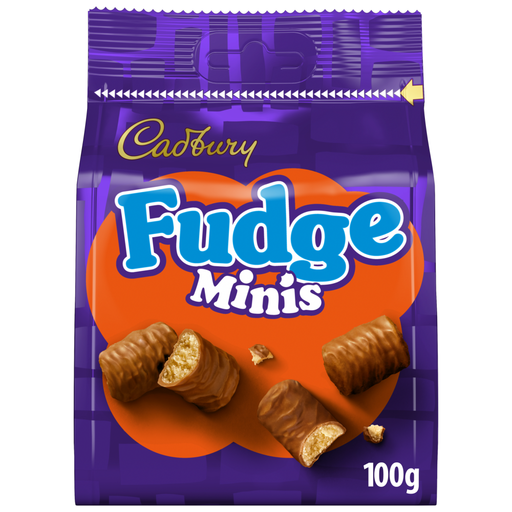
Cadbury Fudge Minis 100g pack

Cadbury Fudge Minis 100g

The 100g pack offers a fudge format to portion for an occasional after-school treat at home. Check the current pack for its serving information, ingredients and precautionary allergen wording before serving.

View on Joybuy
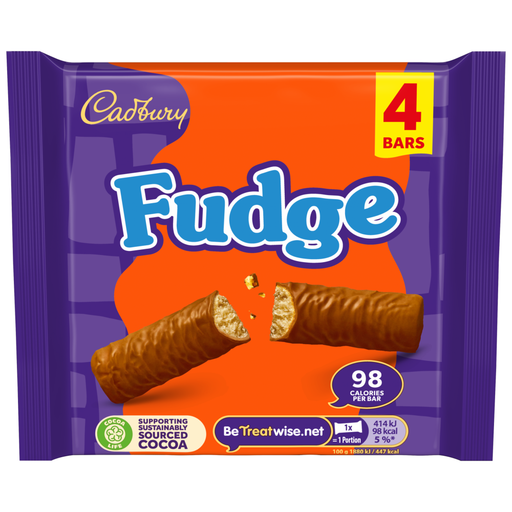
Cadbury Fudge Bar 4 Pack 88g

Cadbury Fudge Bar 4 Pack 88g

The 88g four-pack gives you separate bars to consider when deciding how much to serve as an occasional home treat. Check the current pack for the amount per bar, serving information and complete allergen wording.

View on Joybuy

Questions about buying and serving

Is fudge an everyday after-school snack?

Plan fudge as an occasional sweet treat rather than an everyday default. NHS guidance says the frequency and amount of sugary foods and drinks should be as low as possible; check the product’s sugars for the amount you intend to serve.

Can I send fudge or boxed chocolates into school?

Check the individual school’s packed-food and allergy policy before sending either product in. England’s Requirements for School Food Regulations 2014 define chocolate and non-chocolate confectionery for the school-food context, and Department for Education guidance covers food provided in state-funded schools in England; those sources do not establish a UK-wide rule for a snack brought from home.

Does “may contain nuts” mean nuts are an ingredient?

No. An ingredients list identifies what is used in the recipe, while a “may contain” warning flags possible cross-contact. Thorntons, for example, warns of nut cross-contamination even for products without added nuts. Use the exact current pack and the child’s allergy requirements to decide whether a product is suitable.

Are total sugars on the label the same as free sugars?

No. NHS guidance explains that the total sugars figure includes sugars naturally present in foods such as milk and fruit. Compare confectionery labels using the same measure, such as sugars per 100g, but do not treat the figure as an exact free-sugars amount.

How long can fudge be kept after opening?

Follow the instructions on the exact product. M&S says its Clotted Cream Fudge should be kept in a cool, dry place and eaten within seven days of opening; that period should not be applied to other fudge packs without checking their labels.