Families baking cookies or brownies together
Ready-cut chunks let children help add pieces without handling a knife. Waitrose describes its Cooks’ Ingredients Fudge Chunks as pieces for cookies; an adult still needs to supervise the activity.


Choose ready-cut fudge chunks when a recipe needs pieces and children will help add them: there is less cutting for an adult to do during the activity. A larger fudge pack gives an adult control over piece size, while a bar multipack is more useful for setting aside separate treats than as a ready-to-use baking ingredient. Check the exact pack’s ingredients, allergens and age warnings before children handle or eat it.
Ready-cut chunks let children help add pieces without handling a knife. Waitrose describes its Cooks’ Ingredients Fudge Chunks as pieces for cookies; an adult still needs to supervise the activity.
A pack with a stated number of bars makes it easier to decide what to use in the bake and what to set aside. Check the weight and wrapping of the exact pack rather than assuming every multipack contains separate portions.
Read the physical pack’s ingredients, allergen statements and any age warning before children handle or eat the fudge. The warning on one product does not establish what applies to another.
Start with what the recipe requires, then check the pack size and label against the children who will use or eat it.
Choose when: A cookie, brownie or traybake recipe calls for pieces to mix in or scatter on top.
Trade-off: Pre-cut pieces save a cutting step, but the pack’s allergen and age warnings still apply.
Choose when: An adult wants to cut the amount and piece size specified by a recipe.
Trade-off: Cutting adds a preparation step, and the pack should not be treated as one serving.
Choose when: Setting aside a known number of treats matters more than having pieces ready for a bake.
Trade-off: A fudge bar is not automatically a baking ingredient; check whether the recipe can use chopped bar pieces.
| Priority | What to check | Your needs |
|---|---|---|
| Recipe format | Does the recipe call for pieces? Check whether the exact product is sold as baking chunks or as confectionery that an adult would need to cut. | I’d like children to help add fudge without the baking session depending on them cutting it. |
| Pack quantity | Compare total weight, number of units and, where stated, weight per unit. Weigh the amount the recipe calls for rather than using the whole pack by default. | I want to know how much will go into the bake and whether there will be pieces left to set aside. |
| Ingredients and warnings | Read the current pack’s ingredients, emphasised allergens, precautionary statements and any age or choking warning before use. | A child may handle or eat the fudge, so the label needs to work for that child and the planned activity. |
A bar multipack supplies a stated number of bars; baking chunks supply pieces. Those formats serve different purposes even when both contain fudge.
Match the format to the recipe first. If using bars as an ingredient, check that the recipe can accommodate chopped bar pieces and have an adult do the cutting.
Allergen statements and warnings apply to the exact product and pack. For example, the reviewed Waitrose baking chunks contain milk ingredients.
Check the physical pack’s full ingredient list and precautionary statements before children handle or eat it.
Pack weight describes what is sold, not how much a bake requires or how much to serve. The NHS distinguishes free sugars from the total-sugars figure shown on food labels.
Decide on the recipe quantity and weigh it before adding the fudge; use the remaining pack according to its storage instructions.
M&S states that its 135g Clotted Cream Fudge is not suitable for children under 36 months because of a potential choking hazard. Being involved in baking does not remove that warning.
Read the warning on the product being used, keep pieces away from children below any stated age, and let an adult manage cutting and serving.
Waitrose describes its Cooks’ Ingredients Fudge Chunks as caramel fudge pieces for adding to cookies.
Tesco’s fudge listings include baking-labelled chunks and a Cadbury Fudge Kids chocolate-bar multipack.
M&S describes individually wrapped fudge pieces in its range alongside traditional fudge products.
Thorntons lists an 85g Vanilla Fudge Bag and a 300g Assorted Fudge pack.
This fudge bar multipack is an option when a known bar count matters. Check the recipe separately if you intend to bake with the bars.
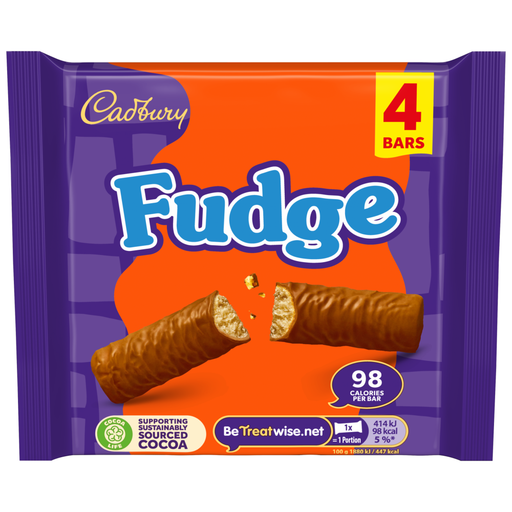 Image unavailable
The four-bar, 88g pack gives a known count for planning treats separately from a bake. Its listing declares milk and gives 65g sugars per 100g. If using the bars in a recipe, check that chopped bar pieces will work; check the physical pack for full allergen information, individual wrapping and any age warning.
Use ready-cut chunks when the recipe needs pieces and you want to avoid cutting fudge during the activity. Waitrose describes its Cooks’ Ingredients Fudge Chunks for cookies; a larger pack can also be used if an adult cuts the amount and size the recipe requires.
They are an option if the recipe can use chopped confectionery-bar pieces, but a bar multipack is not automatically a baking ingredient. Check the recipe and the exact pack’s ingredients before an adult prepares the pieces.
Read the exact physical pack’s ingredient list, emphasised allergens and any precautionary statement before the child handles or eats the fudge. The reviewed Waitrose baking chunks contain milk ingredients; another fudge product may have different ingredients or warnings.
Check the warning on the particular fudge product before involving a young child. M&S labels its 135g Clotted Cream Fudge unsuitable for children under 36 months because of a potential choking hazard; an adult should manage cutting and keep pieces away from children below a stated age.
Use the quantity specified by the recipe and weigh it rather than treating the pack’s total weight as the amount to add. A nutrition label’s total-sugars figure is not the same measure as free sugars, so do not use one as a direct substitute for the other.