Small household or office groups
If a few people are sharing during a break, compare the pack weight with its serving guide. The product examples from Waitrose, M&S and Tesco range from 97g to 150g; their stated portions are not interchangeable.


Choose by the number of people sharing and the pack’s stated servings, rather than the word “sharing” alone. A 150g traditional-fudge box with a serving guide can help plan a small group break; a smaller bag or coated fudge bites may suit a different format, but check the exact pack’s ingredients and allergen warnings before putting any fudge out.
If a few people are sharing during a break, compare the pack weight with its serving guide. The product examples from Waitrose, M&S and Tesco range from 97g to 150g; their stated portions are not interchangeable.
Check the exact pack for ingredients and precautionary warnings before offering it to anyone else. The product examples have different milk, gluten, soya, peanut and nut declarations. The Food Standards Agency advises that UK food businesses must provide information when any of the 14 regulated allergens are used as ingredients.
If a state-funded school is providing food to pupils during the school day, check the applicable England school-food requirements before choosing fudge. The Department for Education describes those requirements for school-provided food; a privately brought snack is a separate situation.
Start with how many people will share, then check the recipe and the nutrition values against the serving size printed on that particular pack.
| Priority | What to check | Your needs |
|---|---|---|
| Amount to share | Compare net weight, stated serving size and approximate number of servings. Waitrose lists approximately six servings for its 150g Clotted Cream Fudge; Tesco lists approximately five for its 150g Buttermilk sharing box. | I’m sharing with a few people and want to decide how much to put out, rather than treating the whole pack as one break’s serving. |
| Ingredients and allergens | Read the current ingredients, emphasised allergens and any “may contain” or “not suitable for” statements. Do not assume that plain fudge and coated fudge bites have the same recipe. | Everyone sharing needs to be able to eat the exact product. M&S warns that its Blond Fudge Bites are not suitable for people with nut, peanut or egg allergy; Waitrose says its Clotted Cream Fudge may contain peanuts and nuts. |
| Nutrition per serving | Compare sugars and energy using the same serving basis, or use per 100g values for a like-for-like quantity. Waitrose lists 19.4g sugars per two pieces of its Clotted Cream Fudge; Tesco lists 21.1g per 30g serving of Buttermilk Crumbly Caramel Sea Salt Fudge. | I want to know what the portion I put out represents. Two pieces and 30g are different measures, so those figures cannot be treated as a direct serving-for-serving comparison. |
Sharing packs can differ in weight and serving guidance. Waitrose’s 150g fudge states approximately six servings, while Tesco’s 150g Buttermilk box states approximately five.
Count the people first, check the pack’s serving information and put out the amount you intend to share.
A coated or biscuit-containing fudge bite can have a different ingredient list from traditional fudge. Precautionary nut and peanut warnings also differ between products.
Read the current ingredients and every “may contain” or “not suitable for” statement on the exact pack before sharing.
Retailers advise that recipes and product information can change. A previously viewed listing may not describe the pack you pick up.
Check the physical label for ingredients, allergens, nutrition and servings at purchase and before serving.
These examples show different fudge formats; a brand name alone does not establish the ingredients or serving size of another product in its range.
M&S lists 128g Blond Fudge Bites in its Chocolate Sharing Bags category, offering a coated-bite format rather than plain traditional fudge.
Waitrose Clotted Cream Fudge is a 150g traditional-fudge option with approximately six stated servings.
Tesco lists different sharing formats, including a 97g Munchies Salted Caramel Fudge bag and a 150g Buttermilk Crumbly Caramel Sea Salt Fudge box.
Thorntons describes chocolate-coated vanilla fudge and other toffee-and-fudge products on its UK site.
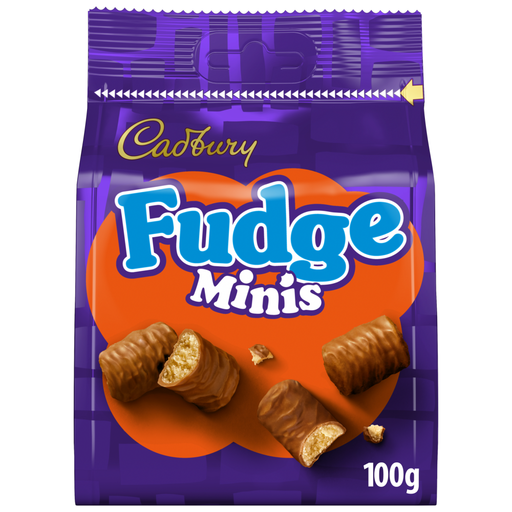
This 100g bag of fudge minis is an option for sharing at a mid-morning break; use its own label to plan servings and check allergens.
 No image available
The 100g bag contains fudge minis for sharing. The product description identifies milk and soya; check the physical pack for its complete allergen statement and serving guidance before putting the pieces out.
Read the current pack’s ingredients, allergen declarations and any “may contain” or “not suitable for” wording. The named product examples have different warnings, so neither the flavour nor the word “fudge” establishes suitability for everyone sharing.
No. Product information can change, so use the online listing to compare options and check the physical pack at purchase and again before serving.
Follow the instructions on the particular pack. Waitrose advises keeping its Clotted Cream Fudge in an airtight container after opening; Tesco’s Buttermilk listing says to keep its fudge tightly sealed after opening.
Check the school-food requirements that apply to food provided to pupils before selecting it. The Department for Education’s guidance concerns state-funded schools in England, while the School Food Regulations define confectionery to include non-chocolate confectionery and products containing chocolate. Those school-provision rules are a separate question from buying a private snack.
No. Department of Health and Social Care guidance on products high in fat, sugar or salt concerns restrictions on promotions of products within its scope, not a general prohibition on consumers buying fudge. Whether a particular pack is covered requires its classification under the applicable rules.