Gym-goers choosing a sweet treat
If you want fudge for enjoyment after exercise, decide on a portion rather than treating it as a protein-focused snack. Check protein per stated serving if that is what you need from your post-exercise food.


For an occasional sweet after training, choose fudge with a portion you can identify; if protein is your priority, do not rely on the fudge portions discussed here as your snack on their own. University College London Hospitals NHS Foundation Trust describes carbohydrate-and-protein snacks for use around exercise, while the Cadbury and Tesco portions cited below list less than 0.5 g or 0.3 g protein respectively. Check the current pack’s ingredients and allergen statements before sharing.
If you want fudge for enjoyment after exercise, decide on a portion rather than treating it as a protein-focused snack. Check protein per stated serving if that is what you need from your post-exercise food.
Separate bars and fudge with a stated piece or serving weight give you a unit to work from. With loose pieces, decide how much to take before passing the pack around.
Ingredients and precautionary allergen statements differ between the fudge examples. Check the specific pack for everyone who will share it; a vegetarian label does not mean dairy-free.
Start with the purpose of the snack, then compare the stated portion and the current ingredients label rather than judging by bag size alone.
| Priority | What to check | Your needs |
|---|---|---|
| Snack purpose | Check protein per declared portion, not just per 100 g. Compare the food with what you want from a post-exercise snack. | If I want a sweet treat, fudge can serve that purpose. If I am looking for protein, I need to check another food too: Sainsbury’s lists less than 0.5 g per Cadbury Fudge Treatsize bar, and Tesco lists 0.3 g per 25 g portion of each of its Dairy and All Butter fudges. University College London Hospitals NHS Foundation Trust describes carbohydrate-and-protein snacks for use around exercise. |
| Portion size | Look for a stated bar weight, piece weight or serving size. Compare sugars on the same quantity where possible; a two-piece serving is not necessarily the same weight as one bar. | I would rather know my portion before opening a sharing pack. Sainsbury’s lists 13.5 g per Cadbury Fudge Treatsize bar; Tesco gives 25 g portions for its Dairy and All Butter fudges, while Waitrose states nutrition for two pieces of its Clotted Cream Fudge. |
| Allergens | Read the current ingredients and any ‘may contain’ statement for the exact product. Check dietary labels separately from allergen information. | When I am sharing fudge, I need a product each recipient can assess from its own label. The listed examples have different milk, wheat, soya, nut and peanut information; M&S also says its Blond Fudge Bites are unsuitable for people with an egg allergy. |
Sainsbury’s lists less than 0.5 g protein per Cadbury Fudge Treatsize bar, and Tesco lists 0.3 g per 25 g portion of its Dairy and All Butter fudges. University College London Hospitals NHS Foundation Trust discusses carbohydrate-and-protein snacks for use around exercise.
Choose fudge as a treat if that is what you want. If protein is the reason for buying a post-exercise snack, check the protein in the food you plan to eat alongside it or instead.
Nutrition figures use different declared portions: Tesco Dairy Fudge lists 14.4 g sugars per 25 g, Tesco All Butter Fudge lists 18.9 g per 25 g piece, and Waitrose Clotted Cream Fudge lists 19.4 g per two pieces.
Check the serving description as well as the number. With loose fudge, put aside the amount you intend to eat before passing the rest around.
The examples have different ingredient and precautionary statements. Thorntons notes that products described as vegetarian may still contain dairy or eggs, and that relevant packs carry nut cross-contact information.
Read the current label for the particular product, especially when buying for someone else.
Sainsbury’s lists a 202 g Fudge Treatsize bag made up of chocolate-covered fudge bars, rather than loose pieces of plain fudge.
Tesco’s Dairy Fudge and All Butter Fudge listings each state nutrition for a 25 g portion.
Waitrose lists its Clotted Cream Fudge in a 150 g carton, with nutrition stated for a two-piece serving.
M&S lists Blond Fudge Bites as a 128 g chocolate-sharing-bag product with fudge centres and biscuit crumb.
Thorntons lists an 85 g Vanilla Fudge Bag and a 300 g Assorted Fudge format in its UK fudge range.
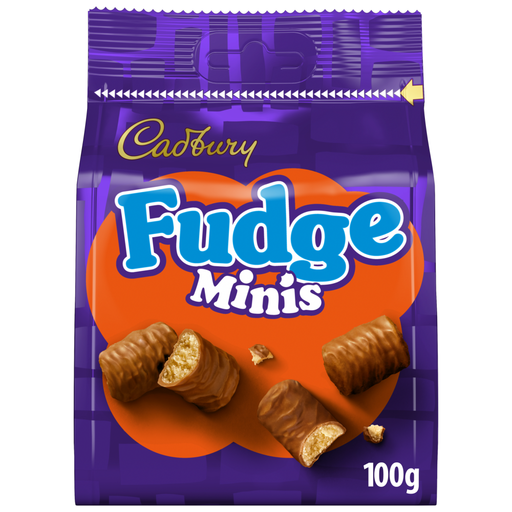
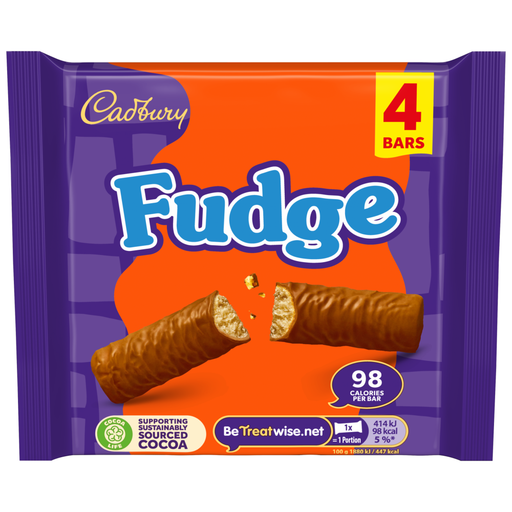
These Cadbury options cover a bag of fudge-centred minis and a four-pack of fudge bars. Compare their pack formats with the portion you want; the four-pack is not the same product as the 202 g Treatsize bag discussed above.
 No image available
This bag of fudge-centred minis is an option for passing around after training as a sweet treat.
The pack is 100 g and contains milk and soya. If you want to plan a portion by piece, check the current pack for the piece weight and serving information.
 No image available
The four-bar format gives you a count of bars to divide when sharing a sweet treat.
The total pack weight is 88 g, and the product contains milk. Check the current pack for each bar’s weight, nutrition and wrapping if those details matter to your choice.
Not on the basis of the portions cited here: Sainsbury’s lists less than 0.5 g protein per Cadbury Fudge Treatsize bar, and Tesco lists 0.3 g per 25 g portion of its Dairy and All Butter fudges. University College London Hospitals NHS Foundation Trust describes carbohydrate-and-protein snacks for use around exercise. Choose fudge as a sweet treat, and check another food if protein is your priority.
Use the bar, piece or serving weight stated on the current pack, then set aside your intended amount before sharing the rest. Sainsbury’s lists 13.5 g per Cadbury Fudge Treatsize bar, while Tesco states 25 g portions for its Dairy and All Butter fudges; those are different products and should not be treated as interchangeable servings.
Check the exact product’s current ingredients and precautionary statements for each recipient. The listed examples differ: M&S says its Blond Fudge Bites are unsuitable for people with nut, peanut or egg allergy, while Waitrose says its Clotted Cream Fudge may contain peanuts and nuts. A vegetarian description does not establish that a fudge is dairy-free.