Traditional fry-up planners
If you want a recognisable Full English, decide whether you need baked beans rather than a pasta side. The English Breakfast Society’s traditional-style recipe includes baked beans.


For a traditional-style Full English, choose baked beans rather than bulk pasta sauce: the English Breakfast Society’s recipe includes beans, not pasta sauce in their place. If your household wants a tomato-and-pasta side over several breakfasts, consider a tinned-spaghetti multipack; choose passata when you want a tomato base to season and cook yourself.
If you want a recognisable Full English, decide whether you need baked beans rather than a pasta side. The English Breakfast Society’s traditional-style recipe includes baked beans.
If you are planning several hot breakfasts and welcome spaghetti in tomato sauce as a side, separate tins may suit repeated meals. ASDA Groceries lists a Heinz multipack containing four 400 g tins.
If you would rather season a tomato ingredient yourself and use it across different dishes, Napolina describes its passata as a base for pasta sauces, soups and casseroles.
| Concern | What to check | Who this matters to |
|---|---|---|
| Breakfast fit | Decide whether the meal calls for baked beans or an optional pasta side before choosing a tomato-based product. | If I want a traditional-style fry-up, I need baked beans rather than a pasta substitute; about 46% of consumers put breakfast fit first. |
| Portions and leftovers | Check the number and size of tins, servings per tin and instructions for opened contents. | For breakfasts on different days, I want portions I can open as needed without wasting leftovers; about 36% of consumers make portion management their primary concern. |
| Ingredients and nutrition | Read the exact product’s current ingredient and allergen statement, then compare nutrition per serving and per 100 g. | When choosing a tomato-based product, I need its ingredients to fit my dietary requirements; about 18% of consumers prioritise those label checks. |
Tinned spaghetti, finished Bolognese sauce and passata differ in what they contain and how they are used. The English Breakfast Society’s traditional-style Full English recipe calls for baked beans, not pasta sauce in their place.
Choose beans for that style of breakfast, tinned spaghetti for an intentional pasta side, or passata or jarred sauce for a dish you plan to cook separately.
ASDA Groceries lists two servings for a 400 g tin of Heinz Spaghetti and says unused contents should be refrigerated and used within two days.
Match the tin size to the number of diners and plan when you will use the remaining portion.
The Heinz tinned spaghetti described by ASDA Groceries contains wheat, and its 400 g listing gives 0.7 g salt per half-tin serving. A different tomato product may have a different ingredient list.
Check the current label of the exact variant for allergens and nutrition before buying.
A finished sauce option for a separate pasta meal, rather than a bulk tinned breakfast side.
A plain tomato-base option for cooks who want to prepare and season a dish themselves.
A grocery-range reference for comparing tinned pasta formats with other tomato-based products.
This tinned-spaghetti multipack is for households choosing an optional tomato-and-pasta side across several breakfasts, rather than pasta sauce or baked beans for a traditional-style plate.
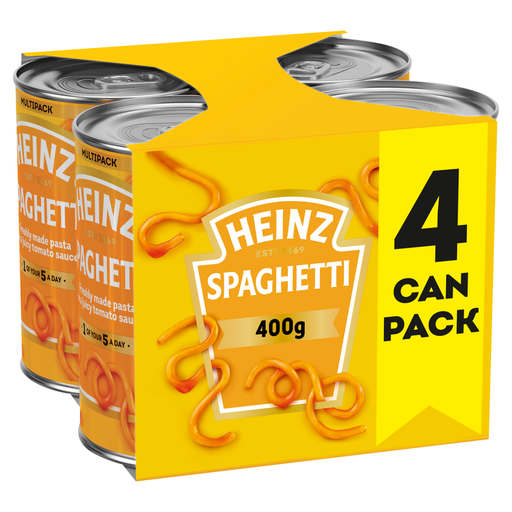 Image unavailable
For households that want a pasta side on more than one breakfast, this pack contains four separate 400 g tins. It is spaghetti in tomato sauce, not plain pasta sauce or baked beans. Check the current label for wheat and nutrition information; ASDA Groceries lists 0.7 g salt per half-tin serving for its 400 g Heinz Spaghetti. Follow the tin’s instructions for storing any unused contents.
Not if you want the traditional-style plate described by the English Breakfast Society: its recipe includes baked beans and treats tomato sauce as a separate optional condiment. Choose pasta sauce or tinned spaghetti only if you deliberately want a different side.
The Heinz Spaghetti 4 × 400 g format listed by ASDA Groceries contains four separate 400 g tins. Its related 400 g listing states two servings per tin, so consider how you will use each opened tin.
For the 400 g Heinz Spaghetti listed by ASDA Groceries, transfer unused contents to a suitable covered container, refrigerate and use within two days. Follow the instructions on the exact product you buy.
No. The Heinz tinned spaghetti described by ASDA Groceries lists durum wheat semolina and wheat flour. Check the current allergen statement on the exact product rather than relying on its tomato-sauce description.