What matters when choosing
Decide whether a larger QHD screen fits your desk and works with your device, then weigh positioning, other games and evening use.
| Concern | What to check | Who this matters to |
|---|
| Card text and workspace |
Check native resolution, device output and whether the game interface remains readable at your preferred scaling. |
When I keep a deck list beside the game, I want enough room to read both without constant window switching; roughly 33% of consumers put readability and workspace first. |
| Desk fit and positioning |
Compare the dimensions including the stand with your desk, and check its adjustment range. The Health and Safety Executive advises placing the screen directly ahead, about an arm's length away, with its top around eye level. |
With a shallow desk, I need the monitor to fit and sit at a comfortable height. Desk fit and positioning come first for around 25% of consumers. |
| Other gaming uses |
Check that your device and connection support the resolution and refresh rate you intend to use; compare response-time claims only when their measurement methods match. |
I also play faster games, so I want the same screen to suit those sessions without overlooking deck-building needs; approximately 25% of consumers prioritise mixed-game use. |
| Shared-bedroom evenings |
Check brightness controls and your quiet-audio options. If you want a low-blue-light mode, confirm it on the exact model rather than treating it as a substitute for bedtime habits. |
When someone else is winding down, I need to manage light and sound as well as the game itself; for about 17% of consumers, evening-use arrangements are the primary concern. |
Joybuy monitor choices
These choices span compact Full HD, 27-inch QHD and larger high-resolution gaming monitors. Use the size and resolution that suit your desk and card-reading needs, then check the exact model's positioning, connections and quiet-audio options.
 No image available
LG UltraGear G8 27G850A, 27-inch 4K UHD Nano IPS
Consider this high-resolution route if card detail and space for other windows are your priorities and a 27-inch screen fits your desk.
The listed dual-mode refresh rates are 240Hz and 480Hz, with DisplayPort 2.1 and HDMI 2.1 connections. Check which modes your device and connection can use, and compare the full dimensions including the stand with your desk.
View on Joybuy
 No image available
Samsung Odyssey G6 S27DG612, 27-inch QHD OLED
This 27-inch QHD option suits consumers considering a larger screen for deck lists alongside gaming in other genres.
The title lists an OLED panel and 240Hz refresh rate. Check desk fit, source-device compatibility and how you will arrange quiet audio in the shared room.
View on Joybuy
 No image available
HKC G27H2DPro, 27-inch QHD Fast IPS
Consider this QHD IPS option if you want room for card text and companion windows on a 27-inch screen.
The title specifies 2560 × 1440 resolution and 220Hz. Check the stand's adjustment range, audio connections and whether your device supports the display mode you want.
View on Joybuy
 No image available
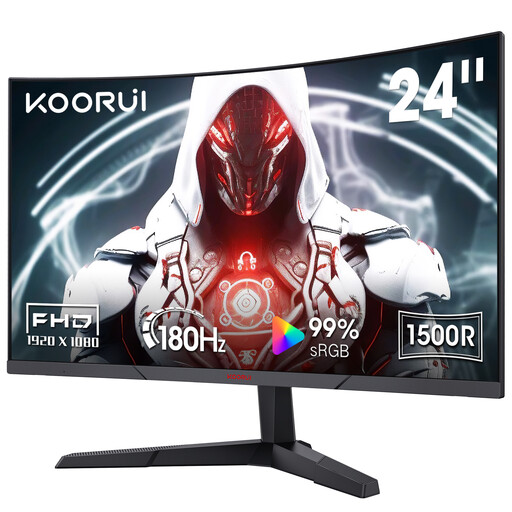
KOORUI MG24A12FV2, 24-inch curved Full HD VA
This smaller-screen route is worth considering when a 27-inch monitor would crowd the desk, provided Full HD gives you enough room for card text.
The title lists a 1500R curve, 180Hz, adaptive sync, tilt adjustment, two HDMI ports and DisplayPort. Check the full dimensions and your quiet-audio arrangements before choosing it for a shared bedroom.
View on Joybuy
 No image available
CRUA 32-inch 1500R curved QHD VA monitor
Consider this larger screen only if your desk and viewing position can accommodate 32 inches; QHD resolution alone does not settle the fit question.
The title specifies 2560 × 1440 resolution, 165Hz, adaptive sync, HDMI, DisplayPort and 100 × 100 mm VESA mounting. Check the full dimensions and whether its positioning options suit your desk and chair.
View on Joybuy
Common questions
Is a 27-inch QHD monitor too much for deck-building games?
Not if you want room for deck lists, guides or other windows and can position the screen comfortably. LG UK lists a 27-inch QHD example in the 27GR75Q-B; if your desk is shallow, a smaller Full HD model may be easier to accommodate.
Do deck-building games need a 165Hz or 180Hz monitor?
No particular refresh-rate threshold is needed to choose a monitor for deck-building. Higher refresh rates are more relevant if you also play faster games; check card readability, desk fit and device connections separately.
Will a low-blue-light mode prevent late-night disruption?
No monitor mode guarantees that bedroom screen use will not disturb sleep. University Hospitals Plymouth NHS Trust advises avoiding bright light, including blue light from devices, around bedtime; also consider brightness, playing time and the other occupant's need for quiet.
How should I position a monitor on a small bedroom desk?
Aim for a position directly in front of you, with the top of the screen around eye level and the screen about an arm's length away, in line with Health and Safety Executive guidance. Compare the monitor's dimensions including its stand with your desk, and check adjustment or compatible mounting options before ordering.


