
24/7 Customer Support

Free returns

Same-day & Next-day Delivery

Quality Guaranteed

Unlock Your Welcome Offers: FREE Delivery | Up to 80% OFF | Free 30-day JoyPlus trial
Download the APP
A full-length freestanding mirror can make a bedroom, hallway or dressing area feel more practical and spacious, but the wrong design may become an awkward piece of furniture rather than a useful everyday essential. Before buying, UK shoppers should look beyond a fashionable frame and check the mirror’s actual footprint, stability and construction.
A product may be advertised as “full length” without clearly explaining its glass dimensions. Check the overall height and width, but also consider whether the frame takes up part of the visible surface. A 153 cm mirror can provide a useful head-to-toe view for many users, while a narrow 30 cm width is easier to position in restricted rooms.
A slim standing mirror may look compact in a product photograph but require more room once angled away from a wall. This is particularly relevant in studio flats, student accommodation and narrow hallways. Check the listed depth as well as the front-facing width. A mirror with a 30 cm depth may fit more easily than a wide dresser-style design.
A lightweight frame is convenient to move, but an unstable base can be unsuitable for busy corridors or uneven flooring. Deep-pile carpets, loose rugs and frequently used walkways can increase wobbling. Look for a clearly stated freestanding structure, place it on a level surface and follow the manufacturer’s positioning guidance.
For head-to-toe viewing, prioritise a mirror tall enough for your intended use. Measure the wall or floor area where it will stand, allowing room for skirting boards, nearby furniture and opening doors.
A full-length bedroom mirror does not need to be wide to be useful. A narrow design can work beside a wardrobe or in a dressing corner, while a wider mirror may be more suitable where several people use it. For a hallway mirror, also check that the frame does not obstruct the normal walking route.
A black metal framed mirror can complement contemporary, industrial and Nordic-style interiors. Powder-coated metal is commonly selected for its neat matt appearance and resistance to everyday surface wear. However, the finish still needs suitable care: avoid abrasive pads, bleach and acidic cleaners that may affect the coating.
Glass and metal construction can offer a clean, relatively slim appearance compared with bulkier wooden furniture. Always lift a freestanding mirror by its lower structural frame rather than pulling from the arch or glass.
A space-saving mirror is only practical if it remains securely positioned. Use it on a flat, level floor and take extra care on thick carpets. If the product arrives fully assembled, that may reduce installation time, but it does not remove the need to position it safely.
For routine cleaning, use a clean microfibre cloth. If glass cleaner is required, apply a small amount to the cloth rather than spraying directly onto the glass or frame. Avoid placing the mirror in a continuously wet, poorly ventilated room, as prolonged moisture may affect the backing over time.
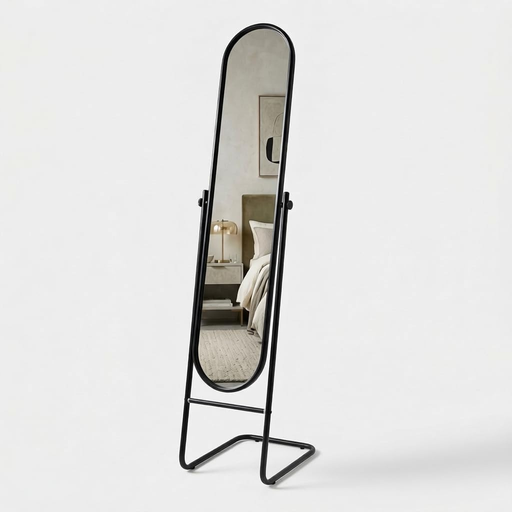
Why This Fits Their Persona: The arched floor mirror suits shoppers who want a defined decorative feature for a bedroom, dressing area or modern hallway without using a broad section of floor space.
Its listed 153 cm height, 30 cm width and 30 cm depth make the dimensions clear, while the freestanding metal structure avoids relying on wall installation.
Rounded-top profile, matt black powder-coated metal frame, 1x reflection, 5 kg listed weight and a 2-year manufacturer’s warranty.
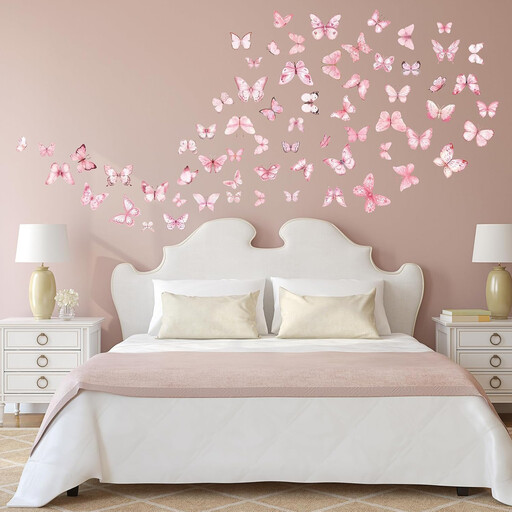
Why This Fits Their Persona: This is a decorative add-on for renters, students or children’s bedrooms where a low-commitment room update is preferred. It is not a substitute for a full-length mirror.
Clear product dimensions of 20 x 30 cm per decal help prevent confusion between decorative wall accessories and functional reflective furniture.
Three separate decals provide a simple decorative option for a bedroom or nursery wall.
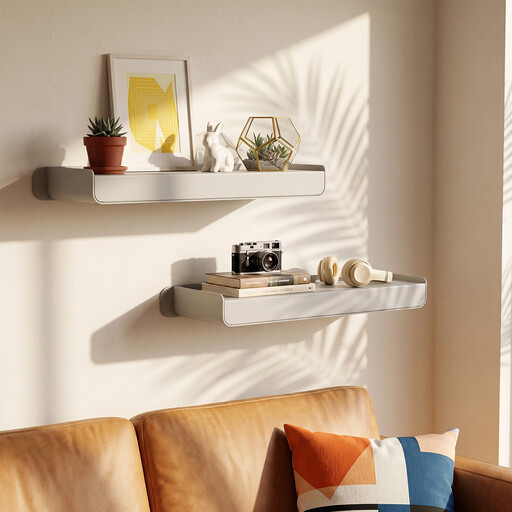
Why This Fits Their Persona: Shoppers furnishing a hallway, dressing area or bedroom may pair a mirror with vertical storage for keys, toiletries, books or display items. This shelf is a complementary furnishing rather than a mirror.
Its stated 20 kg maximum load and included mounting hardware make the storage specification more transparent than vague “heavy-duty” wording alone.
Aluminium construction, waterproof and rust-resistant finish, rubber wall-protection pad and supplied installation hardware.
For a bedroom, place the mirror near a wardrobe or dressing area while keeping enough clearance to stand back. An arched floor mirror can soften angular furniture and add height without requiring wall drilling.
In a narrow hallway, position a black freestanding mirror beside a window or light source where it will reflect brightness without creating glare. Avoid placing it where doors, pets or regular foot traffic could knock into the frame.
A round-top mirror is also useful in rooms with strong rectangular lines, such as spaces with fitted wardrobes, shelving and square furniture. Its curved upper edge can provide visual contrast while retaining the practicality of a standard full-length design.
Usually, yes. A freestanding model avoids drilling into walls and can be moved when you rearrange or leave the property. It should still be placed on a level surface and kept away from busy routes where it could be knocked.
Measure the available floor area first. A slim standing mirror around 30 cm wide can fit beside a wardrobe or in a corner, but check its full depth and the clearance needed for comfortable viewing.
Use a dry, soft cloth for routine dusting. For marks on the glass, apply non-abrasive cleaner to a microfibre cloth rather than directly onto the mirror. Avoid bleach, acidic products and scouring pads on the powder-coated frame.
We have compiled a complete, real-time list of products that fully satisfy these strict selection criteria and UK safety regulations.