For mainly static game-menu layouts and artwork, start with a monitor whose resolution, colour-space coverage and stand adjustment suit your desk and delivery workflow. Give higher refresh rate more weight if you regularly inspect animated menus and in-engine navigation; check that your computer and connection can drive the resolution and refresh rate you intend to use. A 27-inch 4K screen is one option for detailed desk work, not a requirement for every setup.
Who is this for?
Game UI and menu designers
If you create layouts, icons, typography or 2D assets, consider how you will inspect fine details and which colour space your finished work requires. The BenQ PD2705U and ASUS PA279CRV specifications illustrate different colour-space options.
Creators who also test in-engine
If you switch between asset work and checking animated menus or navigation, consider refresh rate alongside resolution and colour requirements. Dell specifies a 120Hz refresh rate for its U2725QE.
Laptop-based home-office creators
If your laptop is your main workstation, check its display connection and charging needs against the monitor’s ports and power delivery. An adjustable stand also gives you more scope to position the screen on your desk.
What matters when choosing?
Colour-focused creator monitor
Choose this when: Most of your work is static layout, typography and artwork in a defined colour space.
Trade-off: A 60Hz model offers fewer screen updates than a 120Hz model when you inspect fast menu movement.
Higher-refresh hybrid monitor
Choose this when: You frequently inspect animated transitions, cursor movement or controller navigation in-engine.
Trade-off: Higher refresh does not establish that the monitor has the colour coverage or calibration your artwork needs; the computer and connection must also support your intended display mode.
| Concern | What to check | Who this matters to |
|---|
| Colour for UI assets |
Match documented colour-space coverage to your working and delivery workflow; check any calibration claim for the exact model. |
If my menu artwork has to follow a defined colour workflow, I want to inspect it in an appropriate display mode. Around 33% of consumers put that colour match first. |
| Workspace and laptop connection |
Check resolution, available display inputs and, for a USB-C desk setup, laptop video compatibility and stated power delivery. |
When I use one screen for editing and previewing menus from a laptop, usable workspace and a compatible connection come first; around 27% of consumers share that primary need. |
| In-engine motion checks |
Confirm the refresh rate at your intended resolution and whether the computer, port and cable support that mode. |
If I regularly assess moving transitions and menu navigation, I want the display mode to suit those checks. That is the first concern for around 20% of consumers. |
| Desk positioning |
Look for useful height and tilt adjustment, or confirm mount compatibility if you plan to use an arm. |
For long sessions at my home-office desk, I need to position the screen without working around an awkward fixed stand; around 20% of consumers prioritise that setup. |
Buying pitfalls
-
Choosing by refresh rate alone
A higher refresh rate helps distinguish monitors for motion checks, but it does not tell you whether their colour coverage, connections or stand suit your work.
Prioritise refresh rate when in-engine movement is a regular part of your task; otherwise establish your artwork and desk requirements first.
-
Choosing a wide gamut without a workflow for it
Coverage of Adobe RGB or DCI-P3 is relevant when your asset workflow uses those spaces. It is not, by itself, a reason to choose a monitor for work delivered in sRGB.
Identify the colour space you work in and deliver to, then compare the exact models’ stated coverage and calibration claims.
-
Assuming any USB-C connection will charge a laptop
USB-C video support and power delivery are separate details, and the laptop’s power requirement still matters.
Check the laptop’s video-output capability, the monitor’s stated power delivery and the cable needed for your intended connection.
You may still need the laptop’s original power adapter during demanding work, rather than relying on a one-cable desk setup.
-
Expecting the monitor alone to fix the desk setup
Stand adjustment is useful only if the screen can be positioned sensibly within the wider workstation. The Health and Safety Executive’s display-screen guidance places the user’s eyes at approximately the height of the screen’s top edge.
Consider screen height, desk layout and reflections as well as the monitor’s adjustment options.
Brands to consider for these workflows
BenQ
The PD DesignVue range includes a conventional 27-inch 4K option for UI and asset work.
- BenQ specifies 99% sRGB and 99% Rec.709 coverage and a 60Hz refresh rate for the PD2705U.
- The PD2705U’s stated 60Hz refresh rate is worth weighing against your need to inspect faster in-engine movement.
ASUS ProArt
The PA279CRV is a reference point when game-menu assets form part of a wider-gamut workflow.
- ASUS specifies 99% DCI-P3 and 99% Adobe RGB coverage for the PA279CRV, alongside a factory pre-calibration claim of Delta E < 2.
- Choose against the colour space your work actually uses; those model-specific specifications do not establish the result in every software workflow.
Dell UltraSharp
The U2725QE is relevant when a 4K work screen must also serve regular menu-motion checks.
- Dell specifies a 27-inch 4K display and 120Hz refresh rate for the U2725QE.
- Check the required connection and colour workflow separately before treating higher refresh as the deciding feature.
Joybuy monitors for game-menu work
These monitors offer different ways to combine detailed menu work with motion checks or a home-office desk setup. Compare the listed model and variant against your own colour workflow, computer connection and available desk space.
 No image available
ASUS ProArt Display PA32UCG-K 32-inch 4K HDR Mini LED
Consider this larger screen if you work on detailed menu artwork and regularly check in-engine motion. Its product title lists 120Hz, DCI-P3, Thunderbolt 3 and a Delta E < 1 claim; check the colour and connection requirements for your workflow.
Allow desk space for a 32-inch screen. If HDR brightness matters to your work, confirm the applicable brightness specification before choosing.
View on Joybuy
 No image available
Dahua 32-inch 4K 165Hz Curved OLED Monitor
This is an option if in-engine interaction checks matter alongside 4K menu work and you want a curved screen. Its product title specifies 165Hz, 99% DCI-P3 and Type-C 65W.
Check that the screen size and curve suit your desk and that your laptop supports the video connection you intend to use.
View on Joybuy
 No image available
BenQ MA270UP 27-inch Nano Glossy 4K USB-C Monitor
Consider this 27-inch option for menu artwork at a laptop-based desk if its connection and Mac-focused features suit your computer. Its product title identifies USB-C, a P3 colour claim and a height-adjustable stand.
If you use a non-Mac computer or need a particular calibration standard, confirm the relevant feature support and colour specification for your workflow.
View on Joybuy
 No image available
iiyama ProLite XUB2792UHSU-B6 27-inch 4K Monitor
Consider this 27-inch 4K screen if your main task is laying out menus and inspecting fine interface details at a home-office desk.
If laptop docking or colour-critical delivery is central to your choice, confirm the exact model’s video, charging and calibration specifications before relying on those functions.
View on Joybuy
 No image available
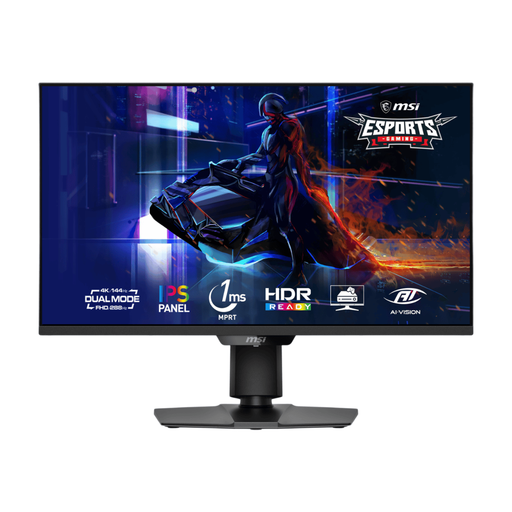
MSI MAG 275UPD E14 27-inch Dual-Mode 4K Monitor
Consider this model if you want a 27-inch screen for 4K menu layouts and separate higher-refresh in-engine checks. Its product title specifies UHD at 144Hz and FHD at 288Hz; 288Hz is the FHD mode, not the 4K mode.
Confirm your computer and connection support the mode you plan to use, and check colour accuracy separately if your artwork requires it.
View on Joybuy
Frequently asked questions
Do I need 4K to create game menus?
No: 4K is a choice for more detailed screen work, not a requirement for creating menus. At 27 inches, consider how you will view fine UI elements, whether you need interface scaling and what resolution your computer can output.
Is 120Hz necessary for game-menu design?
No: a 60Hz monitor can suit work centred on static layouts and assets. Consider 120Hz when you regularly inspect moving transitions or in-engine interaction, provided your computer and connection support the intended resolution at that refresh rate.
Can one USB-C cable display my work and charge my laptop?
It can if the laptop supports video output through the relevant USB-C or Thunderbolt connection and the monitor’s stated power delivery meets its charging needs. Check both devices and the cable before planning a one-cable desk setup.


