Dark-room control seekers
You want to recognise important keys in low ambient light and adjust the lighting to suit your controls, rather than rely on a fixed colour effect.


For space-exploration games in a dark room, start with lighting that helps you identify the keys you use, then choose a layout that fits your controls: a compact board leaves more mouse room, while dedicated macro and media keys put extra commands within reach. Check the exact switch option and connection mode for longer evening sessions; brighter effects or a headline polling rate alone do not settle those choices.
You want to recognise important keys in low ambient light and adjust the lighting to suit your controls, rather than rely on a fixed colour effect.
You spend extended sessions navigating and managing menus, so switch feel, noise and accessible controls matter alongside the lighting.
You need room for mouse movement or want fewer cables, but must decide which physical keys and connection options you are willing to give up.
Decide which keys you need to see and reach, then check the exact layout and switch option. Treat wireless flexibility as a separate choice, especially if you rely on lighting throughout a session.
| Concern | What to check | Who this matters to |
|---|---|---|
| Finding keys in low light | Check whether the exact variant has illuminated legends, adjustable brightness and lighting controls you can use with your device. | If I need to pick out familiar commands without turning on the room light, visible legends matter more to me than decorative effects. Around 31% of consumers put low-light key visibility first. |
| Layout and extra commands | Compare the physical layout, numpad and dedicated macro keys with the controls you use in-game. | When I use frequent navigation or shortcuts, I need to know whether compactness will remove a key I rely on. For around 31% of consumers, layout and command access are the primary concern. |
| Switch feel and noise | Identify the exact switch option and any sound-dampening construction; try the feel where possible. | Late-night play calls for keys that feel right without causing unwanted noise around other people. Switch feel and sound come first for around 23% of consumers. |
| Connection flexibility | Check the available wired and wireless modes, charging arrangements and what happens to lighting in power-saving mode. | If I move between devices or want fewer cables on my desk, connection options can shape the whole setup. Around 15% of consumers make that flexibility their first priority. |
A striking lighting pattern does not necessarily make the legends or your most-used controls easy to identify. Keyboard lighting also does not address monitor glare or the wider room setup.
Look for visible backlit legends and useful brightness or per-key controls on the exact variant. Consider screen glare and breaks separately; the Health and Safety Executive identifies several workstation and use factors that can contribute to fatigue and eye strain.
Compact layouts can change which keys are directly available, while UK-ISO and US arrangements differ. That matters if a game command or everyday typing depends on a particular physical key.
Inspect the selected variant’s layout and key images, and decide whether you need a numpad before ordering.
An unsuitable arrangement can mean adapting your controls or replacing the keyboard.
Connection and power-saving modes can change a keyboard’s behaviour. Keychron specifies different polling rates for the Q3 Max’s Bluetooth and wired or 2.4 GHz modes; Razer says power saving on its BlackWidow V4 Tenkeyless HyperSpeed can turn lighting off.
Compare specifications for the mode you intend to use, particularly when backlighting is essential in your dark-room setup.
Keeping a preferred mode available may also mean charging the keyboard, connecting a cable or occupying a USB port with a receiver.
A pronounced key sound may not suit late-night play near other people, even if you like the feedback. Switch labels alone cannot tell you exactly how a keyboard will feel or sound in your space.
Check the switch fitted to the precise variant, consider any acoustic construction and try the keys where possible. If you may need to return it after opening, check the retailer’s applicable policy before purchase.
The K70 CORE TKL illustrates a compact, wired route for players who want to adjust lighting and remap controls.
The BlackWidow V4 is a control-focused option for players who expect to use dedicated shortcuts and media controls.
The G515 LIGHTSPEED TKL offers a low-profile, compact route when connection flexibility matters.
The Q3 Max UK-ISO is worth considering when layout, switch choice and acoustic construction take priority over a gaming-focused lighting system.
These keyboards cover different desk layouts and connection preferences for the dark-room gaming scenario. Check the exact key legends and lighting controls before relying on any model to make your controls visible.
 No image available
Consider this UK-designated wireless model if you want a more compact desk arrangement; check that its lighting and profile controls work with your intended device.
 No image available
A 60% layout may suit a desk where mouse room matters more than having every navigation key directly available. Check the physical key arrangement, UK layout and visibility of the legends before choosing it.
Analog optical keyboard; 60% layout.
 No image available
Consider this UK-layout option if you want to keep a numpad in a 96% arrangement. Check how its lighting illuminates the keys you use during dark-room play.
Wireless keyboard; black variant.
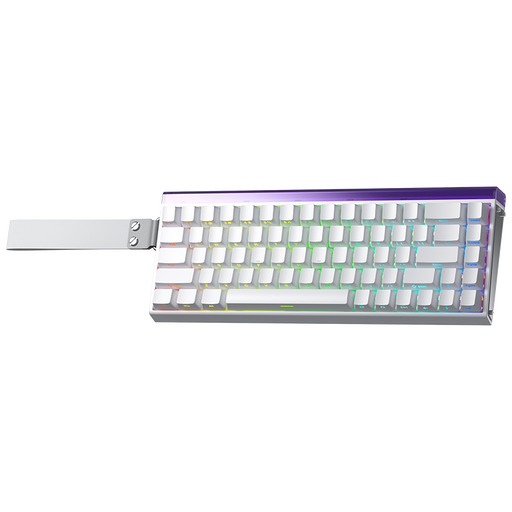 No image available
Consider the compact arrangement only if its US key layout works for your usual commands. Check whether the side-engraved legends are illuminated before counting on them in a dark room.
Hall effect magnetic switches, adjustable actuation, RGB lighting and cable connection are stated in the product name.
 No image available
This 75% option pairs a compact layout with several connection choices, provided its US key arrangement suits you. Check whether its RGB backlighting makes the keys you need readable at your preferred brightness.
The product name specifies wired, Bluetooth and 2.4G modes, RGB backlighting and PBT keycaps.
No: backlighting can help you locate keys, but it does not address the whole viewing setup. The Health and Safety Executive identifies overuse and workstation or environmental factors among contributors to fatigue and eye strain, so assess glare, monitor position and breaks separately.
Choose TKL if you want more mouse room and do not depend on a numpad. If your usual game controls require a numpad or readily accessible extra commands, compare a larger layout or a model with dedicated macro keys instead.
Not necessarily: check the figures and lighting behaviour for the mode you plan to use. Keychron specifies 1,000 Hz polling for the Q3 Max over wired and 2.4 GHz connections but 90 Hz over Bluetooth; Razer says power saving on its BlackWidow V4 Tenkeyless HyperSpeed can reduce polling and switch off lighting.
Great Britain continues to recognise CE marking alongside or in place of UKCA marking where the relevant product regulations allow it, according to GOV.UK guidance. That Great Britain guidance should not be assumed to describe Northern Ireland’s process, and a marking alone does not establish whether a particular keyboard has the layout or features you need.
Check an appropriate electrical-equipment collection or recycling route rather than treating the keyboard as ordinary household waste. GOV.UK describes the Waste Electrical and Electronic Equipment Regulations 2013, as amended, as supporting the recovery, reuse and recycling of electrical equipment and components.