Low-light story-game players
If you play detective or mystery games after dark, you may want adjustable lighting that makes the controls you use easy to locate without switching on the room lights.


Start with lighting you can adjust to make the keys readable, then choose a layout that keeps the arrows, function keys and shortcuts you use within easy reach. A smaller board saves desk space but may put commands behind Fn combinations; if you play near others at night, check switch noise as carefully as lighting. Wireless options and very high polling rates need not drive this choice unless they also serve another part of your setup.
If you play detective or mystery games after dark, you may want adjustable lighting that makes the controls you use easy to locate without switching on the room lights.
If you share a room or play near someone who is sleeping, the sound of the selected switches matters alongside the lighting. A mechanical label alone does not tell you how quiet a keyboard will be.
If you regularly open maps and inventories, take notes or use PC shortcuts, check which commands have dedicated keys before giving up desk space for a larger layout.
For detective games played in a dark room, settle key visibility and command access before treating specialist gaming-speed features as priorities. The table separates consumers by the need they would put first, even when several needs matter to the same person.
| Concern | What to check | Who this matters to |
|---|---|---|
| Readable keys | Check whether the legends illuminate and whether brightness can be adjusted; RGB effects alone do not establish readability. | When I play with the room lights off, I want to find movement, interaction and journal keys without hunting for them. Around 33% of consumers would put key visibility first. |
| Late-night noise | Check the exact switch variant and any sound-dampening features; do not assume all mechanical switches sound alike. | Playing near someone who is sleeping makes the sound of each keypress important to me. Reduced typing noise would be the primary concern for around 27% of consumers. |
| Command access | Check for dedicated arrow and function keys, and whether navigation commands require Fn combinations. | I move between maps, clues, menus and PC shortcuts often enough to care where those keys sit. Around 27% of consumers would prioritise familiar command access. |
| Desk flexibility | Compare physical size and connection options, including any charging needs for wireless use. | If I need more mouse room or use the keyboard with another device, its footprint and connections matter most. That would be the leading need for around 13% of consumers. |
Decorative effects do not tell you whether the legends are visible at a brightness you find comfortable.
Check the actual keycaps and brightness controls in the listing. If the keyboard permits it, a steady lighting setting may be easier to assess than an animated effect.
A 60%, 65%, 75% or tenkeyless layout can change which arrows, function keys and navigation commands have their own keys. A US physical layout may also differ from the UK layout you expect.
Inspect the exact variant’s key layout and decide which commands you are comfortable accessing through Fn combinations.
A high polling-rate or rapid-actuation claim does not answer whether you can read the keys, reach your shortcuts or tolerate the switch sound during a detective game.
Consider those specifications after the lighting, layout and noise checks, unless you also need the keyboard for reaction-focused competitive games.
GOV.UK’s guidance on waste electrical and electronic equipment describes recovery, reuse and recycling as aims of the UK framework.
When replacing a keyboard, check your local authority’s electrical-waste arrangements or the retailer’s take-back options.
Worth comparing if you want a gaming-focused, tenkeyless layout that retains a function row.
Relevant if you are comparing a compact board with tactile switches against a design aimed at faster competitive input.
Relevant if a thin keyboard and a choice of wired, Bluetooth and LIGHTSPEED connections suit your desk setup.
These keyboards cover several desk layouts and connection preferences for dark-room play. For each one, check the exact key legends, lighting controls and physical layout against the way you use maps, notes and shortcuts.
 Image unavailable
Consider this wireless, UK-labelled model if you want a smaller desk setup. Before choosing it for dark-room play, check whether the key legends illuminate and whether you can set the brightness to suit your room.
 Image unavailable
If a UK physical layout matters to you, this wireless Scope II 96 variant is one to compare. Confirm the selected switch type, key-legend illumination and brightness controls before relying on it for quiet, low-light play.
 Image unavailable
If typing noise matters, this named Silent Tactile variant is worth assessing, but the name is not a measured noise result. Its listed configuration has 108 keys, an aluminium build, tri-mode connectivity, hot-swappable switches, RGB lighting and an 8000mAh battery. Check that the US key positions and lighting of the legends suit you.
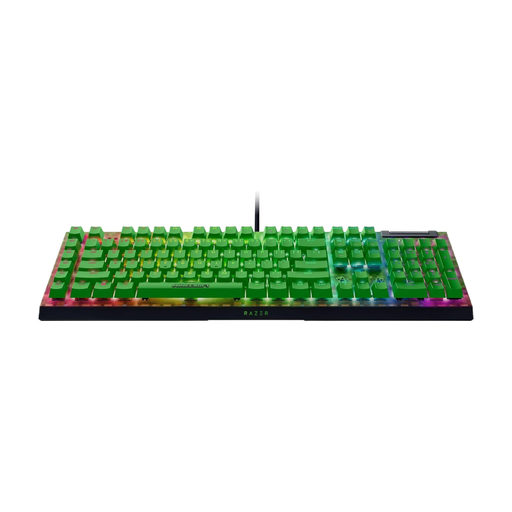 Image unavailable
Consider this themed mechanical keyboard if its switch sound will not disturb your room. Its Green switches are described as clicky, so do not assume sound-dampening makes it quiet; also confirm the physical layout and whether the legends illuminate.
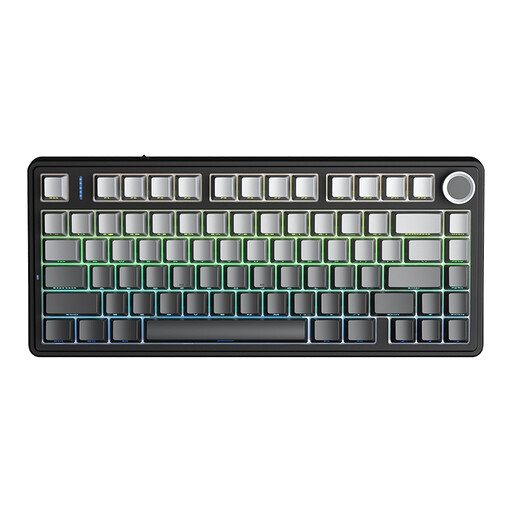 Image unavailable
For a smaller desk setup, this 75% keyboard offers listed Bluetooth, 2.4G and wired connections, hot-swappable switches and RGB backlighting. Check whether its US key positions, dedicated command keys and key-legend lighting work for your games.
A very high polling rate need not be your starting point for detective games. Razer positions the Huntsman V2’s up-to-8,000 Hz polling around competitive responsiveness; for this use, check readable lighting, command access and acceptable switch noise first, unless you also play reaction-focused games.
Not necessarily: it depends on how often you need keys that may sit behind Fn combinations on a compact model. If you frequently open maps and menus or use PC shortcuts, compare the exact arrow, function and navigation-key arrangement with a 75% or tenkeyless board before choosing the smaller footprint.
Check whether the exact variant has the UK or US physical layout you expect. Joybuy identifies some compact keyboards as US-layout models, so inspect the key positions rather than assuming a UK layout from the retailer or a generic product image.
Check an electrical-waste collection or take-back route before disposing of it. GOV.UK’s guidance on waste electrical and electronic equipment describes a UK framework supporting recovery, reuse and recycling; your local authority or retailer can provide the relevant collection arrangements.