What to check when buying
Decide which matters most in your room: avoiding disturbance, keeping keys within easy reach or making the desk easier to rearrange. Then compare exact layouts and configurations rather than relying on a keyboard’s size label alone.
| Concern | What to check when buying | Who this matters to |
|---|
| Noise near others |
Check the selected switch and whether the exact model states sound damping or a quiet-switch option. Neither establishes how it will sound on your desk. |
If someone nearby needs to study or sleep, I want to avoid disruptive keystrokes without assuming that a linear switch is quiet. Around 42% of consumers put avoiding disturbance first. |
| Desk space and controls |
Inspect the layout image for arrows, function keys and navigation-key access; decide whether you need a number pad. |
With little desk space, I still want keys for game menus and everyday work within easy reach. Keeping compact controls accessible is the main concern for around 33% of consumers. |
| Connection and setup |
Choose wired or check the wireless modes, included receiver, device compatibility and charging connection. |
When I clear the desk for study or move between devices, connection flexibility matters more to me than avoiding a charging routine. Roughly 25% of consumers prioritise that flexibility. |
Joybuy keyboard options
These compact gaming keyboards offer different approaches to limited desk space and connection choice. Compare their exact key layouts and switch configurations against your need for navigation controls and consideration for people nearby.
 No image available
ASUS ROG Strix Scope II 96 Wireless Gaming Keyboard, black, UK layout
Consider its compact 96% format if you want to save desk space without moving straight to a smaller layout. The title identifies a wireless keyboard and a UK layout; check the selected switch and key arrangement, and do not assume that acoustic treatment will make it quiet enough for a shared room.
View on Joybuy
 No image available
AULA F75 75% Tri-Mode Gaming Keyboard, US QWERTY layout
The 75% format is worth comparing if a smaller footprint matters but a 60% layout looks too restrictive. Its title specifies wired, Bluetooth and 2.4G modes, PBT keycaps and a US QWERTY layout. Check the physical key image if UK key placement matters; the title’s sound description is not a measure of quietness.
View on Joybuy
 No image available
ASUS ROG Falchion Ace HFX 65 Analog Gaming Keyboard, UK layout
A 65% format may suit a particularly small desk if you are comfortable checking how often-used navigation controls are accessed. The title identifies an analog gaming keyboard and UK layout; inspect the exact key arrangement before choosing it for frequent menu or coursework use.
View on Joybuy
 No image available
HyperX Alloy Rise 75 Wireless Keyboard UK
Consider this 75% wireless model if you want a compact board and a desk that is easier to clear. Check its exact physical key layout and sound profile before buying, particularly if someone nearby studies or sleeps.
View on Joybuy
 No image available
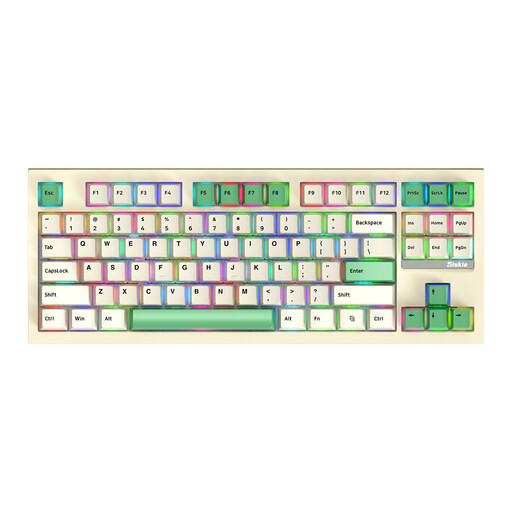
Siukie PL87W 87-Key Three-Mode Mechanical Keyboard
The 87-key format is an option to examine if you prefer a TKL-sized desk setup with connection flexibility. Its title identifies a detachable-switch, three-mode model; confirm the physical layout, access to the keys you use and sound suitability on the exact listing.
View on Joybuy
Common questions
Is a 60% keyboard practical for exploration games in a student room?
It can be if desk space matters more to you than direct access to every key. Razer says its 60% Huntsman Mini omits the function row, home cluster and number pad, so check whether secondary functions will suit the game controls and study tasks you use most.
Will linear switches make a keyboard quiet enough for a shared room?
Not necessarily: a switch name alone cannot tell you how a keyboard will sound in your room. Check the exact switch and any stated sound damping; Corsair specifies two damping layers for its K70 CORE TKL, but that is not a measured sound level for your desk.
Do I need a wireless keyboard for student-room gaming?
No. A wired keyboard avoids charging if it stays at one desk, while wireless may be useful when you regularly clear the desk or change devices. For wireless, check connection compatibility, receiver inclusion and charging arrangements on the exact model.
How should I dispose of a keyboard I no longer use?
Use an electrical-waste collection route rather than putting it in ordinary household waste. GOV.UK says electrical products can be taken to a local household waste recycling centre; check which collection or take-back options are available where you live.


