Players who reposition their keyboard
If you move between a desk and a large-display setup, wireless placement may be useful. Check which connection mode you intend to use for gaming and how you will charge the keyboard.


For exploration games on a large screen, choose wireless connectivity if you need to position the keyboard away from the PC; choose a full-size board if dedicated keys and a number pad matter more. A tenkeyless board leaves more room for the mouse but omits the number pad, while adjustable input features are most relevant if you also play reaction-heavy games. Check the exact layout, connection modes and keys before buying.
If you move between a desk and a large-display setup, wireless placement may be useful. Check which connection mode you intend to use for gaming and how you will charge the keyboard.
Maps, inventories and menus make key availability worth checking alongside the keyboard’s position at your desk. A compact format is less helpful if it removes keys you reach for regularly.
Adjustable actuation or other configurable input features may be relevant if you also play reaction-heavy games. For exploration alone, decide whether you would use those settings before making them a priority.
For large-screen exploration games, start with where the keyboard will sit. Then check the keys you use for maps and menus, the space available for your hands and mouse, and whether input tuning matters for other games you play.
| Concern | Buying checks | Who this matters to |
|---|---|---|
| Cable-free placement | Check for 2.4 GHz wireless, Bluetooth and a wired option; compare battery-life claims under the lighting and connection settings you expect to use. | If I move the keyboard between the desk and a large display, I want freedom to position it without awkward cable routing. Around 33% of consumers put cable-free placement first. |
| Long-session layout and comfort | Check the board’s size, front height and palm-rest arrangement, then make sure your screen and keyboard can sit centrally. | During a long session, I need the keys I use and a position that does not make me twist towards the screen. Suitable layout and positioning come first for around 27% of consumers. |
| Access to commands | Check for the function, navigation and number keys you use, and whether any remapping requires software or compatible game settings. | When I switch between maps, inventory, chat and other PC tasks, I want familiar commands within easy reach. Around 27% of consumers prioritise key availability and command access. |
| Competitive input tuning | If you also play reaction-heavy games, check whether actuation can be adjusted and how settings are changed or stored. | Exploration is only part of what I play, so I may want to tune how readily keys register in faster games. Input tuning is the main concern for around 13% of consumers. |
US and UK QWERTY layouts differ in some symbols, key positions and key shapes. That can matter for chat, shortcuts and everyday typing.
Check the exact layout in the product title, photographs and specifications rather than relying on the storefront’s location.
Tenkeyless and 75% formats omit the number pad; smaller formats may move or omit other dedicated keys. The saved desk space is less useful if you frequently need those keys.
List the keys you use for maps, menus and other PC tasks, then inspect the exact keyboard layout.
Quoted wireless runtime can depend on lighting and connection settings, so a maximum figure may not describe how you plan to play.
Compare the conditions attached to the quoted figure and check how the keyboard charges during use.
A palm rest or lower-profile board cannot compensate for a screen position that makes you twist or raise your shoulders.
For display-screen setups, the Health and Safety Executive advises positioning the screen and keyboard centrally and keeping the keyboard just below elbow height where possible.
The G915 X LIGHTSPEED illustrates a low-profile wireless option for a keyboard that may move between playing positions.
The UK-layout K70 CORE and K70 CORE TKL WIRELESS illustrate different choices between a desk-based full-size board and a smaller wireless format.
The Huntsman V3 Pro Tenkeyless is a more specialised option for players who want to adjust input behaviour for games beyond exploration.
These keyboards focus on wireless placement for a flexible large-screen setup, with different layouts and key-label choices. Compare the exact keys and connection options you need rather than treating the models as interchangeable.
 No image available
Consider this wireless model if you want to reposition your keyboard for large-screen play while retaining a listing that specifies a UK layout.
Confirm which switch option applies to this exact keyboard and check the battery-life conditions for the settings you plan to use.
 No image available
This wireless Alloy Rise 75 is an option if you want a smaller board for a flexible playing position.
Check photographs of the exact key layout before ordering: the title includes UK, but you should confirm the physical keys and symbols you need.
 No image available
Consider the F75 if flexible placement and a 75% layout matter more to you than a dedicated number pad.
Its title specifies wired, Bluetooth and 2.4G modes, PBT keycaps and a US QWERTY layout. Check that the US key positions suit your typing and which keys this exact layout retains.
 No image available
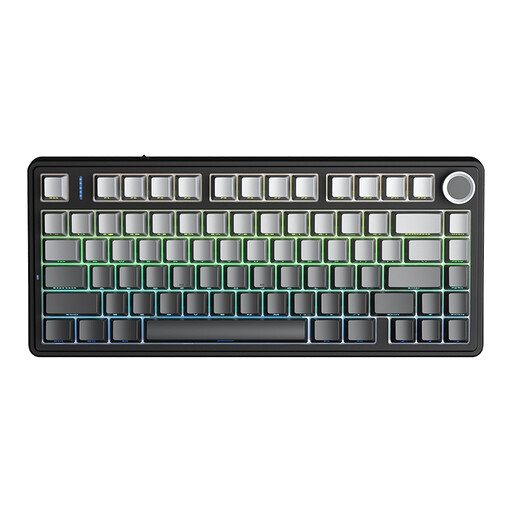
This F75 PRO may suit a flexible large-screen setup if you also want the hot-swappable switches named in its title.
The title specifies Bluetooth, 2.4G and wired modes and a US QWERTY layout. Check the exact keys retained by the 75% format and whether US key positions suit your other PC tasks.
No. Joybuy’s UK keyboard guidance notes that some symbols, positions and key shapes differ. If you type as well as play, compare photographs of the exact keyboard with the layout you use now.
Choose a connection mode supported by the exact keyboard and suited to where it will sit. For wireless gaming, check the model’s intended 2.4 GHz mode rather than assuming its Bluetooth connection behaves the same way; a wired option is useful if the keyboard stays near the PC or needs charging.
Not by itself. The Health and Safety Executive’s display-screen guidance advises keeping the screen and keyboard central and the keyboard just below elbow height. Consider the whole desk and seating arrangement before relying on a keyboard accessory.
You give up a dedicated number pad with either format. Check the exact model’s other keys too: if you frequently use arrows, navigation keys or function keys for games and everyday tasks, make sure they remain convenient to access.