Large-screen PC desk players
If the game appears on a large monitor or television while you sit at a desk, consider how the keyboard, mouse and available desk space work together. A compact layout is useful when you can do without a number pad.


For large-screen deck-building, confirm that your game and host device accept keyboard input before choosing a layout. A tenkeyless keyboard can free desk space if you do not need a number pad; wireless placement and quieter switch options matter when they suit your connection options and room. Macro controls and adjustable actuation are optional rather than necessary for turn-based play.
The right keyboard depends as much on where you play and who shares the space as it does on gaming features.
If the game appears on a large monitor or television while you sit at a desk, consider how the keyboard, mouse and available desk space work together. A compact layout is useful when you can do without a number pad.
When other people are nearby, switch feel and keyboard noise may matter more than rapid-input settings. Check the exact switch variant rather than relying on a keyboard family name.
Remapping, macro keys and adjustable actuation may be worth considering if you also use the keyboard for other games or desktop tasks. Confirm that the software and game rules allow any shortcuts you intend to use.
Start with game and host compatibility. Once the keyboard can serve the intended setup, choose which matters most to you: shared-room comfort or the balance between desk space and shortcuts.
| Concern | What to check | Who this matters to |
|---|---|---|
| Game and host compatibility | Confirm keyboard input in the exact game, then check the host’s USB, Bluetooth or 2.4 GHz receiver options against the keyboard’s connection method. | If I play on a television through a device other than my usual PC, I need to know the game will accept my keys before choosing switches. Around 42% of consumers put compatibility first. |
| Switch feel and noise | Identify the exact switch option and any sound-dampening construction; compare key feel in person where possible. | During a long session near other people, I want keys that feel comfortable without causing unwanted disturbance. Roughly 33% of consumers make shared-room comfort their primary concern. |
| Space and shortcuts | Decide whether you need a number pad, function keys or dedicated controls, and check that planned remaps are permitted. | At a crowded PC desk, I want mouse room without losing the shortcuts I use in other tasks. About 25% of consumers prioritise that layout-and-controls balance. |
The display does not determine whether the game accepts keyboard input or whether the host supports a particular connection. Steam Support notes that an input configuration can fail when a game does not support the selected input style.
Check the exact game’s input support and the host’s connection options before comparing keyboard features.
The same product family can have different regional layouts. Razer lists regional choices for its BlackWidow V4 Low-Profile Tenkeyless HyperSpeed, while Keychron identifies a UK-ISO Q1 HE variant.
Check the exact product title, selected variant and photographs for the layout you want, especially if punctuation keys and familiar shortcuts matter to you.
Short actuation and rapid-trigger settings offer extra configuration, but they are not established as necessary for turn-based deck-building. They will not resolve an incompatible host or awkward keyboard placement.
Consider those settings if you also want them for other games; settle compatibility, layout and placement first.
Manufacturers describe sound damping and quieter switch choices, but those descriptions do not establish which keyboard will sound quieter in your room.
Look for a chance to try the exact switch type and review the seller’s return terms before ordering an unfamiliar feel.
These product lines illustrate different layout, connection and control choices; the brand alone does not establish compatibility with your game.
A reference point for players considering a low-profile tenkeyless keyboard with several connection options.
A reference point for a wired tenkeyless keyboard at a PC desk.
A reference point for choosing between a low-profile wireless tenkeyless layout and a larger board with dedicated macro keys.
A reference point for buyers who want a UK-ISO compact layout and adjustable magnetic-switch actuation.
These keyboards offer different approaches to a large-screen desk setup, from UK-layout wireless models to compact boards with configurable controls. The two AULA options are explicitly US QWERTY variants; check whether that layout suits you. For every model, confirm input support in your game and host before choosing a connection method.
 No image available
Consider this model if you want a UK-layout wireless keyboard at a large-screen desk. Check that its available connection method suits your host and seating position.
 No image available
Consider this model if you want a compact UK-layout keyboard and value configurable input for uses beyond deck-building. It is a wired choice, so check that a cable suits the distance between your seat and host.
 No image available
Consider this UK-variant wireless model when a cable-free desk arrangement matters. Confirm its connection method against the host, and assess the exact switch feel if shared-room noise is a priority.
 No image available
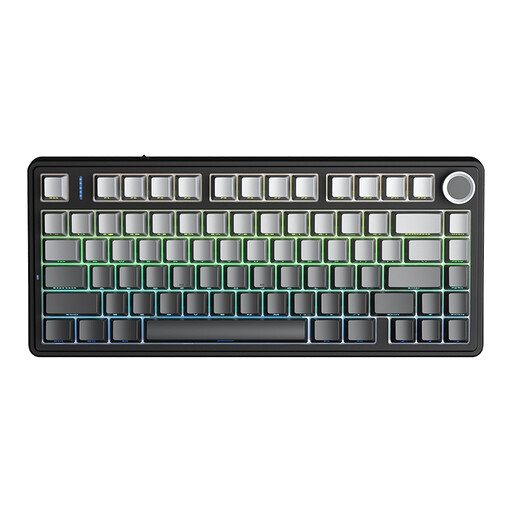
Consider this compact option if you want connection choices and are comfortable with a US key layout rather than UK ISO. Its title specifies Bluetooth, 2.4 GHz and wired modes, plus hot-swappable switches; check which mode your host accepts.
 No image available
Consider this compact option if a US layout suits your typing and you want several ways to connect. Its title specifies wired, Bluetooth and 2.4 GHz modes and PBT keycaps; check host support and the exact switch feel separately.
Not necessarily: the game and the device running it must accept keyboard input, and the device must support the keyboard’s chosen connection. Steam Support notes that a configuration can fail if a game does not support its selected input style. Check the exact game and host before buying.
Choose tenkeyless if you can do without a number pad and want more room for a mouse; keep a full-size layout if you regularly use the number pad. CORSAIR describes its UK K70 CORE TKL as retaining function keys and shortcuts in a smaller footprint, but layout alone does not establish better gameplay.
Choose by the exact switch variant, not the keyboard family, and check the seller’s return terms before trying an unfamiliar feel. Logitech G lists tactile and linear G515 options, while Razer lists different switch choices across its BlackWidow models; their labels are not comparable noise measurements.
For qualifying UK distance sales, GOV.UK says sellers must tell customers they can cancel up to 14 days after delivery; exceptions can apply. Check the seller’s cancellation process and return-postage terms before ordering. A change-of-mind cancellation is distinct from a remedy for goods that are faulty, damaged or misdescribed.
Check that the product and seller are identifiable and that you can understand the supplied instructions. For equipment within their scope, the UK Electrical Equipment (Safety) Regulations 2016 require manufacturers to provide instructions and safety information in a language consumers can easily understand; that rule alone does not establish which specific requirements apply to every USB keyboard.