Mouse-space-first stealth players
If a narrow desk restricts your mouse movement, a 60% keyboard may give you more room. Check whether its secondary shortcuts work for the commands you use.


Choose a 60% keyboard if mouse room matters more than direct access to function and navigation keys; Razer notes that its 60% layout omits those dedicated sections and the numpad. A tenkeyless (TKL) board takes up more room but keeps a more familiar set of keys. If avoiding an unintended movement is your priority, look for adjustable actuation you are willing to tune rather than assuming the shortest setting will suit you.
If a narrow desk restricts your mouse movement, a 60% keyboard may give you more room. Check whether its secondary shortcuts work for the commands you use.
If an unintended movement or action is your main concern, adjustable actuation lets you consider a less sensitive setting. SteelSeries also describes a feature on the Apex Pro Mini Gen 3 intended to reduce accidental presses on selected neighbouring keys.
If you regularly use function or navigation keys outside games, compare a 60% board’s shortcuts with the more direct key access of a TKL layout before downsizing.
Start with the space available for your mouse, then decide which commands need their own keys. Treat switch sensitivity and connection type as separate choices.
| Concern | What to check | Who this matters to |
|---|---|---|
| Mouse room | Compare the board’s physical layout with the space you need beside it. | If my desk limits mouse movement, I would give the keyboard’s footprint priority. Around 36% of consumers put mouse room first. |
| Deliberate inputs | Check whether actuation is adjustable and whether the exact model offers neighbouring-key protection. | When an accidental movement could spoil a stealth sequence, I want control over key sensitivity; around 29% of consumers make deliberate inputs their primary concern. |
| Command access | Compare dedicated keys with Fn shortcuts or programmable layers for your usual commands. | I use maps, menus or desktop shortcuts often enough that reaching them comfortably matters. For around 21% of consumers, command access comes first. |
| Cable management | Confirm the connection type and, for a wireless model, what charging and setup involve. | If I regularly move the keyboard around a shared desk, a cable-free position matters most; around 14% of consumers prioritise that flexibility. |
A 60% board omits dedicated function, navigation and numpad sections. Frequent commands may therefore require shortcuts that interrupt your usual workflow.
List the commands you rely on, then check the exact board’s Fn layer or remapping options against a TKL alternative.
Razer and SteelSeries specify adjustable actuation down to 0.1 mm on the cited compact models, but a very sensitive setting may not suit deliberate movement or action keys.
Try a less sensitive setting and adjust individual keys where the exact model permits it. Check separately for any neighbouring-key protection feature.
Key placement and shortcut legends affect a compact board’s everyday usability, even when the model-family name looks familiar.
Check the exact listing’s layout designation and product photos before choosing a variant.
These model ranges illustrate different compact-layout choices; check the features of the particular variant you intend to buy.
The Apex Pro Mini Gen 3 is relevant if you want a small board with configurable key sensitivity.
The Huntsman V3 Pro range offers a choice between the smaller Mini layout and a TKL alternative.
The PRO X 60 is relevant if a wireless compact setup and programmable commands are priorities.
These compact keyboards are choices for a small desk, including 60% layouts that prioritise mouse room and a 65% layout for consumers considering some direct-access keys. Check each variant’s layout and controls against your own commands.
 No image available
Consider this 60% model if mouse space takes priority and you are comfortable using shortcuts for omitted keys.
Razer specifies adjustable actuation from 0.1 mm to 4.0 mm for the Huntsman V3 Pro Mini. Check the listing’s exact keyboard layout before buying.
 No image available
Consider this 65% layout if you want a compact board but would rather check for more direct-access keys than a 60% layout typically provides.
The product title identifies a UK-layout variant. Compare its exact key arrangement and secondary functions with the commands you use.
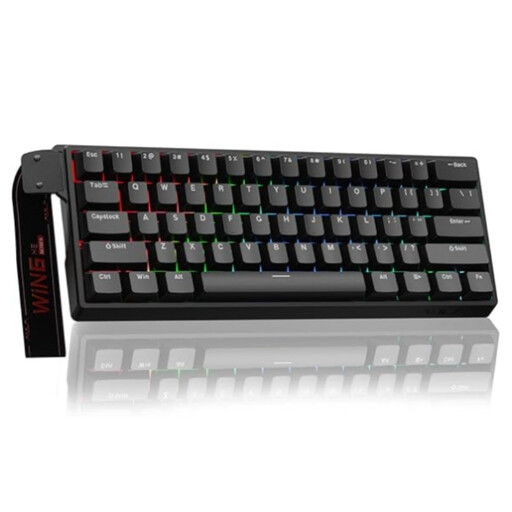 No image available
Consider this wired 60% model if reducing the keyboard’s footprint is your main aim.
Its product name lists hot-swappable magnetic switches, adjustable actuation and Rapid Trigger. Check the exact keyboard layout and how its secondary keys work for your commands.
Not if the extra mouse room is worth using shortcuts for less frequent commands. Razer notes that its 60% layout omits dedicated function, navigation and numpad sections, so check how the exact board provides access to keys you still need.
Not automatically: a deeper setting may suit keys where you want a more deliberate press. Razer and SteelSeries specify a 0.1 mm to 4.0 mm range for the cited Mini models, but their settings and any accidental-input features should be checked model by model.
Confirm the exact model, keyboard layout and connection type, then read the seller’s return terms. GOV.UK says customers who want to cancel an online order must tell the seller within 14 days of receiving the item; check the applicable conditions and keep change-of-mind cancellation separate from remedies for faulty or misdescribed goods.
Check local electrical-equipment collection or retailer take-back options rather than treating the keyboard as ordinary rubbish. GOV.UK identifies the Waste Electrical and Electronic Equipment Regulations 2013, as amended, as the legislation underpinning UK recovery, reuse and recycling measures.