For long digital card-game sessions, prioritise a keyboard that fits your desk, preferred key feel and everyday layout over competitive-speed features. A compact tenkeyless board leaves more mouse space but omits the dedicated number pad; a fuller layout suits you if those keys matter outside the game. Keyboard choice is only part of the setup: the Health and Safety Executive advises placing the keyboard just below elbow height and taking short, frequent breaks during prolonged screen work.
Who should consider these choices?
Comfort-first long-session players
If you sit through extended card-game sessions, consider how keyboard height and key feel work with your desk and chair rather than choosing on input-speed specifications alone. The Health and Safety Executive advises assessing the whole workstation and taking regular breaks during prolonged screen work.
Quiet shared-space players
If you play near other people or during calls, the fitted switch matters. Razer offers differently described clicky, tactile and linear low-profile switches, but a switch label cannot tell you exactly how a keyboard will sound in your room.
Multi-device desk players
If you alternate between a desktop, laptop or tablet, compare the connection modes on the exact model. Logitech G, Razer and CORSAIR each describe wireless options on relevant keyboard lines; check the modes and device compatibility you would actually use.
What should you check before buying?
Start with workstation fit and the keys you use, then choose switch feel and connection modes. Slim construction does not replace a suitable desk setup, and a compact layout is only helpful if it retains the keys you need.
| Concern |
What to check |
Who this matters to |
| Fit for long sessions |
Check the keyboard’s front height and angle against your desk and seated elbow height. The Health and Safety Executive advises placing the keyboard just below elbow height and taking short, frequent breaks. |
If a session runs long, I want the keyboard to fit my workstation rather than expect a slim design to fix an awkward setup. Around 36% of consumers put workstation fit and sustained use first. |
| Key sound and feel |
Confirm the fitted switch variant and compare its described feedback; terms such as quiet or silent do not establish room-level noise. |
Playing near others makes repeated keypresses more noticeable, so I want a feel I like without assuming every switch sounds alike. Key sound or feedback is the primary concern for around 29% of consumers. |
| Layout and desk space |
List the number-pad, navigation and shortcut keys you use beyond card games, then check their positions on the exact layout. |
I may welcome more mouse space, but not if the smaller board removes keys I regularly use. Around 21% of consumers place layout and desk space first. |
| Connections and controls |
Check the stated wired and wireless modes, device switching and whether any key-programming software works with your operating system. |
Moving between devices or using assigned shortcuts would make those options worthwhile to me. Connection flexibility or programmable controls lead the choice for around 14% of consumers. |
Which buying mistakes matter?
-
Treating a low-profile board as the whole workstation solution
A lower front edge may suit your preference, but chair and desk height still affect where the keyboard sits. Health and Safety Executive guidance considers the whole workstation, not the keyboard in isolation.
Check your seated elbow height against the desk and keyboard position before choosing a profile. Make room for breaks during a long session.
-
Choosing a model without checking its switch variant
Switch options within a keyboard line can have different intended feedback and sound. Razer, for example, describes distinct low-profile switch choices for its BlackWidow V4 Low-Profile HyperSpeed.
Confirm the installed switch on the exact product variant; do not assume low-profile construction or sound-dampening material makes it quiet.
-
Choosing a compact layout before checking the missing keys
A tenkeyless layout omits the dedicated number pad. That can free desk space but may be inconvenient if you use the pad for work or other tasks.
Note the number-pad, navigation and shortcut keys you use outside card games, then compare their positions on the layouts you are considering.
-
Prioritising competitive-speed features over everyday fit
High polling rates and specialist input functions are not established requirements for playing digital card games. They do not answer whether the layout, switches or workstation position suit a long session.
Choose the layout, key feel and connections you need before considering specialist gaming controls.
Brands to consider
Logitech G
The G515 LIGHTSPEED TKL is a low-profile tenkeyless option for consumers interested in receiver, Bluetooth and wired connections.
- Logitech G specifies low-profile GL switches, sound-dampening construction and key programming through G HUB for this model.
- Its tenkeyless layout omits a dedicated number pad; its stated specifications do not establish how comfortable it will feel at your desk.
Razer
The BlackWidow V4 Low-Profile HyperSpeed line is relevant if choosing a switch’s feel and intended sound profile is central to your decision.
- Razer describes clicky, tactile-quiet and linear-silent low-profile variants, along with 2.4 GHz wireless and Bluetooth device switching.
- Quiet and silent are Razer’s switch descriptions, not guarantees of noise levels in a shared room; check which variant you are buying.
CORSAIR
The VANGUARD AIR 99 offers a near-full-size, low-profile route for consumers who want more keys while retaining wireless connection choices.
- CORSAIR specifies a 99% layout, low-profile switches and receiver, Bluetooth and wired connection modes.
- Check its exact key positions and desk footprint before choosing it over a smaller board. Specialist gaming-input features are not established necessities for card games.
Joybuy products for different layouts
These keyboards offer compact and fuller key arrangements for card-game desks. Compare the exact layout and switch variant you need; their inclusion does not establish that any one model is more comfortable over a long session.
 No image available
Ticktype DP104, Gecha Gray, Silent Tactile switches
Consider this if you want a fuller key arrangement for card games and other desk tasks. The title specifies 108 keys, a US layout, hot-swappable switches and tri-mode connection. Silent Tactile identifies the switch variant, not a measured noise level; check that the US key arrangement and keyboard height suit your setup.
View on Joybuy
 No image available
ASUS ROG Strix Scope II 96 Wireless, White
Consider this model if you are comparing less conventional layouts with your current keyboard. Its title identifies a wireless gaming keyboard and specifies a UK layout, but confirm the delivered key arrangement and fitted switches before deciding whether it suits your shortcuts and preferred feel.
View on Joybuy
 No image available
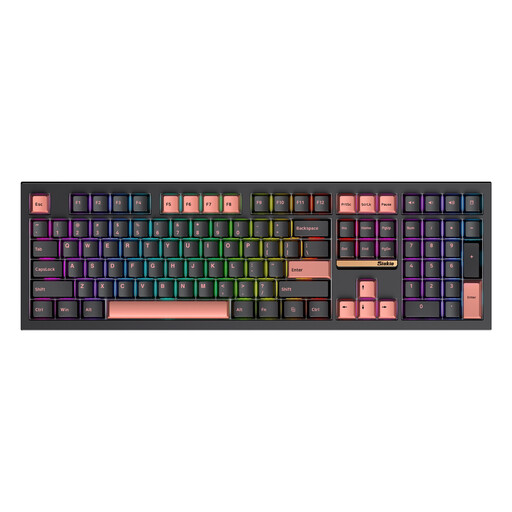
Siukie PL108W 108-key mechanical keyboard, Black
Consider this if retaining a fuller set of keys matters beyond card-game controls. Its title specifies 108 keys, detachable switches and three connection modes. Check the exact key arrangement and regional layout before relying on a particular number-pad or shortcut position.
View on Joybuy
 No image available
AULA F75 75% wireless keyboard, US layout
Consider this if a compact arrangement leaves the desk space you want for your mouse. The title specifies a 75% layout, US QWERTY keycaps and wired, Bluetooth and 2.4G connection modes. Check the positions of keys you use outside card games; its sound description is not a measured noise result.
View on Joybuy
 No image available
MACHENIKE KG87 80%, Latte Switch-Pink
Consider this if you are looking at compact layouts but want to compare their key positions carefully. Its title specifies an 80% layout, tri-mode connection, US QWERTY arrangement and Latte Switch-Pink variant. Check that the keys you use regularly are present and that the keyboard fits your desk height.
View on Joybuy
Common questions
Do I need a gaming-specific keyboard for digital card games?
You need not choose one for competitive-speed features alone. Focus on the layout, key feel, sound and connections you will use; high polling rates and specialist input functions are not established requirements for card-game play.
Should I choose tenkeyless or a fuller layout?
Choose tenkeyless if you can do without a dedicated number pad and value the desk space; choose a fuller layout if you regularly use those keys. Check the exact arrangement on a 99% model rather than assuming every key occupies its familiar full-size position.
How should I position a keyboard for a long session?
The Health and Safety Executive advises placing the keyboard just below elbow height as part of a suitable display-screen workstation. Check your chair, desk, screen and mouse positions too; a low-profile keyboard alone does not determine how the whole setup fits.
How often should I step away during a long card-game session?
Take short breaks often rather than relying on fewer long breaks. In its guidance for display-screen work, the Health and Safety Executive gives 5 to 10 minutes every hour as an example preferable to 20 minutes every two hours; it is workplace guidance, not a card-game-specific rule.


