Fast-movement co-op players
If repeated movement inputs and mouse space matter most, compare compact layouts first. Adjustable actuation or Rapid Trigger is relevant only on models that specify those features and if you intend to configure them.


Choose a layout that leaves enough room for mouse aim without hiding keys you use for chat or everyday tasks. Adjustable actuation is worth considering if repeated movement inputs are a priority and you are willing to configure it; for play near other people or an open microphone, check the exact keyboard's noise-related features instead. Wired avoids charging, while wireless adds connection-mode and receiver checks.
If repeated movement inputs and mouse space matter most, compare compact layouts first. Adjustable actuation or Rapid Trigger is relevant only on models that specify those features and if you intend to configure them.
Headphones do not stop keypresses reaching people nearby or an open microphone. Look for quiet switches or sound damping specified for the exact keyboard rather than judging noise by the word mechanical.
If you want fewer cables or need to switch devices, check whether the model offers the connection modes you need. Bluetooth, dedicated 2.4 GHz wireless and wired USB should not be treated as interchangeable.
Start with the space and direct-access keys your setup needs, then weigh switch behaviour, keyboard noise and connection modes against the way you play.
| Concern | What to check | Who this matters to |
|---|---|---|
| Repeated movement inputs | Check whether the exact model offers adjustable actuation or Rapid Trigger, and how its settings are configured. | If I repeatedly change direction in a fast shooter, I want control over when supported keys actuate without assuming the shortest setting will suit me. Around 33% of consumers put movement response first. |
| Mouse room and key access | Compare the board's footprint and direct access to arrows, function keys and the numpad. | When broad mouse sweeps matter, I need space to aim but still want my commonly used keys within reach. Mouse space and layout are the primary need for around 27% of consumers. |
| Keyboard noise | Look for quiet switches or sound damping on the exact version; consider microphone placement too. | If I use voice chat near other people, I do not want keypresses to dominate the room or my microphone. Around 20% of consumers place quieter shared-space use first. |
| Connection and customisation | Confirm the available wired, 2.4 GHz and Bluetooth modes, plus any remapping or hot-swap compatibility you need. | If the desk serves my gaming PC and another device, flexible connections or supported customisation may matter more than a particular switch setting. That is the leading need for around 20% of consumers. |
A 60% board can move function, arrow or navigation controls to secondary layers; TKL and 75% layouts make different compromises.
Compare the actual key diagram with your game, chat and typing shortcuts before choosing a size.
People nearby, and potentially a voice-chat microphone, can still hear keypresses.
If noise is a priority, check quiet-switch or sound-damping information for the exact model and consider your microphone setup.
Bluetooth, dedicated 2.4 GHz wireless and wired USB are different connection modes; the available modes depend on the model.
Confirm the modes, included receiver or cable, and charging method for the version you intend to buy.
An English-language listing does not by itself establish the physical key arrangement or legends you expect.
Check the stated layout, photographs, Enter-key shape and keycaps if UK placement matters to you.
Its Huntsman and BlackWidow lines offer different approaches to switch control and keyboard layout.
Relevant if you are comparing low-profile TKL designs with selected wireless or adjustable-actuation models.
Its Apex range includes quieter-switch options and separate models focused on adjustable inputs.
Relevant when comparing 75% layouts or considering a keyboard with replaceable switches.
Relevant if UK ISO availability and keyboard customisation are important to your choice.
These compact keyboards cover adjustable-input options and a 75% wireless option. Compare their stated layouts closely: several specify US key placement, which may not suit a UK ISO setup.
 No image available
Consider this if you want a compact keyboard with a stated UK layout for your mouse-aim setup.
The name specifies a 65% analog gaming keyboard. Check its physical key arrangement against the chat and navigation keys you use.
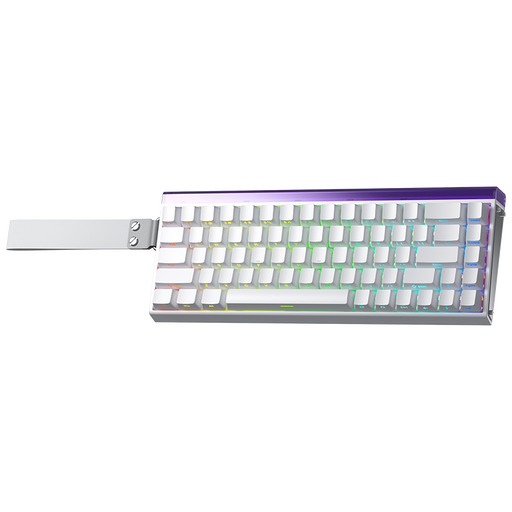 No image available
Consider this if adjustable inputs and a small footprint matter more than direct access to every key.
The name specifies 0.01 mm adjustable actuation, Rapid Trigger, an 8K polling-rate claim and a wired 60% design. It states a US layout; check the key placement and secondary controls before choosing it for a UK setup.
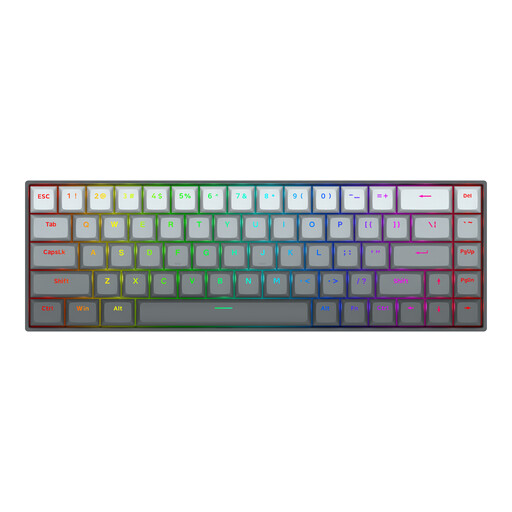 No image available
Consider this if a 68-key layout leaves the mouse space you need and its accessible keys suit your chat controls.
The name specifies magnetic switches, Rapid Trigger and an 8000 Hz polling-rate claim. It states a US layout, so check the physical keys if you expect UK placement.
 No image available
Consider this if a 60% footprint suits your aiming space and you are comfortable accessing some controls through secondary functions.
The name identifies an analog optical keyboard. Check the physical layout before buying if UK key placement is important.
 No image available
Consider this if you want a 75% board and the choice of a cable, Bluetooth or 2.4 GHz wireless connection.
The name specifies PBT keycaps and a US layout. Check its key legends and placement, and assess its sound for your shared-room or microphone setup rather than relying on the product name's sound description.
Choose TKL if mouse room matters more than a numpad; consider 75% if you want a smaller footprint and its key placement suits you. Full-size remains useful when direct numpad access matters more than desk space.
Yes, because headphones do not prevent other people or an open microphone from hearing your keys. Check noise-related features on the exact model and consider microphone placement or push-to-talk use.
No. Replace switches only on a model explicitly identified as hot-swappable, using compatible switch types. Corsair warns that pulling a soldered switch can damage it and the keyboard's circuit board.
If you want a dedicated gaming wireless mode, confirm that the exact keyboard supports 2.4 GHz rather than assuming Bluetooth provides the same option. Logitech G, for example, specifies Bluetooth, LIGHTSPEED wireless and wired modes for the G915 X LIGHTSPEED.