Players with limited sockets
You play at a desk with few available wall sockets and want to reduce cables during play. A wireless model still needs a practical USB charging route, while its receiver needs an available USB port.


Choose a keyboard with a dedicated 2.4 GHz receiver if you want fewer desk cables while keeping a direct wireless connection to your gaming PC; Bluetooth is useful if you also switch between devices. Limited wall sockets do not require a wireless keyboard, though: a wired model can use the PC’s USB port without a separate wall adapter. Choose a compact layout only if you can do without the keys it removes, and plan how you will charge any wireless model.
You play at a desk with few available wall sockets and want to reduce cables during play. A wireless model still needs a practical USB charging route, while its receiver needs an available USB port.
You want more room around your keyboard and mouse for football games and can manage without a dedicated number pad. A tenkeyless (TKL) layout is worth considering if it also suits your other PC tasks.
You use a gaming PC alongside Bluetooth-capable devices and want to switch the keyboard between them. Check the connection modes on the exact model rather than assuming every wireless keyboard offers both Bluetooth and a receiver.
Start with the connection you can accommodate at the PC, then decide how much desk space and number-pad access you need. Treat switch options and device switching as priorities only if you expect to use them.
| Concern | What to check | Who this matters to |
|---|---|---|
| Connection and charging | Check for a dedicated 2.4 GHz receiver mode, an available PC USB port and a workable charging connection. | I want fewer cables while playing football games, but I still need a connection and a way to recharge. Around 42% of consumers put connection and power first. |
| Desk space and key layout | Compare the keyboard’s footprint and confirm whether you need a number pad; consider front height if you prefer a lower keyboard. | My desk feels crowded, yet I also use the keyboard for tasks outside games. For around 33% of consumers, space and everyday key access are the primary concern. |
| Controls and device switching | Check the offered Bluetooth connections and whether the exact model has controls or adjustable switches you would use. | I move between devices or want to configure how my keys respond, so basic wireless operation is not my only priority. Roughly 25% of consumers place these options first. |
A wireless keyboard can reduce desk cables during play, but its battery still needs charging. Lighting settings and use conditions can affect the battery figures manufacturers quote.
Plan an accessible USB charging route and compare battery figures only alongside their stated test conditions.
Bluetooth and a dedicated 2.4 GHz receiver are different connection options. The receiver also needs a suitable USB port on your PC.
Check which modes the exact keyboard offers and which PC port you intend to use before choosing it for football games.
A TKL keyboard removes the number pad to save space, which may be inconvenient for other PC tasks that rely on those keys.
Check your everyday shortcuts and number entry before choosing TKL over a layout that retains the number pad.
Key legends and physical layouts can differ between variants. The SteelSeries Apex Pro TKL Wireless Gen 3 page considered here, for instance, identifies a US keyboard version.
Check the exact variant’s key layout, switch option, receiver and charging cable before ordering.
Its G915 X TKL is relevant if you want a low-profile TKL keyboard with 2.4 GHz LIGHTSPEED, Bluetooth and wired modes.
Its BlackWidow V4 TKL options include conventional-height and low-profile models for buyers weighing connection modes against key feel.
The Apex Pro TKL Wireless Gen 3 is relevant if adjustable key actuation matters alongside 2.4 GHz and Bluetooth connectivity.
These wireless gaming keyboards offer compact or space-conscious layouts for the limited-socket setup. Compare their stated connection modes and physical key layouts carefully: a compact board with a number pad is a different choice from a 75% layout, and several listed variants do not have a UK key layout.
 No image available
Consider this model if you want a wireless keyboard with a stated UK layout rather than a US or German key arrangement.
The title identifies a 96 layout and a white variant. Check its exact connection modes, charging arrangement and number-pad configuration against your setup.
 No image available
Consider the F99 if you want to choose between a 2.4G connection for the PC, Bluetooth and a wired option.
This variant is Light Blue with Reaper switches and a US QWERTY layout. Check whether that physical layout suits your typing and how you would charge the keyboard.
 No image available
Consider the F75 if a 75% layout suits your desk and you want the listed wired, Bluetooth and 2.4G modes.
The title also specifies PBT keycaps and RGB backlighting. Its US QWERTY layout may not suit UK typing habits; check charging details and battery-life conditions before deciding.
 No image available
Consider the S75 Pro if you want a 75% wireless keyboard with a display and knob.
The title specifies a TFT display, hot-swappable Star Vektor switches and side-printed keycaps. Confirm its physical key layout, precise connection modes and charging arrangement for your PC.
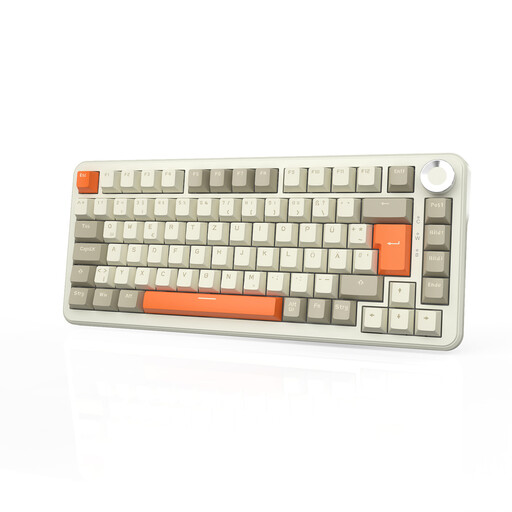 No image available
Consider this model only if its German QWERTZ key layout works for the way you play and type.
The title specifies a 75% layout, Flying Fish switch, volume knob, tri-mode connection and 8000mAh battery. Battery capacity alone does not establish operating time; check the available modes and charging details.
It can avoid a separate wall adapter during normal play, but the keyboard will still need charging. For example, Logitech G says its G715 can charge through its included USB-C-to-USB-A cable and operate in wired mode; check the charging connection for the particular keyboard you choose.
Choose the dedicated 2.4 GHz mode if you want the keyboard’s receiver connection to the gaming PC and have a suitable USB port; Bluetooth can be useful when switching to another compatible device. Check the exact model’s supported modes rather than assuming that wireless means it offers both.