Players managing cables and sockets
If you want fewer permanent cables across a railway-gaming desk, work out whether wall sockets or computer USB ports are scarce. Bluetooth and a 2.4 GHz receiver place different demands on the computer.


Choose the connection around the shortage you actually have: Bluetooth can leave a computer USB port free, while 2.4 GHz wireless needs a receiver port but offers a dedicated gaming connection. Neither removes the need to charge a wireless keyboard. For railway-management shortcuts, favour a layout with a numpad if you use one regularly; choose TKL or 75% when desk space matters more than those physical keys.
If you want fewer permanent cables across a railway-gaming desk, work out whether wall sockets or computer USB ports are scarce. Bluetooth and a 2.4 GHz receiver place different demands on the computer.
If you use number entry and repeated game commands, compare a full-size layout and dedicated controls with the smaller footprint of TKL or 75%. The keys you use in a typical session should drive that choice.
If the keyboard also serves a laptop, tablet or second PC, check the exact model’s device-switching options alongside the connection you plan to use for games.
For a railway-management gaming desk, distinguish a shortage of wall sockets from a shortage of computer USB ports before deciding how many physical shortcut keys you need.
Choose it when: Your computer supports Bluetooth and keeping a USB port free matters most.
Accept: Connection behaviour varies by model, and the keyboard still needs charging. Keychron specifies a lower polling rate over Bluetooth than over 2.4 GHz for its Q1 Max.
Choose it when: You want a dedicated gaming wireless connection and can spare a computer USB port for the receiver.
Accept: The receiver occupies a port, and rechargeable models still need a charging plan.
Choose it when: Wall sockets are the constraint, a computer USB port is available and you would rather avoid battery charging.
Accept: The keyboard keeps a permanent cable on the desk.
| Concern | What to check | Who this matters to |
|---|---|---|
| Cables and connections | Check the exact connection modes, computer Bluetooth support, receiver-port requirements and charging arrangements. | I want fewer desk cables without using a USB port I need for something else, and I can make time to recharge. Around 42% of consumers put connection and socket management first. |
| Shortcut access | Compare the physical numpad and dedicated keys with the commands you use; check remapping support for the exact model. | When I manage routes and timetables, I want frequent commands within easy reach rather than hidden behind layers. For around 33% of consumers, accessible controls are the primary need. |
| Desk fit and key feel | Confirm the physical layout, omitted keys and switch variant; check UK-ISO availability if that arrangement matters to you. | A crowded desk makes keyboard footprint important to me, but I still need a layout and keys I am comfortable using for a long session. Compactness and key feel come first for around 25% of consumers. |
A wireless keyboard can remove a permanent desk cable, but a rechargeable model still needs power between sessions.
Check the charging connection, stated battery-life conditions and whether the exact model can be used in wired mode while charging.
A receiver-based connection reduces keyboard cabling across the desk but uses a computer USB port.
Count wall sockets and computer USB ports separately. If the port is the bottleneck, check whether both your computer and chosen keyboard support Bluetooth.
TKL and 75% layouts free desk space partly by omitting physical keys. That can make a difference if your railway-game controls rely on a numpad or direct shortcuts.
Note the keys you use repeatedly during a typical session, then compare that list with the exact layout and its remapping options.
Layout can vary within a keyboard family. Keychron, for example, lists UK-ISO options for the Q1 Max and Q1 HE rather than making every variant identical.
Confirm the selected variant’s physical keys in the listing and product images before ordering.
Its G915 X range includes wireless layouts for players weighing connection flexibility against the number of physical controls.
Its BlackWidow V4 wireless models include compact options with different connection and customisation features.
Its Q1 Max and Q1 HE lines offer UK-ISO variants for players interested in compact wireless layouts and key configuration.
These keyboards cover compact and 96% wireless layouts for a railway-gaming desk. Compare each listing’s physical keys and connection options with your own socket, USB-port and shortcut needs; a product title alone may not settle every setup detail.
 Image unavailable
Consider this 96% wireless layout if you want to reduce permanent keyboard cabling without moving to a 75% board.
The title specifies a white UK Layout variant. Check the exact physical keys, connection modes and charging accessories against your setup before ordering.
 Image unavailable
This 75% model suits a desk where a smaller keyboard footprint matters more than a physical numpad.
Its title specifies wired, Bluetooth and 2.4 GHz modes, RGB lighting and PBT keycaps. It also specifies a US QWERTY layout, so check the key arrangement before choosing it for UK typing.
 Image unavailable
Consider this model if a larger layout appeals more than a 75% board but you still want wireless connection choices.
The title specifies wired, Bluetooth and 2.4 GHz modes and a US QWERTY layout. Confirm that its physical keys meet your number-entry and shortcut needs, and that the US arrangement suits you.
 Image unavailable
This 75% wireless keyboard is worth considering when desk space is tight and you can work without a physical numpad.
Check the exact physical UK key arrangement and the connection accessories for this variant. Plan for charging if you intend to use it wirelessly.
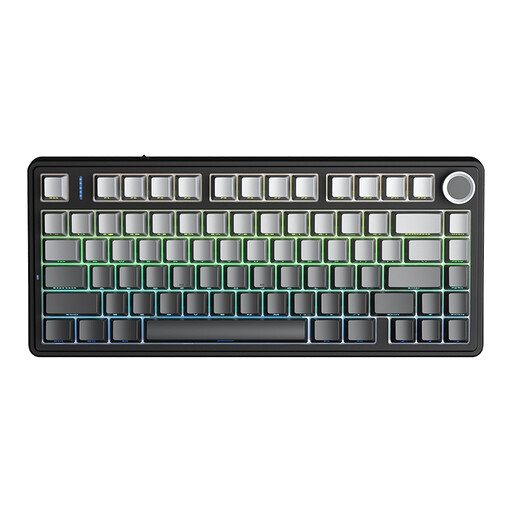 Image unavailable
Choose this compact layout only if its omitted physical keys will not get in the way of your regular railway-game commands.
The title specifies Bluetooth, 2.4 GHz and wired modes, hot-swappable switches and RGB lighting. It specifies US QWERTY, so check the physical layout and your host-device compatibility.
It can remove a permanent keyboard cable from the desk, but it does not remove the need to charge a rechargeable model. If computer USB ports, rather than wall sockets, are scarce, remember that a 2.4 GHz receiver normally uses one; Bluetooth may avoid that receiver when both devices support it.
Use Bluetooth when preserving a USB port is the priority, or choose a model’s 2.4 GHz mode when you want its dedicated gaming connection and have room for the receiver. Check specifications for the exact keyboard: Keychron states 90 Hz over Bluetooth and 1000 Hz over 2.4 GHz or wired connection for the Q1 Max, not for wireless keyboards generally.
No. Keyboard size and socket use are separate choices. A TKL or 75% layout can free desk space, while a larger layout may be more practical if you regularly use a numpad or other dedicated keys for simulation controls.
Treat an old rechargeable keyboard as electrical waste rather than ordinary household rubbish. GOV.UK says waste electrical products can be taken to a local household waste recycling centre; check the centre’s instructions for the keyboard and its battery.