If you do not need a number pad, a tenkeyless (TKL) keyboard can leave more room for your mouse while keeping more dedicated keys than a 60% board. For real-time strategy (RTS) play in a student room, decide whether accessible shortcuts, less disturbance to others or adjustable key sensitivity matters most: very shallow actuation can invite unintended commands, and sound-dampening features do not make a keyboard silent.
Who should consider these keyboards?
RTS hotkey organisers
If you use control groups, camera positions and custom build commands, access to the keys you rely on may matter more than the smallest possible footprint. Check remapping options for the exact keyboard and keys you intend to use.
Shared-room late-night players
If someone nearby is studying or sleeping, switch choice and sound-dampening construction deserve attention. Neither feature, on its own, establishes how quiet a keyboard will be in your room.
Small-desk players
If your mouse shares a desk with a laptop and notes, a compact layout can free space. A TKL board retains dedicated navigation keys that a 60% layout may require you to access through key combinations.
What should you check before buying?
Start with the keys your RTS bindings and coursework need, then weigh desk space against noise and input settings; a smaller layout or shorter actuation point is useful only if you can work comfortably with its trade-offs.
| Concern | Buying checks | Who it matters to |
|---|
| RTS hotkeys |
Check physical key access, remapping on the keys you use and whether profiles can be saved for your setup. |
I need my control groups and build commands within easy reach rather than hidden behind key combinations; around 29% of consumers put hotkey access and customisation first. |
| Room disturbance |
Check the exact switch variant and any dampening construction; neither is a guarantee of silence. |
When someone nearby is sleeping or studying, I want my keystrokes to cause less disturbance. Reducing that disturbance comes first for around 29% of consumers. |
| Desk fit |
Compare TKL, 75% and 60% key access with the space each leaves for a mouse; consider keyboard height if it affects your comfort. |
My desk also holds study materials, but I still need a layout I can use every day; around 21% of consumers chiefly prioritise desk fit and comfort. |
| Input tuning |
Check which keys support adjustable actuation and whether you can set command-heavy keys deeply enough to avoid mispresses. |
I want to adjust repeated inputs without triggering the wrong command during a busy match. For around 21% of consumers, that control over key sensitivity is the main concern. |
Common buying mistakes
-
Assuming every key has adjustable actuation
SteelSeries says 61 keys on the Apex Pro TKL Gen 3 can be adjusted. An adjustable-actuation feature therefore does not mean every physical key on that model has the same setting options.
Check the exact model’s supported keys against the RTS commands you use most.
-
Choosing 60% solely to save space
A 60% keyboard has fewer physical keys than TKL, so shortcuts used for play or coursework may depend on key combinations.
Map out your bindings before buying; choose the smaller layout only if its access to missing keys works for you.
-
Expecting dampening to make a keyboard silent
Foam, lubrication and switches described as silent are intended to address noise or vibration, but they do not establish that typing will be inaudible beside someone studying or sleeping.
Confirm the switch variant and check the seller’s current return terms if room noise is a deciding factor.
-
Setting every adjustable key to its shallowest point
Razer, SteelSeries and Logitech G list adjustable models with settings down to 0.1 mm. A very shallow setting can leave less margin for accidental presses around crowded RTS hotkeys.
Begin with a more deliberate setting on command-heavy keys, then adjust according to how reliably you use them.
Relevant brands to consider
SteelSeries
Its Apex Pro TKL Gen 3 is relevant if you want to adjust key sensitivity while considering a TKL board with noise-dampening construction.
- SteelSeries lists 0.1–4.0 mm adjustable actuation, onboard-saved configurations, per-key lubrication and sound-dampening foam for this model.
- SteelSeries support says 61 keys can be adjusted on the Gen 3 TKL; check whether those include your preferred RTS keys. The construction features do not guarantee quiet use.
Razer
Its Huntsman V3 Pro range offers analog-optical switch options in TKL and smaller 60% layouts.
- Razer specifies a 0.1–4.0 mm adjustable-actuation range and Rapid Trigger for the Huntsman V3 Pro Tenkeyless.
- The Huntsman V3 Pro Mini has fewer physical keys than TKL. Check how its key combinations affect your game bindings and everyday work.
Logitech G
Its G515 TKL models are relevant if a lower-profile keyboard appeals to you, with connection and switch options varying by model.
- Logitech G lists tri-mode connectivity, a 22 mm height and sound-dampening construction for the G515 LIGHTSPEED TKL. It lists 0.1–2.5 mm adjustable actuation for the wired G515 RAPID TKL.
- Do not assume that the two G515 models share the same connection modes or key feel; check the exact variant before choosing.
Joybuy keyboard choices
These choices span compact 60%, 75% and 68-key layouts and a full-size 108-key layout. Compare them against the shortcuts you need, the width of your desk and your preferred switch type; a sound-focused product name alone cannot tell you how quiet the board will be in your room.
 No image available
Razer Huntsman V3 Pro Mini 60% Analog Optical Keyboard
Consider this 60% board if mouse space matters more to you than having dedicated keys for every RTS shortcut.
Its product name specifies analog-optical switches. Check how the reduced layout handles your bindings and confirm the key legends you need before buying.
View on Joybuy
 No image available
AULA F75 75% Wireless Gaming Keyboard, US Layout
The 75% layout is worth considering if you want a compact desk setup but prefer more physical keys than a 60% board.
The title specifies wired, Bluetooth and 2.4G connection modes, PBT keycaps and a US QWERTY layout. Check whether its key layout suits your typing and RTS bindings; the sound-focused description is not a room-noise measurement.
View on Joybuy
 No image available
AULA S75 Pro 75% Wireless Keyboard, Star Vektor Switch
Consider this compact mechanical option if you want a 75% layout and the option to change switches later.
Its title specifies tri-mode connectivity, hot-swappable Star Vektor switches, a TFT display and a knob. Confirm the key legends before buying, and do not treat its sound-focused description as a guarantee of quiet use.
View on Joybuy
 No image available
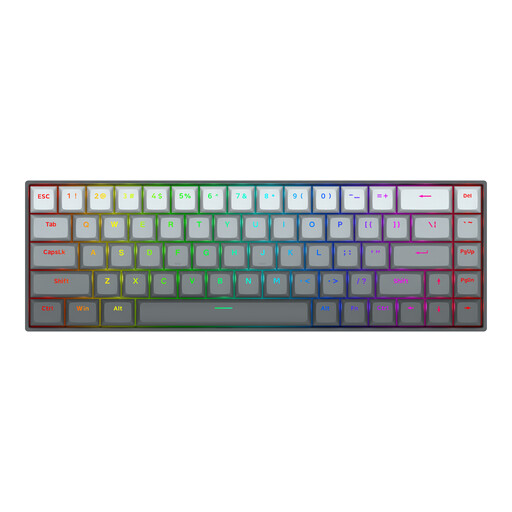
Redragon M68 68-Key Magnetic-Switch Keyboard, US Layout
This compact layout may suit you if you want to consider magnetic-switch input tuning without using a full-width board.
The title specifies 68 keys, Rapid Trigger and an 8000 Hz polling rate. Check physical access to your RTS shortcuts and whether the US layout suits you; those features do not establish how quietly it operates.
View on Joybuy
 No image available
Ticktype DP104 108-Key Keyboard, Silent Tactile Switches, Gecha Gray
The full-size layout is an option if dedicated key access matters more than leaving maximum room for your mouse.
The title specifies tri-mode connectivity, hot-swappable switches and a US layout. Its silent-tactile switch description is not a measured noise result, so consider the room and seller’s return terms if disturbance is your priority.
View on Joybuy
Frequently asked questions
Should I choose TKL or 60% for RTS play?
Choose TKL if you want to save desk width without giving up as many dedicated keys; choose 60% only if its key combinations work for your RTS bindings and study tasks. Razer describes its Huntsman V3 Pro Mini as a 60% board, whereas the Tenkeyless version retains a larger physical key set.
Should I set adjustable keys to their shallowest point?
Not by default: a very shallow actuation point may make crowded RTS hotkeys easier to press unintentionally. Start with a setting that lets you enter commands reliably, then adjust individual keys where the model permits it.
Will a dampened keyboard be quiet enough for a shared room?
Dampening alone cannot guarantee that a mechanical keyboard will be quiet enough beside someone sleeping or studying. Check the exact switch variant and the seller’s current return terms if the sound it makes could change your decision.
What should I do with an old keyboard in the UK?
Check local reuse and electrical-equipment recycling options when disposing of an old keyboard, including any local collection rules. GOV.UK describes the UK waste electrical and electronic equipment framework as intended to reduce electrical equipment sent to landfill or incineration.


