What matters when choosing?
For fantasy-adventure play in a student room, settle the noise and desk-space questions before paying attention to extra controls: a layout or switch you cannot comfortably use for coursework is a poor trade.
| Concern |
What to check |
Who this matters to |
| Noise around others |
Check the exact switch variant and any stated sound-dampening construction; seek independent noise information if disturbance is a deciding factor. |
If I play while someone nearby studies or sleeps, I want key presses that will not draw attention across the room. Around 42% of consumers would put reducing that disturbance first. |
| Space for gaming and study |
Compare TKL and 75% key arrangements with your mouse space, number-pad use and required UK key positions. |
With a mouse and coursework on one desk, I need room to play without making everyday typing awkward. Roughly 33% of consumers would make desk-space efficiency their primary concern. |
| Key feel and controls |
Consider the switch feel you prefer and whether remapping works with your computer; check setup and switch restrictions on customisable models. |
For long adventures, I want keys and shortcuts that feel manageable across both games and assignments. About 25% of consumers would prioritise control and feel over the other factors. |
Brands worth considering
These examples show different approaches to room noise, desk width and controls; the features below apply to the named models, not every keyboard from each brand.
SteelSeries
The Apex 3 TKL is a UK-market membrane option to consider when shared-room noise and a compact layout matter.
- SteelSeries specifies Whisper Quiet switches, anti-ghosting, media controls and IP32 dust-and-water resistance for this model.
- Its membrane switches are not the choice if you specifically want conventional mechanical-switch feedback.
CORSAIR
The UK-layout K70 CORE TKL models offer compact mechanical options in wired and wireless variants.
- CORSAIR specifies MLX Red v2 linear switches and two sound-dampening layers for the wired model; the wireless variant offers Slipstream wireless and Bluetooth.
- Damping is not a measured quietness guarantee, and the wireless version brings charging into the routine.
Logitech G
The wired G515 TKL is a low-profile option if you prefer a slimmer keyboard with a familiar function row.
- Logitech G specifies a 22 mm-high body, low-profile GL switches with 1.3 mm actuation and remapping through G HUB.
- The TKL layout has no dedicated number pad; check whether that affects your study work.
Keychron
The K2 QMK ISO range is relevant if you want a compact keyboard with a UK-ISO option and configurable controls.
- Keychron lists UK-ISO variants, Bluetooth 5.2 and wired connectivity for the K2 QMK ISO model.
- Launcher configuration requires wired use and a supported browser. The separate K2 HE magnetic variant accepts only its specified switch family.
Razer
The full-size BlackWidow V4 X is worth examining if direct macro controls matter more than minimum desk width.
- Razer specifies six dedicated macro keys, media controls and a choice of Green or Yellow switch variants.
- Check the switch variant carefully for a shared room: the Green option is clicky, and the full-size board occupies more desk space than a TKL layout.
Joybuy keyboards for this setup
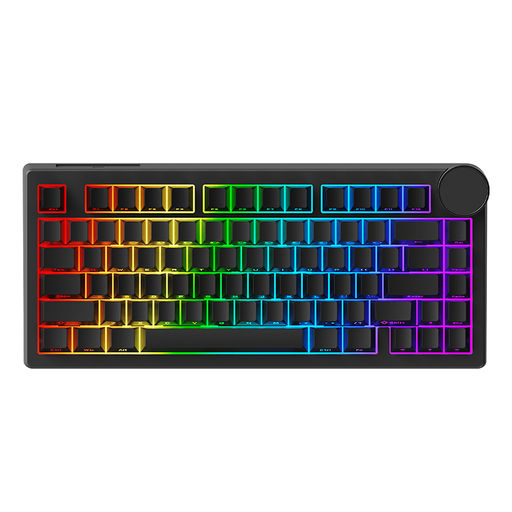
These keyboards offer several ways to balance a compact gaming desk with study use: mostly 75% layouts, plus a 96% option for anyone considering a number pad. Check the selected key layout and switch variant before deciding whether a model suits a quiet room.
 No image available
AULA S75 Pro 75% Wireless Mechanical Keyboard
Consider its 75% layout if desk width matters and you want wireless use. The named variant has a gasket design, five-layer padding, a display and knob, and hot-swappable Star Vektor switches; these details do not establish its typing noise. Confirm the physical UK key arrangement if you need it for coursework.
View on Joybuy
 No image available
AJAZZ AK820 V2 75% Wired HE Magnetic Keyboard
Consider this compact wired option if magnetic-switch controls interest you more than wireless use. Its name specifies a 75% layout and metal knob. Before relying on customisation, check that its Windows-based configuration process suits your computer, and confirm the physical key layout and noise characteristics you need.
View on Joybuy
 No image available
AULA F75 75% Wireless Keyboard, US QWERTY
Its 75% layout suits a desk where mouse room is important. The named variant offers wired, Bluetooth and 2.4G connections, PBT keycaps and RGB lighting. It is specified as US QWERTY: check the key positions and symbols against your coursework before buying. Its acoustic wording is not a substitute for assessing typing noise.
View on Joybuy
 No image available
HyperX Alloy Rise 75 Wireless Keyboard UK
Consider this wireless 75% model if you want a compact desk arrangement. Despite the UK designation in its name, inspect the physical key arrangement you will receive. Check the switch and noise details separately if someone nearby needs quiet; a wireless or compact design does not settle that question.
View on Joybuy
 No image available
ASUS ROG Strix Scope II 96 Wireless Keyboard, UK Layout
Consider its 96% layout if number entry for study work matters as much as gaming desk space; compare its footprint with the narrower 75% choices. The named variant specifies wireless use and a UK layout. Confirm which switch option is fitted before judging its feel or suitability for a quiet room.
View on Joybuy
Frequently asked questions
Should I choose TKL or 75% for fantasy-adventure gaming?
Choose TKL if you want more familiar spacing around the function and navigation keys; choose 75% if reducing desk width matters more and you are comfortable checking a tighter key arrangement. Neither layout is inherently better for fantasy adventures, and a number-pad layout may suit you better if you use it regularly for coursework.
Is a mechanical keyboard necessarily too loud for a student room?
No: the exact switches and construction matter more than the mechanical label alone. RTINGS notes that clicky switches can be among the loudest options, so compare switch variants and look for independent noise information if someone nearby needs quiet.
What matters most when choosing wireless?
Check that the keyboard has the connection modes your devices need and that its charging routine fits how you use the desk. Read the conditions behind any battery figure: CORSAIR, for example, gives its longest stated K70 CORE TKL Wireless figure with RGB lighting off.
Do I need to check for a UK-ISO layout?
Yes, if you rely on familiar UK symbol positions and Enter-key shape for coursework. Check the exact variant and its pictured keys rather than assuming that a model name or product-family page confirms the physical arrangement of the keyboard you will receive.


