Gamers short of sockets or USB ports
If connections around your PC are scarce, you may want Bluetooth or a compatible shared-receiver arrangement rather than another permanently connected peripheral.


Choose the connection and key layout before focusing on gaming-speed claims. Bluetooth can leave a USB port free, while a keyboard with 2.4 GHz wireless and a wired mode gives you other ways to connect; sharing one receiver with a mouse works only for compatible devices. For turn-based tactics, a TKL or 75% layout is worth considering if you use dedicated function or navigation keys, whereas a 65% layout asks you to rely more on shortcuts or layers.
If connections around your PC are scarce, you may want Bluetooth or a compatible shared-receiver arrangement rather than another permanently connected peripheral.
A smaller keyboard may free desk space, but function, arrow and navigation keys can matter for your game bindings and other PC tasks. Check which keys remain dedicated before choosing a layout.
Wireless use still calls for a charging plan. If you keep lighting or a display enabled, compare battery claims under the settings you expect to use.
For turn-based tactics at a desk with limited connections, settle how the keyboard will connect, then check your game’s key bindings against the layout. Charging and switch preferences can narrow the choice further.
| Concern | What to check | Who this matters to |
|---|---|---|
| Connections | Check whether the exact keyboard offers Bluetooth, 2.4 GHz and wired data. If you plan to share a receiver with a mouse, confirm that both models are compatible. | I have few free USB ports and do not want the keyboard permanently cabled; around 33% of consumers put connection management first. |
| Key layout | Compare the layout image with your bindings, particularly the function row, arrows and navigation keys. | When I open menus or use mapped commands, I want the keys within direct reach; roughly 27% of consumers prioritise control access. |
| Charging | Read the maker’s battery conditions, including lighting and display settings, and check whether wired use while charging is possible. | A recharge during a long session would interrupt my setup, so about 20% of consumers put charging endurance first. |
| Feel and customisation | Check the switch option and noise preference, plus hot-swap or remapping support on the exact model if you need either feature. | I also type and use shortcuts outside games, and want the keys to suit those tasks; around 20% of consumers make feel or customisation their primary concern. |
Removing a permanent keyboard cable does not remove the need to recharge. A charging cable still needs somewhere usable to connect.
Check the charging connector and whether the keyboard works in wired mode while charging. Judge battery claims using the lighting and display settings you intend to keep on.
Bluetooth can avoid a keyboard receiver if your computer supports it. A 2.4 GHz receiver normally occupies a USB port, and mouse sharing applies only to compatible combinations.
Confirm receiver-sharing support for your exact keyboard and mouse before planning around a single port.
Razer’s BlackWidow V3 Mini HyperSpeed illustrates the trade-off: its 65% layout omits a dedicated function row and Home cluster.
Check your game bindings against the key diagram. If those controls need to stay directly accessible, consider a layout that retains them.
ASUS ROG quotes more than 2,000 hours for the Azoth in 2.4 GHz mode with its OLED display and RGB lighting off. That figure does not describe use with both features enabled.
Compare makers’ stated settings alongside their figures rather than treating maximum claims as like-for-like results.
These product lines illustrate different ways to balance wireless connections, desk space and direct controls; brand inclusion does not determine which individual keyboard fits your bindings.
The G515 LIGHTSPEED TKL is a low-profile route for consumers who want several connection modes without choosing a 65% layout.
The BlackWidow V4 Tenkeyless HyperSpeed and BlackWidow V3 Mini HyperSpeed offer different balances of direct keys and desk space.
The ROG Azoth is a 75% option for consumers interested in wireless connection choices and switch customisation.
These wireless and multi-mode keyboards offer compact layouts for a connection-constrained gaming desk. Compare each layout with your tactics controls, and check the connection and charging details of the variant you plan to buy.
 No image available
Consider this if you want a wireless keyboard in a 96-format layout. Check the key diagram for your direct tactics controls, and confirm connection modes, receiver compatibility and charging accessories for this variant.
 No image available
Consider this if you want a wireless board with a choice of connection modes. Its name specifies wired, Bluetooth and 2.4 GHz operation; check the key diagram for your shortcuts and whether the US layout suits your typing.
 No image available
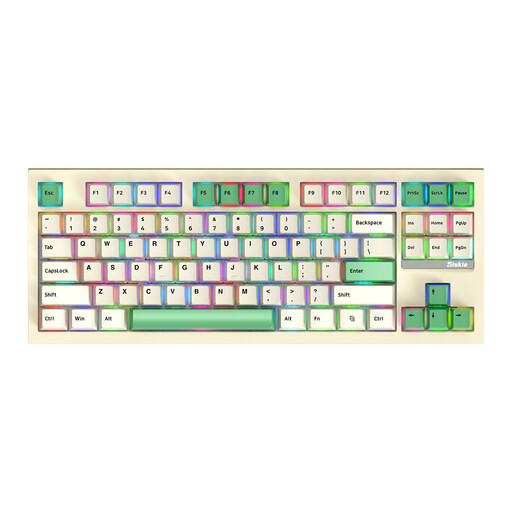
The 87-key format may suit a desk where a full-size board takes too much room. Check which navigation keys are dedicated, the three connection modes, charging arrangements and the switch compatibility for this variant.
 No image available
Consider this compact option if desk space matters but you still want to inspect the layout for frequently used keys. Its name specifies wired, Bluetooth and 2.4 GHz modes, RGB lighting and PBT keycaps; check the key diagram and whether the US layout works for you.
 No image available
The 80% format is another compact route for a tactics desk. Check the exact key diagram against your commands, confirm how its tri-mode connection works with your PC and make sure the US layout suits you.
It can remove a permanently connected keyboard cable, but it still needs charging. Bluetooth can also leave a USB receiver port free if your computer supports it; check where you will connect the charging cable when needed.
They can only share a receiver when the specific devices are compatible. Logitech G documents compatible-mouse pairing for the G515, while Razer documents a compatible-mouse option for the BlackWidow V3 Mini; check your exact mouse model before relying on either arrangement.
It can work if its shortcuts suit your game bindings and desk space is the stronger priority. Razer’s BlackWidow V3 Mini retains arrow keys but lacks a dedicated function row and Home cluster, so check whether commands assigned to those keys are comfortable to access through layers.
Compare the operating conditions before comparing the hours. ASUS ROG states more than 2,000 hours for the Azoth in 2.4 GHz mode with OLED and RGB off; that maximum should not be treated as its runtime with those features enabled or as directly equivalent to another maker’s differently configured claim.