Replay-and-tag reviewers
If you repeatedly pause footage, adjust audio and mark moments at a desk, look for accessible media controls and keys you can assign to your review commands.


For frequent pausing, replaying, volume changes and tagging, choose a keyboard around the controls your footage player can use rather than gaming-input specifications alone. A full-size board suits a fixed desk where dedicated shortcuts matter; a tenkeyless board leaves more mouse room, while wireless is worth prioritising if you review away from the PC or switch devices. Check the physical layout and whether your player and operating system support the assignments you need.
If you repeatedly pause footage, adjust audio and mark moments at a desk, look for accessible media controls and keys you can assign to your review commands.
If you move between competitive play and footage review, a smaller keyboard may leave room for mouse movement. Check that it still gives you the function and navigation keys your review workflow uses.
If you sometimes review from another seat or switch between devices, connection modes and straightforward media access may matter more to you than a bank of dedicated macro keys.
Start with the playback and annotation commands you use, then decide how much desk space, wireless reach and configuration support the keyboard must provide.
| Concern | What to check | Who this matters to |
|---|---|---|
| Playback and shortcuts | Check for direct media controls and whether keys or a dial can be assigned to commands in your player or analysis software. | If I repeatedly pause clips, adjust audio and tag moments, I want those commands within reach rather than buried in on-screen menus; around 36% of consumers put playback and shortcut control first. |
| Desk space and keys | Compare the keyboard footprint with your mouse area, and decide whether you need a number pad, function row or navigation keys. | When I play and review at one desk, I need mouse room without losing the keys used for my shortcuts; desk-space balance comes first for around 29% of consumers. |
| Wireless use | Confirm the required connection mode, device compatibility and how charging or switching modes will work in your setup. | If I review from another seat or change devices, I need a connection that fits both positions; roughly 21% of consumers prioritise wireless reach or device switching. |
| Long-session fit | Check the physical key layout, required software support and whether you can position the keyboard and screen comfortably. | During a long review session, I need usable shortcuts without an awkward desk position or unavailable software features; around 14% of consumers place fit and compatibility first. |
Features such as adjustable actuation do not establish that pausing, muting or tagging footage will be easier.
List your most-used player commands, then check which physical controls can execute them in that application.
A smaller keyboard may leave more mouse room but omit a number pad or place some commands on a function layer. A product name written in English does not establish its physical key layout.
Inspect the exact layout and key arrangement, particularly if you enter timestamps or use number-pad shortcuts.
Key assignments and profiles can depend on software support. SteelSeries notes that not all software features are supported across the Windows and macOS versions listed for its Apex Pro TKL Gen 3.
Check your operating system, the remapping method and whether your required settings work without companion software running.
A keyboard and mouse positioned away from the screen can still make long desk sessions uncomfortable.
The Health and Safety Executive advises placing the keyboard just below elbow height and keeping the keyboard and screen central rather than twisting towards them.
Razer's BlackWidow line includes a full-size wired option for reviewers who want several physical controls at a fixed desk.
CORSAIR's K70 CORE TKL WIRELESS is a compact option to examine when mouse room and accessible audio controls both matter.
The PRO X TKL is relevant to a combined play-and-review desk where a tenkeyless layout and wireless options are useful.
SteelSeries' Apex Pro Gen 3 range is relevant if you also want its adjustable gaming-switch features.
These keyboards offer different layout and connection choices for a large-screen review desk. Compare their physical controls and check software compatibility against the playback or tagging commands you actually use.
 No image available
Consider this wireless model if you want a UK-labelled keyboard for reviewing at a desk. Before relying on it for tagging, confirm whether its keys can be assigned to commands in your footage player and which switch variant is supplied.
 No image available
Consider its wireless format if cable-free placement matters alongside desk space. Check the knob's exact functions, whether your review software accepts the key assignments you need and the physical layout of this variant; UK in the name alone does not settle the last point.
 No image available
The 75% layout is worth considering when mouse room matters and a US QWERTY physical layout suits you. The title specifies wired, Bluetooth and 2.4G modes; check which commands its multimedia knob handles and whether the shortcuts you need can be assigned in your review software.
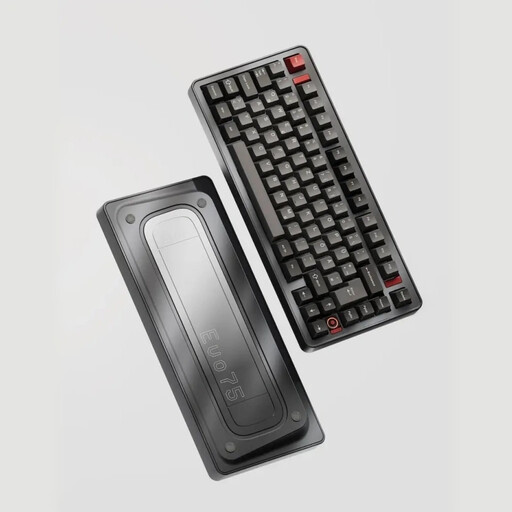 No image available
Consider this model if assignable shortcuts are central to your review routine and its US physical layout works for you. The title identifies it as VIA compatible with Creamy Rye switches; confirm that your operating system and review application support the assignments you intend to use.
No. Choose a keyboard for the playback, audio and annotation commands it lets you use; assess picture quality through the display, video source and player settings separately.
No: a tenkeyless board can suit a desk where mouse space matters and you do not need a number pad. A full-size board makes more sense if your workflow depends on numerous dedicated controls or number-pad entry; check the actual keys and assignments rather than choosing by size alone.
Check that the keyboard's connection mode works with the host device and that charging and pairing fit where you sit. CORSAIR lists 2.4 GHz and Bluetooth modes for the K70 CORE TKL WIRELESS, while Logitech G lists LIGHTSPEED and Bluetooth for the PRO X TKL; confirm the exact model's controls work in your chosen mode.
Keep the keyboard and screen central and position the keyboard just below elbow height, following Health and Safety Executive guidance. Adjust the rest of the workstation as well rather than expecting a different keyboard alone to resolve an awkward position.
For products placed on the market in Great Britain, Department for Business and Trade guidance updated in August 2026 explains that UKCA or CE marking may apply according to the relevant product rules; a mark indicates the manufacturer believes the product meets those requirements. If delivery is to Northern Ireland, check the applicable market information for that product rather than assuming the Great Britain guidance gives the same answer.