
24/7 Customer Support

Free returns

Same-day & Next-day Delivery

Quality Guaranteed

Unlock Your Welcome Offers: FREE Delivery | Up to 80% OFF | Free 30-day JoyPlus trial
Download the APP
A gaming mechanical keyboard can improve comfort, control and desk space, but product pages often emphasise headline specifications without explaining what they mean in daily use. A compact gaming keyboard may save room for a mouse, yet hide arrow keys behind function layers. A wireless mechanical keyboard may suit a tidy desk, but requires charging and can introduce another connection point to manage.
The most common buying traps are:
Choose the smallest layout that still includes the controls you use. A 60% board is suitable for FPS players who mainly need movement keys, number-row controls and mouse space. However, arrow keys and function commands may require an Fn combination.
A 65% gaming keyboard adds dedicated arrow keys and some navigation functions without becoming as wide as a full-size model. A 75% layout usually retains the function row, making it more practical for office work, study, shortcuts and everyday typing.
Full-size keyboards provide a number pad, which may be useful for spreadsheets, finance work or frequent numerical entry. Check the product listing carefully: a board described as QWERTY may still use the US ANSI layout rather than the UK ISO layout.
Traditional mechanical switches use physical contacts. Linear red switches provide a smooth press, tactile switches offer a noticeable bump and clicky switches add audible feedback. The choice affects feel and sound rather than automatically determining gaming performance.
A hot-swappable keyboard allows compatible switches to be removed and replaced without soldering. Check whether the PCB accepts 3-pin, 5-pin or a specific switch format before buying replacements.
A magnetic switch keyboard, also called a Hall Effect keyboard, detects key position magnetically. Products may offer an adjustable actuation keyboard function, allowing the activation point to be changed in software. Rapid Trigger can reset a key as it moves upwards, which may appeal to competitive FPS and esports players who practise quick directional changes. These features are not essential for casual gaming and they may require compatible software and a Windows PC.
A wired mechanical keyboard normally provides plug-and-play use without battery charging. Look for a detachable USB-C cable if you frequently move between a home desk, student accommodation or a gaming event.
A wireless mechanical keyboard may support Bluetooth, 2.4GHz wireless or both. Bluetooth is convenient for laptops and tablets, while a 2.4GHz receiver is generally intended for lower-latency desktop use. Confirm battery information, charging method and whether the keyboard can also operate while connected by cable.
For durability, inspect the keycap material and frame. Double-shot PBT keycaps are designed with separately moulded legends, while ABS keycaps can feel smoother and may show shine with extended use. N-key rollover and anti-ghosting are useful specifications when pressing several keys at once. RGB lighting is optional, but per-key control and onboard profiles can be helpful if you use more than one computer.
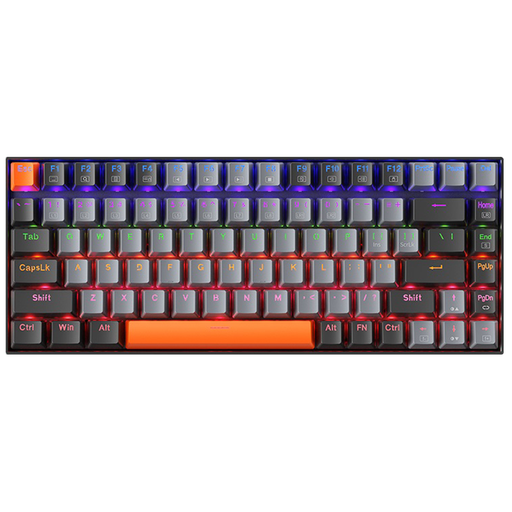
Why This Fits Their Persona: Its 75% format keeps arrow keys and the function row while using less desk space than a full-size board, making it practical for a first gaming and study setup.
The specification clearly identifies a wired USB-C connection, 75% layout and QWERTY US arrangement, helping buyers check compatibility before ordering.
Red linear switches, detachable cable, LED backlighting and N-key rollover are listed features.

Why This Fits Their Persona: This UK ISO 65% wired model suits enthusiasts who want a compact board with adjustable magnetic switches, dual USB-C connectivity and additional sound-dampening construction.
The listing specifies UK ISO layout, 0.1–4.0mm adjustable actuation and wired operation, rather than leaving essential compatibility details unclear.
Hall Effect switches, Rapid Trigger, 8,000Hz polling, PBT keycaps and five-layer dampening are specified.

Why This Fits Their Persona: Its 60% footprint leaves more room for low-sensitivity mouse movement, while adjustable actuation and onboard profiles support a dedicated PC gaming setup.
It records the 0.1–4.0mm actuation range, detachable USB-C cable and six onboard profile slots, allowing buyers to distinguish useful controls from lighting alone.
Optical analogue switches, Rapid Trigger, N-key rollover, anti-ghosting and per-key RGB are listed specifications.

Why This Fits Their Persona: The 96% layout keeps arrow and number keys for work, while tri-mode connectivity supports a desktop, laptop and tablet setup.
The product information states Bluetooth, 2.4G and USB-C wired modes, plus compatibility with 3-pin and 5-pin replacement switches.
Hot-swap support, 8,000mAh battery, double-shot PBT keycaps, RGB lighting and five-layer sound dampening are listed.
We have compiled a complete, real-time list of products that fully satisfy these strict selection criteria and UK safety regulations.
It can be, particularly if desk space and portability matter. However, users who regularly use arrow keys, function-row shortcuts or navigation commands may prefer a 65%, 75% or 96% layout. Check whether missing keys are accessed through an Fn layer.
A 2.4GHz wireless mechanical keyboard can suit gaming, provided the receiver, battery condition and software meet your needs. Wired models remove charging concerns and are straightforward for tournament or fixed-desk use. Bluetooth is convenient for general devices but is not always the preferred mode for competitive play.
Lifespan depends on switch design, usage, keycap material, cleaning and liquid exposure. Some listings specify figures such as 50 million or 100 million keystrokes, but this is a component rating rather than a guarantee of identical performance for every user. Keep the board dry, disconnect it before cleaning and replace compatible switches or keycaps when supported.